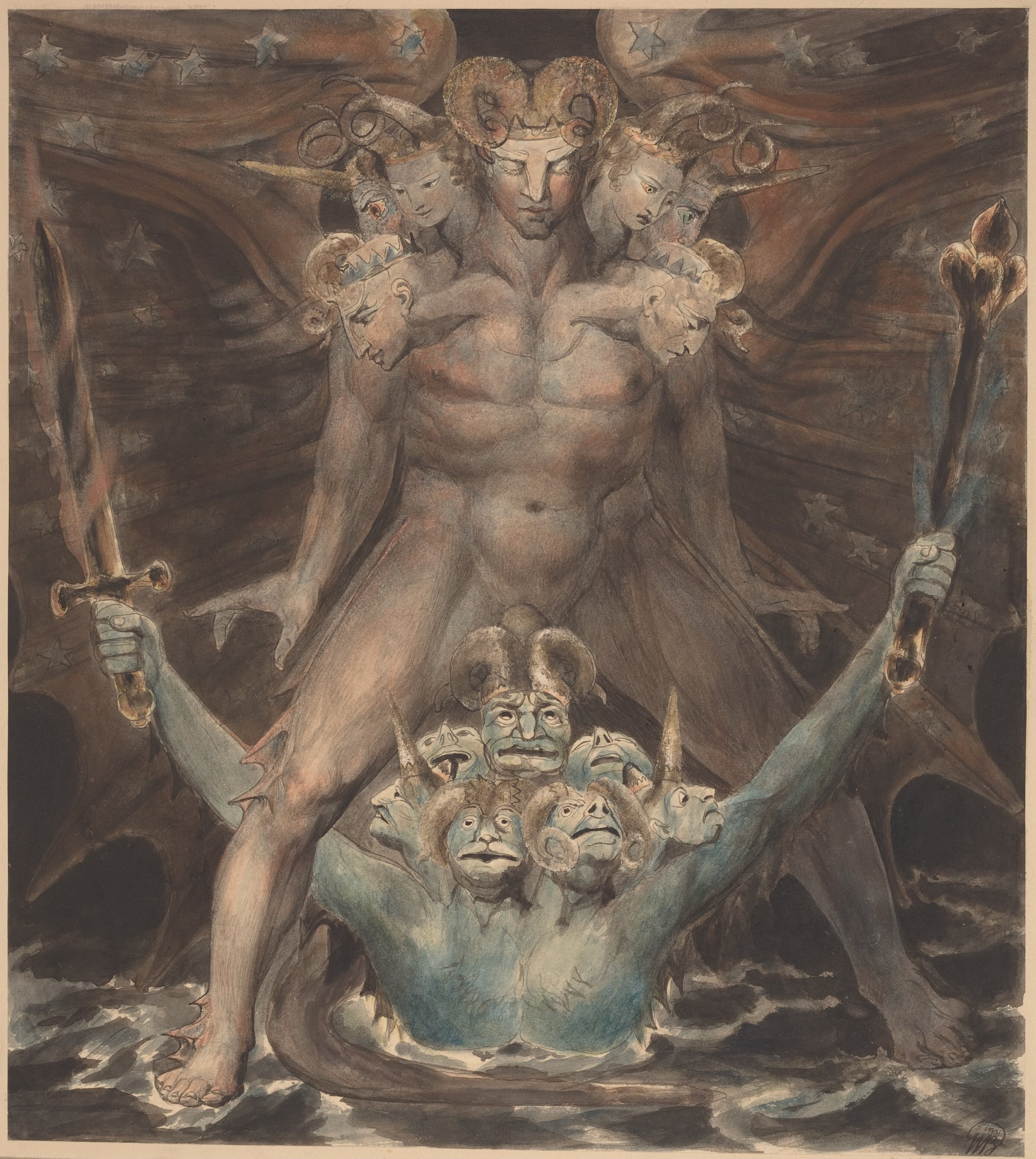
You do not first see a monster. You are blocked by one. The Great Red Dragon spreads his wings and plants his legs until the sheet is almost sealed; the Beast from the Sea can only surface beneath him. Blake turns power into an unnervingly legible pose: one body owns the frame, the other strains inside its opening.
Order draws the eye closer; anomaly makes it recoil.
Composition | Closure, then revelation
The dragon forms the large outer triangle: wings brace the upper edge, legs split toward the bottom, and the torso locks the center. The sea beast creates a smaller inverted triangle, its weapon-bearing arms thrown outward. The shapes interlock without quite colliding. Their narrow opening carries more tension than a painted impact would. Seven faces accumulate around the central axis like a crown. We register classical symmetry before noticing identity multiplying.
Color | The title says red; the image lowers its voice
This is a muted split-complementary field. Mauve flesh balances verdigris blue; brown-black consumes the background; aged-paper beige supplies air. Rust red and dark gold become small heat signals. Blue-green and red-orange approach opposition on the wheel, yet both are desaturated. The contrast feels less like decorative color blocking than an alarm remembered after it has faded.
Light | Illumination rises from the body
No stable light source exists behind the figures. The brightest values gather on chest, faces, and foam, making the dragon seem rubbed out of darkness like a relief. Brown washes, lateral strokes, and scattered stars let the wings read as membrane and night sky at once. The sea beast is cooler and brighter but severed by the central body; that value reversal pushes it below the surface.
Technique | Line names; watercolor mutates
Fact: The museum records pen and ink with watercolor over graphite, c. 1805, from the Bible for Thomas Butts series. Overall dimensions are 40.1 × 35.6 cm; accession number 1943.3.8997. Blake signed “WB inv.” at lower right.
Graphite establishes anatomy and pose. Ink pins down horns, faces, fingers, and weapons. Watercolor disperses through wings, sea, and shadow. The monsters are precisely named by contour while their color fields remain unstable, as if still forming. The stars do not brighten the dark; they make the wings vast enough to impersonate a cosmos.
The artist | Poet and image-maker in one hand
Fact: William Blake (1757–1827) was a British poet, painter, and printmaker trained as an engraver. He developed relief etching to place text and image on one page, and repeatedly worked with biblical subjects, prophecy, and a private mythology. Thomas Butts was his most important patron for a substantial group of biblical images.
Why it moves us | Terror made calm
Interpretation: The unsettling element is not the seven heads or flames, but the dragon's composure. Arms hang low and fingers spread as though space has always belonged to him. The sea beast moves more and shines brighter, yet can appear only between his legs. Domination becomes not attack, but ownership of the frame.
Meanwhile, the faces look in different directions as the central one lowers its gaze toward our space. One body contains incompatible minds. Grandeur turns fragile: absolute power looks whole, but has already divided within.
A visual formula to borrow
- Composition: Let the primary form occupy 82–90% of the image height. Build a gate with a wide top, narrow waist, and forked base; reveal only 25–35% of the secondary figure.
- Palette:
#2C272642% +#8B777024% +#547C7C18% +#D8C3A011% + rust red/dark gold 5%. - Light: Hold the background roughly 1.5–2 stops below the subject. Reserve the highest value for the face, chest, or core message.
- Poster or portrait: Let the subject touch three edges. Keep one narrow central negative shape; show the lower figure only in fragments and from below.
Work and source
The Great Red Dragon and the Beast from the Sea, William Blake, c. 1805. Pen and ink with watercolor over graphite. National Gallery of Art, Washington, Rosenwald Collection, 1943.3.8997. View the collection record.
The image was downloaded from the museum's IIIF service; the museum marks this object's media as Public Domain. Image rights remain with the artist and any applicable rights holders. Object facts follow the museum record and research materials. Composition, color, and emotional readings are visual analysis by Daily Art. Hex values are screen-image approximations, not pigment measurements. Verify rights before reuse or commercial publication.