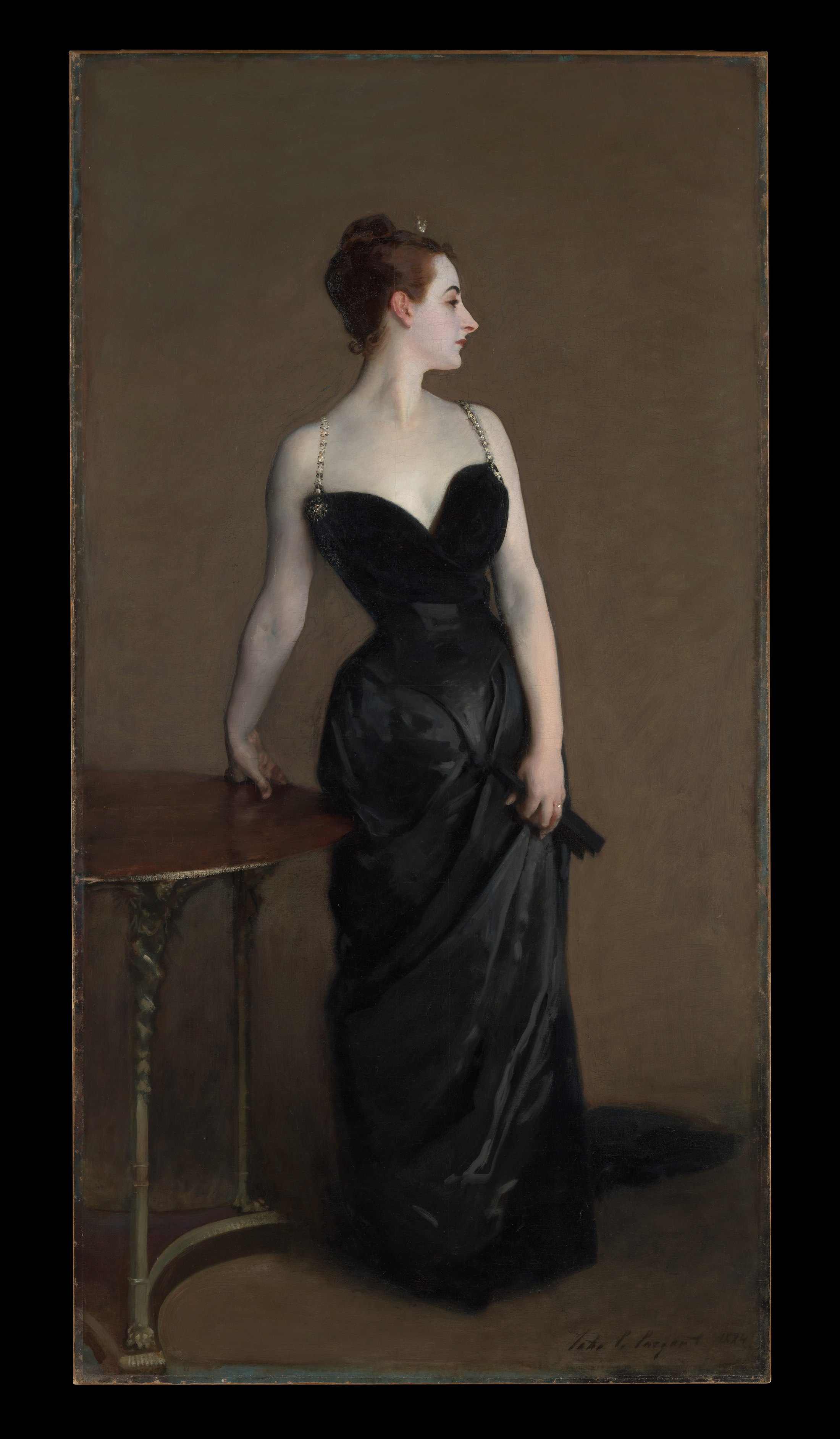
Refusing our gaze, claiming the room
Her head turns sharply right, cutting nose and chin into a blade-like profile, while her body occupies the canvas frontally. The dress falls from neckline to lower edge in one sustained dark mass. This is less a friendly likeness than a rigorously staged public appearance.
Interpretation: The tension lies not in how much is revealed, but in display and refusal happening at once.
One body, three directions
The figure is nearly life-size. Head, torso, and left arm each point differently, joined by the long twist of the neck. Empty wall opens on the gaze side. At lower left, the small table acts like a visual rivet: her fingertips touch its edge and steady an otherwise precarious pose.
The dress pinches into an hourglass, then widens into a heavy triangle. Pale shoulders form an inverted triangle above it. Their narrow meeting point is stable and tense. The tall crop leaves the figure almost nowhere to retreat—and gives the viewer nowhere neutral to stand.
Complementary tension at a whisper
The picture appears black, white, and brown, but its engine is desaturated warm–cool opposition. The wall is warm, olive-leaning smoked umber; the skin is cool ivory with blue-gray shadows. The dress is not dead black: blue-gray, charcoal, and warm brown move across satin. Value shifts replace hue shifts.
The formula is an achromatic field, one high-value skin zone, and minute metallic accents. With so few hues, material contrast carries the image: matte wall, moist skin light, reflective satin, jeweled straps.
The body, not the eyes, holds the light
Light brushes shoulder, chest, and forearm from the front left. The eyes nearly leave the narrative; illuminated skin becomes architecture. A soft background gradient supports the silhouette. On the dress, a few cool-gray reflections recover volume. Sargent gives vision just enough evidence to complete the satin.
One cut at distance, revisions up close
Fact: The oil on canvas measures 208.6 × 109.9 cm and dates to 1883–84. Born in Florence to American parents, Sargent trained in Paris with Carolus-Duran. The sitter was Virginie Amélie Avegno Gautreau. The artist pursued the picture rather than receiving a routine commission. After its hostile reception at the 1884 Paris Salon, he repainted a jeweled strap that had originally slipped from one shoulder and used the anonymizing title Madame X.
Face and silhouette are relatively exact; skirt, table, and wall dissolve. Satin emerges from long, wet gray-black strokes. Skin balances pink, gray, and blue-green notes. Across the room it feels like one decisive cut; nearby, it breathes with adjustment.
Why it moves us
She appears displayed and in command of display. The anonymous title turns her into a symbol, while the profile preserves an inaccessible will. The dress emphasizes the body; the pose refuses to please. The raised strap seems to restore decorum, yet makes us forever conscious that it once fell.
The painting turns the public act of looking at a woman into the event itself. The longer our gaze remains, the more forcefully her face turns away.
Turn it into a visual formula
- Layout: Fill 75–85% of the frame height, just left of center. Keep 25–30% air on the gaze side; anchor the opposite lower corner with one small object.
- Palette: #171719 38% + #4C4237 30% + #D9C7B4 20% + #8A584C 7% + #B69A62 5%.
- Styling: 80% black + 15% cool ivory + 5% aged gold. Mix matte and satin black; keep jewelry to one point.
- Portrait: Body to camera, face away by 60–80°. Use broad soft light on neck and shoulders, with the background 1.5–2 stops darker.
Object and sources
John Singer Sargent, Madame X (Virginie Amélie Avegno Gautreau), 1883–84. Oil on canvas; 208.6 × 109.9 cm; The Metropolitan Museum of Art; 16.53.
Record and image: The Met object page and collection API. Artist background: Tate. The museum API marks the object Public Domain; see its Open Access policy.
Fact and interpretation: Object data, sitter, strap alteration, and biography are sourced facts. Composition, palette, lighting, emotional reading, and approximate hex values are visual analysis by Daily Art. Image rights remain with the artist and any applicable rights holders. Published for criticism, research, and appreciation; verify source and permission before republication or commercial use.