The ending arrives before the fight
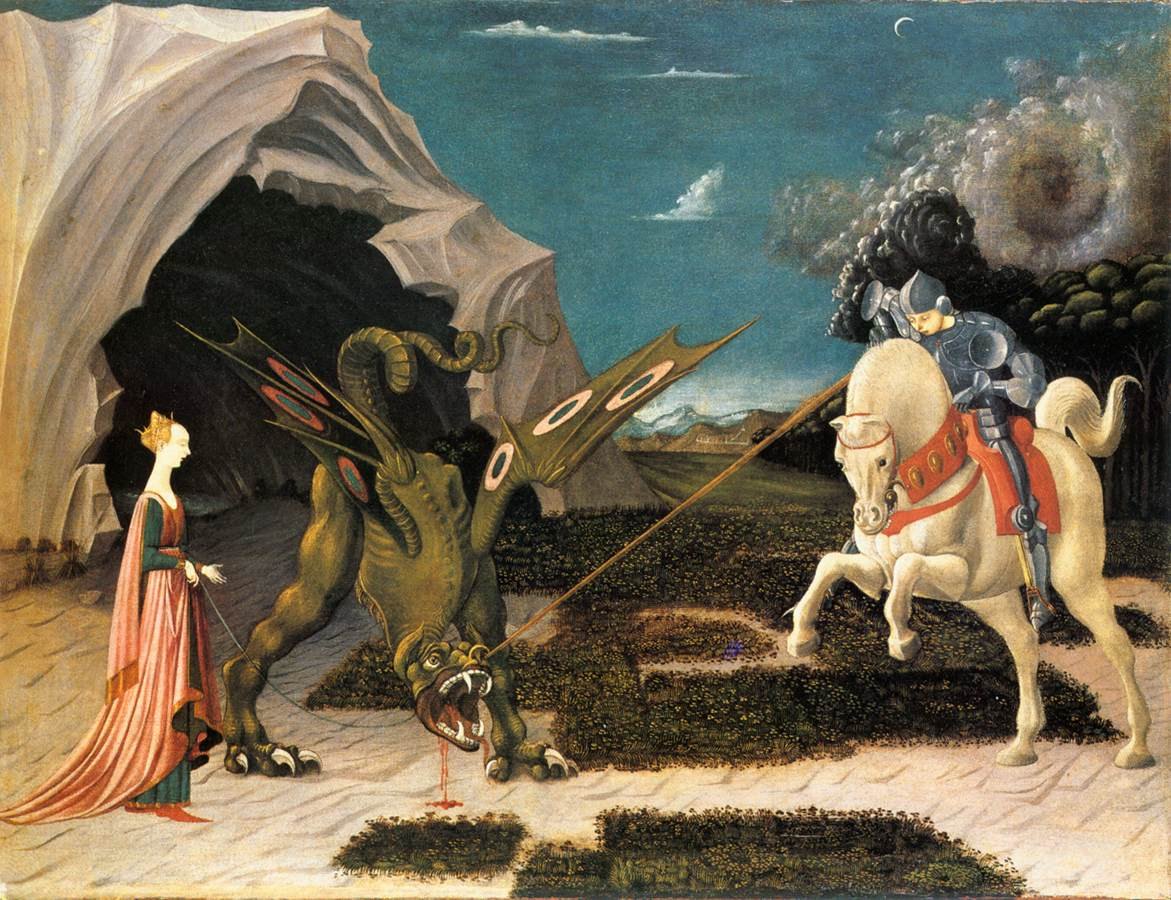
At first glance, it has every ingredient of a fairy tale: white horse, knight, princess, dragon. Then the scene slips out of alignment. The dragon’s wings echo the mouth of its cave. The lance runs through both and points toward the eye of a storm. The princess already holds the beast on a slender leash, as if the ending arrived before the fight. This is not one instant; it is two moments folded together.
Interpretation: What moves us is not simply the hero’s courage. Fear has already been caught by a thread, yet it remains huge, strange, and unexplained.
One lance stitches chaos into order
On the left, cave, dragon wing, and the princess’s train form a dark cluster. On the right, white horse, armor, and open sky make a bright one. The lance cuts from upper right to lower left through horse, wing, and mouth. It becomes a narrative axis: one clean vector joining action to impact.
Yet the order never settles. Rectangular stones tilt upward to the right while clipped green patches pull toward the horizon. The cave’s arc answers the spiral cloud, but each opens a different depth. The museum notes that these lines do not converge consistently. The apparent error is expressive: space feels less like a landscape than a stage set unfolding all at once.
Muted complements keep fantasy ancient
Blue-green sky, olive dragon, and warm ivory horse build the field. Teal meets coral in the princess’s dress and horse’s harness: a muted complementary scheme. Coral is scarce, but hue and temperature contrast make it flare. The brown-black cave is the value anchor; the horse is the largest light. The dragon is trapped between them, born from darkness and pulled toward light.
The colors we see are not exactly those of 1470. The National Gallery notes that the azurite sky has shifted greener; grasses and the princess’s green clothing have darkened; her red overdress has faded. This hushed harmony belongs partly to design and partly to time.
Light is assigned by role, not by weather
There is no fully consistent natural source. Horse, armor, and cave ridges receive the brightest values, while the dragon’s belly and cave collapse into dark. Each figure seems individually spotlit. The upper-right cloud reads as both storm and enormous eye; the tiny crescent beside it cools the violence into nocturnal suspense.
Perspective study and visual sleight of hand
The work is oil on canvas, about 55.6 × 74.2 cm. Uccello was absorbed by linear perspective, but did not force this world into a perfect single-point system. He bent anatomy for pictorial purpose: George’s grip is implausible, yet it lets the lance align with wing and cloud. Infrared reflectography reveals a curved geometric shape beneath the princess’s dress, perhaps an unfinished heraldic design on a reused canvas. Her hands, crown, clothing, the cave, and the lance changed between underdrawing and final paint.
Paolo Uccello (about 1397–1475) trained in Ghiberti’s workshop and later worked on mosaic design in Venice. His art joins International Gothic decoration to the Early Renaissance fascination with constructed space. Figures can behave like pattern; perspective can behave like experiment.
Why it stays with us
The painting refuses to be only a clean heroic verdict. The dragon is being pierced and has already been tethered. The princess does not scream; she is eerily composed. The knight moves with machine-like precision, while the sky carries the real panic. The lance is blunt victory. The nearly invisible leash is another kind of power: a tiny gesture that changes the relationship between monster and human. Vast fear is gathered by something very thin.
Turn it into a visual formula
- Layout: Place 35–40% visual masses on opposite sides; connect them with a 25–35° diagonal. Put the focal impact near the lower-third crossing.
- Palette: #1F5153 32% + #D8C8A7 27% + #6E7138 20% + #B95F48 14% + #20231D 7%.
- Styling: Ivory 55% + deep teal 30% + olive 10% + coral 5%; use matte textures and one metallic “armor” highlight.
- Photography: Split one bright and one dark subject across the frame; let a railing, arm, or shadow create a real diagonal.
Object record and sources
Paolo Uccello, Saint George and the Dragon, about 1470. Oil on canvas; 55.6 × 74.2 cm; National Gallery, London; NG6294.
Collection record and technical facts: National Gallery artwork page.
Source image: Wikimedia Commons file page, marked Public Domain Mark 1.0. Rules for faithful reproductions of public-domain two-dimensional works may vary by jurisdiction; verify before reuse.
Fact and interpretation: Dates, medium, dimensions, collection, material changes, underdrawing, and biography follow the museum record. Composition, palette, light, emotional reading, and approximate hex values are visual analysis by Daily Art. Image rights belong to the original artist and any applicable rights holders. Presented for criticism, research, and appreciation; verify permissions before republication or commercial use.
_01.jpg)