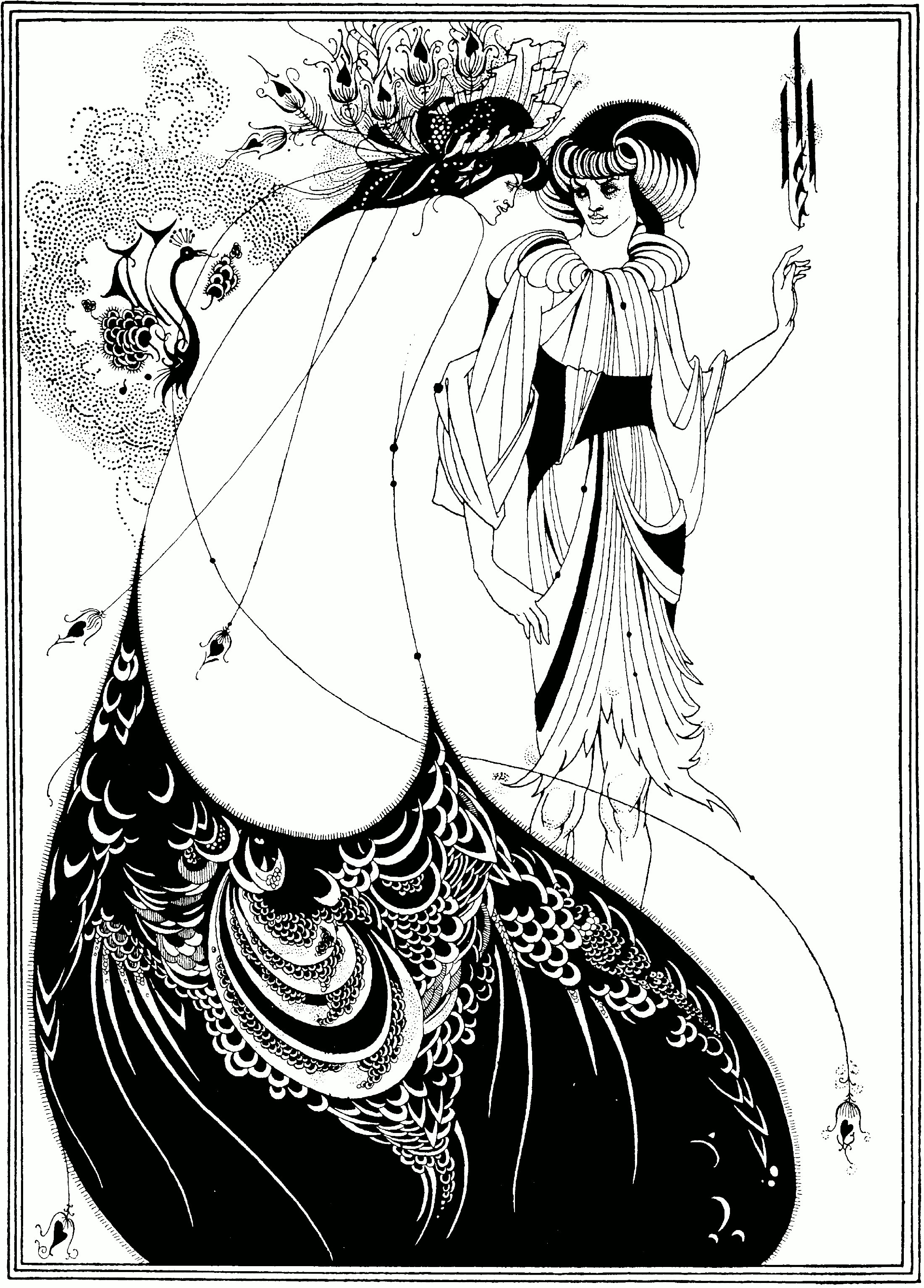
The hem is not the end of the costume. It is the gravity of the entire image.
The Peacock Skirt contains black ink, paper white, and traces of graphite, yet feels more lavish than many full-color images. Salome bends in from the left as her robe floods the lower half like black water. A young, androgynous figure stands almost upright on the right, one hand suspended in open space. Clothing, hair, feathers, and negative space conduct the scene.
One curve rewrites the power balance
The largest structure is not a body. It is the arc of the skirt sweeping across the lower frame—a stage edge and an unseen peacock tail at once. Salome presses diagonally right; the youth answers with vertical pleats, a raised arm, and a tall coiffure. One form expands; the other contracts. One crosses the boundary; the other withdraws.
Their faces nearly touch, yet clothing creates immense formal distance between their bodies. Left is dense, right open; bottom heavy, top light. The upper-right void reserves psychological distance around the lifted hand. The border seals the scene as a page while the skirt threatens to burst it.
Black and white still carry temperature and rhythm
Energy comes from value ratio rather than hue. Large black masses establish weight, small black dots create rhythm, and hairline contours connect them. Maximum contrast suits line-block reproduction and makes every interruption legible.
Approximate visual ratio. Stippling produces optical grey without grey pigment. Peacock green belongs to this editorial page, not the artwork.
Silhouette, not illumination
No consistent light source exists. Faces, hands, and pleats remain paper white as if chosen by a theatrical spotlight; skirt and sash collapse into opaque black. Value follows narrative hierarchy instead of naturalism: the eye collides with costume before discovering the quieter tension in the glances.
A line already thinking about print
The museum records the original as black ink and graphite on white wove paper. Graphite establishes placement; ink pushes forms toward reproducible clarity. Solid fill, hairline contour, stipple, and repeated ornament act as separate voices. The drawing entered print as an illustration for Salomé, and related museum records document line-block impressions. Paper, blank space, and reproduction are compositional materials from the beginning.
Hair, feathers, pleats, and hem repeatedly accelerate and tighten into the Art Nouveau “whiplash” line. Straight lines are rare. Bodies seem pulled by ornament rather than supported by anatomy.
Intimacy and danger share one line
Fact: Aubrey Beardsley (1872–1898) was a British illustrator; this 1893 drawing belongs to the Salomé series. Museum sources connect his style to Japanese prints, Whistler's peacock imagery, and early British Art Nouveau. His professional career lasted less than seven years; he died at 25.
Reading: Two faces approach but their gazes do not meet. Costume is seduction and armor. The black skirt erases bodily detail and turns a person into an unavoidable graphic force.