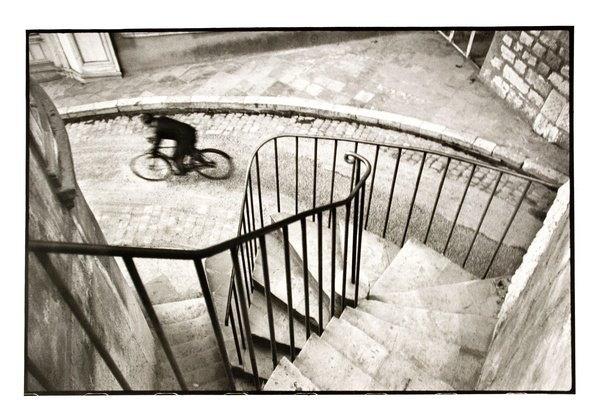
At first, you may see the spiral stair. Then the dark blur at upper left announces itself—and is already leaving. Henri Cartier-Bresson gives the cyclist neither the center nor a readable face. He releases the shutter where the wheels enter the curb’s arc just as the rider clears the descending rail. Architecture holds still; the body flows. The image becomes electric where the two meet without colliding.
Composition: two curves prepare a stage for chance
The staircase coils from lower right toward the center while the street bends from upper left to right. The curves work like opposing brackets: one draws the eye in; the other carries the cyclist away. Repeating rails establish a beat, then the diagonal handrail accelerates it.
The rider occupies the upper-left third. Pale road isolates his dark form, and a precise pocket of air keeps him clear of rail and doorway. Architecture sets the rule; the moving figure becomes its single deviation.
Color: monochrome is still a palette
Hue is nearly absent, so value distribution organizes the frame. Warm paper and pale stone occupy roughly 58 percent, middle gray 24 percent, charcoal 14 percent, and warm near-black 4 percent. In color-theory terms, this is value contrast plus contrast of extension: the darkest tones cover little area, concentrating their visual weight.
Faintly warm paper against cooler limestone gives the print a restrained temperature shift. Signal red belongs only to this editorial layout.
Light: let movement draw the figure
Diffuse light preserves a long middle scale across wall, steps, and street. Texture remains legible without demanding attention. The still railing owns the hardest edge; the moving cyclist owns the softest. Light does not model him—motion blur does.
Rendered sharply, he would merely be a passerby. Slightly dragged across the emulsion, body and wheels become the shape of time. The photograph allows a short duration to remain on a fixed surface.
Technique and artist: waiting is pre-visualization
This is a gelatin silver photograph. Cartier-Bresson first recognizes the relation among stair, curb, and railing, then waits for movement to enter it. A moderately slow shutter keeps just enough blur; deeper focus holds the architecture firm.
Cartier-Bresson (1908–2004) studied painting and associated with Surrealists before turning to photography in the early 1930s. *Hyères, France* belongs to that formative period. The Met connects his early work to Cubist and Surrealist influence—flat planes, collage-like construction, and spatial ambiguity are all present here.
The decisive is not fast reflex. It is the instant when event and form close together.
Why it moves us
It turns the easiest thing to lose—a stranger passing—into a poem precise without becoming rigid. Railings resemble a musical staff; the wheels are two hurried notes. The building will not chase him, and the rider will not return. We see not speed itself, but the absence speed leaves behind.
Interpretation: the decisive point is not his arrival, but the instant he has already begun to leave.
A visual formula to borrow
- Composition: Pair opposing curves or diagonals. Place movement near a thirds intersection with half a subject-width of clean space.
- Shutter: Start at 1/30s–1/60s. Brace the camera so the setting stays firm while the subject trails slightly.
- Palette: #E8E0D1 38% + #B8B9B4 20% + #777874 24% + #242522 14% + #A33A2B 4%.
- Styling / layout: bone 60% + middle gray 25% + charcoal 15%; keep a dark-red accent below 5%.
Work, sources, and rights
Verified object data: Henri Cartier-Bresson, Hyères, France, 1932, gelatin silver photograph. Musée d’Art Moderne de Paris, accession AMPH 1683. Dimensions, crop, and printing dates vary among collection prints.
- Musée d’Art Moderne de Paris record and downloaded image source
- The Metropolitan Museum of Art object record
- Fondation Henri Cartier-Bresson biography
Rights: The source page credits © Henri Cartier-Bresson / Magnum Photos; The Met also lists the photograph as copyrighted. The local image supports this critical and research presentation and does not imply permission to sublicense it. Image copyright belongs to the artist and applicable rights holders. Verify permission before republication or commercial use.
Facts and interpretation: Object data and biography come from the sources above. Composition, color, light, emotional readings, and approximate values are analysis by Daily Art.