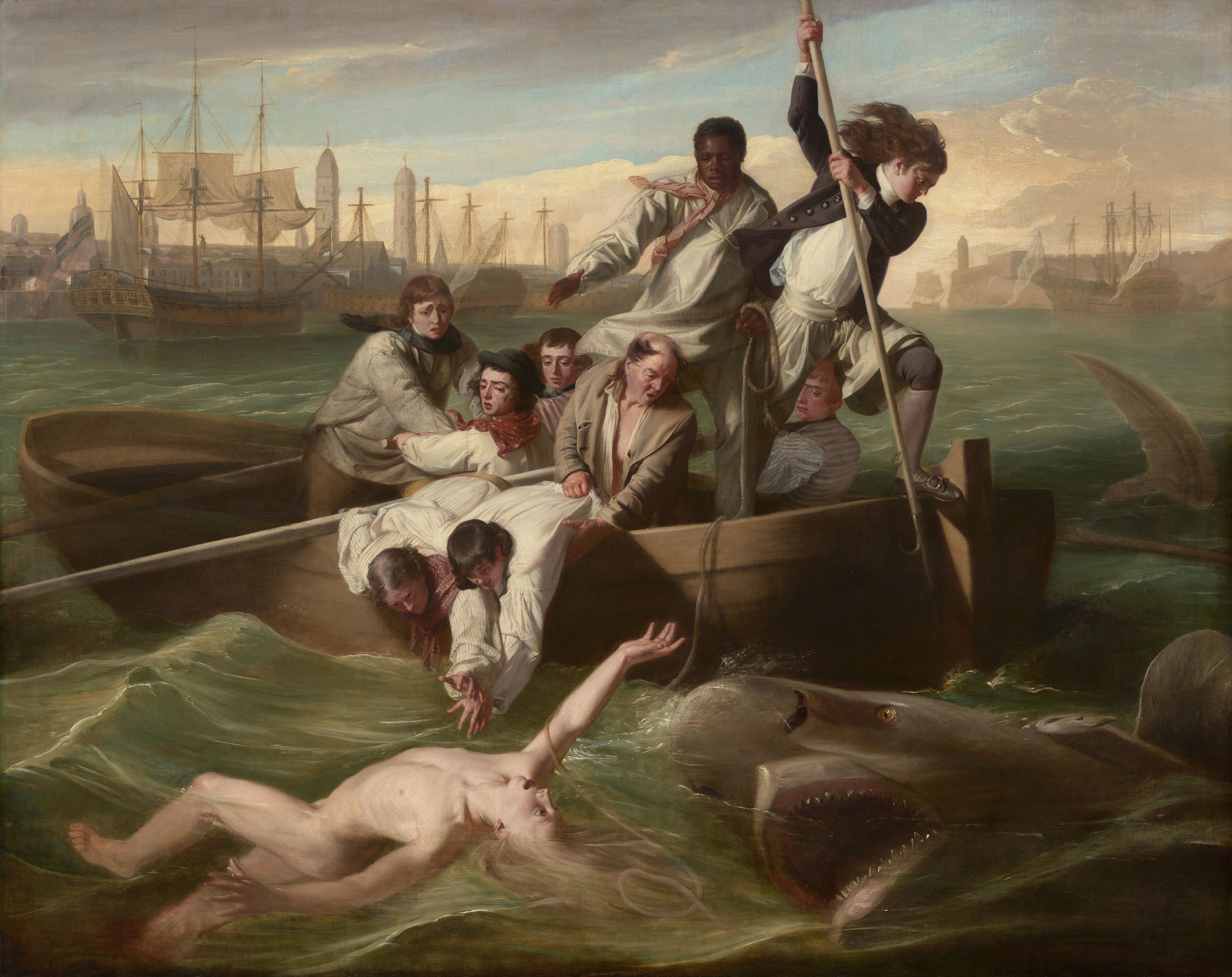
The open jaws at lower right seize the first glance. Stay for two seconds and the eye travels along Watson’s raised arm, crosses the gunwale, and reaches the sailor holding the rope above. Copley does not paint “the rescue.” He stops at the instant before its outcome: bodies, rope, and harpoon are already in motion, but contact is still missing.
Composition: Three Triangles Turn Panic into Order
The crew forms a broad human pyramid crowned by the Black sailor with the lifeline. Watson’s arched nude body makes a second, inverted triangle. The shark and harpooner lock into a third, sharper wedge. These shapes interleave while preserving one crucial gap—the space between Watson and the rescuers.
Movement comes from colliding vectors. The boat climbs upper-right; the harpoon drives down; Watson reaches up-left; the shark enters laterally. A level harbor braces the chaos, making the foreground feel like a wave arrested in time.
Interpretation: the true protagonist is the distance that has yet to close.
Colour: Muted Complements Put Flesh at Risk
Low-chroma blue-green, lead grey, and muddy brown build a wet, heavy atmosphere. Watson’s ivory skin and the pale yellow horizon are warm lights against cold, dark water. They advance because their value is highest. Rust red appears sparingly in cloth, hull, and flesh shadows, acting as a warning against the blue-green complement.
This is not a bright orange-and-blue poster clash. Both complements are greyed, so danger feels damp, physical, and near.
Light and Technique: One Beam Decides Who Is Seen
Light enters from the upper left, catches Watson’s torso, white sleeves, and the gunwale, then disappears into the darker sea at right. The nude body becomes a stage-lit focus while individual faces emerge along the light-shadow boundary. A warm horizon opens depth; darkening clouds push pressure toward the rescue.
These are not casual poses observed in one natural second. They are organised for drama. Oil’s gradual transitions shape skin and sky; harder highlights pick out wet cloth, foam, and eyes. Portrait-level specificity is fused with the scale of history painting.
Artist and Context: A Modern Disaster as History Painting
Copley (1738–1815), born in Boston, built his reputation through exacting portraits and later pursued his career in London. Here he reconstructs a real 1749 event in Havana Harbor as a classically ordered, large-scale catastrophe. The museum notes that the Black sailor occupies the apex of the human pyramid and controls the essential lifeline—an unusually central, active role in eighteenth-century European painting.
That heroism cannot be separated from colonial history. Havana was a major port in the transatlantic slave trade; Watson later became a merchant and politician and opposed abolition. “Who reaches to save whom” therefore exceeds plot: rescue, power, and selectively recognised humanity occupy one canvas. Those historical points follow museum research; identifying the hand-gap as the emotional centre is this essay’s visual interpretation.
Why It Moves Us
Courage is not assigned to one heroic pose. It becomes a chain of partial actions: one person holds the rope, another reaches, another anchors his companion, another raises the harpoon. No figure is sufficient alone; together they approach sufficiency. We know Watson survived, yet the painting refuses to release us early.
Hope here is not an ending. It is a distance pulled taut.
A Structure to Borrow
- Poster / photography: 60% deep cool base (#263B42) + 20% grey-green middle (#61706B) + 12% ivory light (#E8D8BC) + 8% rust signal (#9C4A38).
- Composition: build one stable large triangle, then cut it with a counter-diagonal. Leave a gap where the vectors almost meet.
- Light: lower the background by one or two value steps; retain one upper-left-to-lower-right band and a few hard wet highlights.
- Dress: 60% deep navy + 25% grey-green + 10% bone + 5% rust. Use matte fabrics for mass and one lustrous surface as the crest.
Work and Sources
Documented facts: John Singleton Copley, Watson and the Shark, 1778, oil on canvas, 182.1 × 229.7 cm, National Gallery of Art, accession 1963.6.1.
_-_NGA_Washington.jpg)
Rights note: The museum marks this object’s media as public domain; the source image page applies the Public Domain Mark 1.0. Image rights remain with the original creator and any applicable rights holders; consult the source page and local law. Analysis and approximate editorial colours: Daily Art.