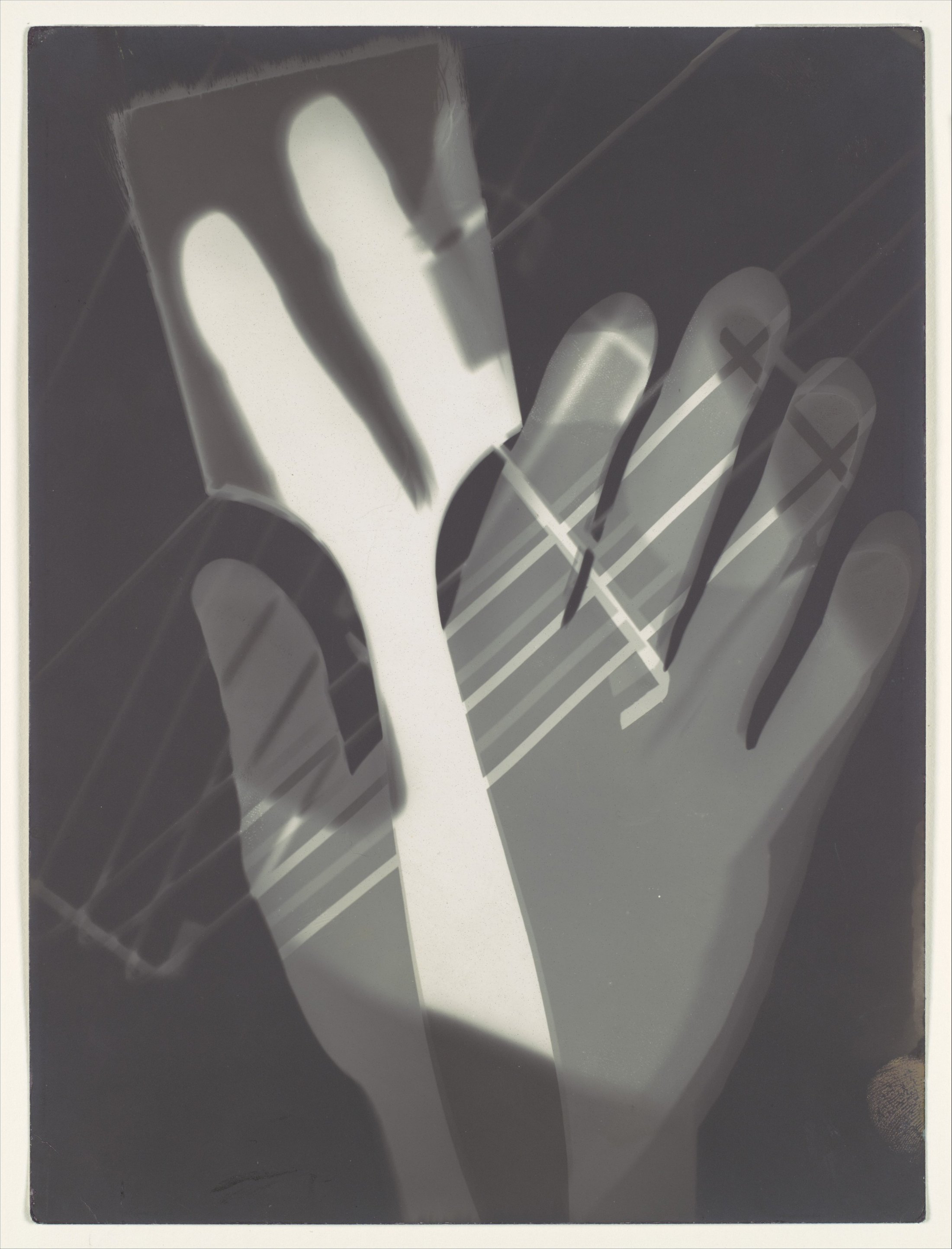
Do not ask what the camera saw. There was no camera. A hand, a brush, and transparent or translucent objects met photosensitive paper; light crossed the arrangement and left densities behind. This is less a portrait of things than a pressure map of their brief contact with light.
Two hands are not two drawings.
They are two distances, two durations.
Two hands, two kinds of time
A white, arm-like diagonal locks the image from upper left to lower right. The left hand is nearly pure white, a hard-edged sign of close contact with the paper. The right hand is smoke-grey and threaded with narrow diagonals, as if lifted, shifted, or filtered through a transparent layer during exposure. They are not mirror images. They oppose contact and suspension.
Direction creates the tension. Fingers rise; fine lines cut laterally across the palm; the thick white arm traverses both. Three vectors cancel and energise one another, giving still paper a mechanical velocity. The surrounding black is not backdrop but active negative space—the condition that lets brightness appear.
Achromatic, not colourless
The palette runs from near-black through graphite and photosensitive grey to silver fog and paper-bone. Value, not hue, organises the hierarchy: the brightest hand advances first, the mid-grey hand recedes, and the dark field compresses them into depth.
In colour-theory terms, high-value contrast is moderated by a narrow middle range. Large low-value areas carry visual weight; small high-value areas open the image. Bone white leans faintly warm while silver grey feels cool, a subtle temperature split that keeps monochrome from becoming brittle.
Shadow is material, not absence
In conventional photography, light describes a world that already exists. Here, light produces the image directly. Objects close to the paper yield crisp pale forms; lifted or translucent objects produce soft edges and grey; movement or repeated exposure makes echoes. Transparency becomes distance, blur becomes duration, and white marks what was blocked from full exposure.
Silver gelatin without a camera
Fact: The museum dates the work to 1926 and identifies it as a gelatin silver print measuring 23.9 × 17.9 cm. Its account notes that Moholy-Nagy placed ordinary objects—including his hand and a paintbrush—on sensitised paper and exposed them to light. The photogram predates the modern camera; twentieth-century avant-garde artists revived it to explore light as a form-making medium.
The craft lies beyond arranging objects. Contact distance, exposure time, opacity, and movement between exposures govern the result. Touching, hovering, sliding, and rotating create hard edges, soft edges, echoes, and density shifts. The darkroom stops being the endpoint of representation and becomes the place where composition begins.
Treating a medium as a school
Fact: László Moholy-Nagy (1895–1946) worked across painting, photography, design, and teaching. Active at the Bauhaus from 1923 to 1928, he argued for photography within modern visual education.
Interpretation: The work’s modernity is not merely abstract style. It revises authorship. The artist does not dictate every contour; he sets conditions and allows light to take part in the decision.
We recognise a hand but cannot decide whether it reaches, refuses, caresses, or searches in darkness. The familiar body splits into several transparencies—intimate and alien at once. The brush leaves no painted stroke, yet photography turns it into a ghost of painting. One medium does not defeat another; for a moment, they pass through each other.
Bring this light into your frame
- Composition: 70% dark negative space + 20% translucent mid-grey subject + 10% hard highlight; hold the dominant diagonal near 25°–35°.
- Darkroom: Under a proper safelight, hover transparent film, mesh, leaves, or a hand above photographic paper; make three short exposures at different distances. Follow all paper and chemical safety instructions.
- Graphic design: Pair one thick diagonal with one family of fine parallel lines. Let scale contrast replace decoration.
- Dress: charcoal 65% + fog grey 25% + bone 10%; add one translucent outer layer for a mobile grey-scale overlap.
Object and source
László Moholy-Nagy, Fotogramm, 1926
Gelatin silver print, 23.9 × 17.9 cm; The Metropolitan Museum of Art, object 1987.1100.158.
Collection: object record · Image: Wikimedia Commons file page, marked CC0 1.0.

Museum records support the facts. Composition, colour, feeling, and practice notes are visual analysis by Daily Art. Hex values are editorial approximations, not conservation measurements. Image rights belong to the original creator and applicable rights holders; check the source page and local law.