A small sea, held in blue
The seaweed left the page. Light kept its outline.
Dictyota dichotoma · Anna Atkins · c. 1853 · Cyanotype
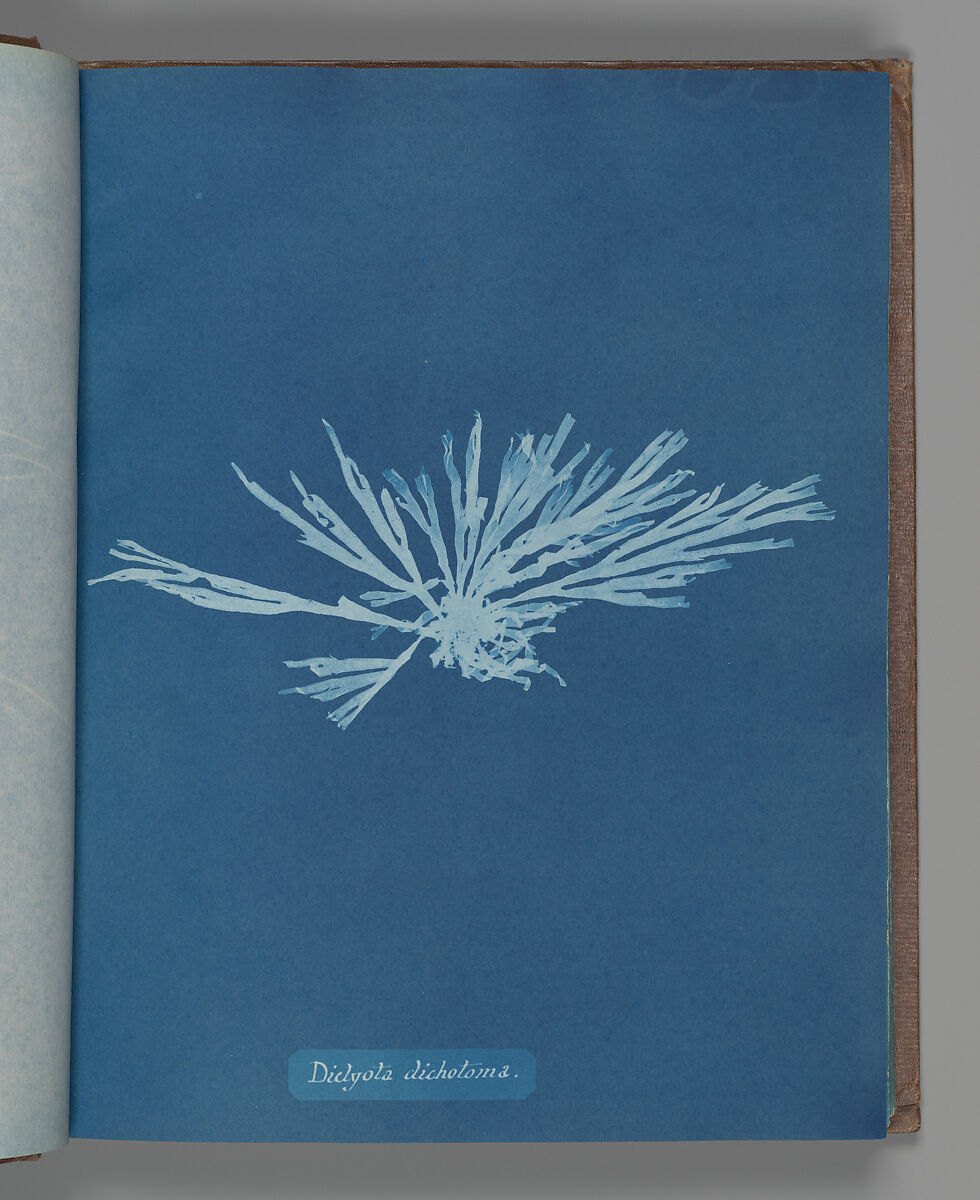
Composition | A cluster with room to breathe
Begin at the knot below the centre, then follow the branches outward. A long, sparse extension reaches left; a denser fan opens toward the upper right. Their unequal shapes balance across the page. The broad blue above delays the eye, while the isolated handwritten label gathers it back below. Empty space gives this small specimen a field much larger than its own body.
Colour | Distance inside a single hue
In this digital image, deep blue, grey blue and pale cyan organise the surface. The main relationship is tonal, close to monochrome, rather than complementary. Light branches separate from the darker ground; neighbouring blue and cyan hues keep that separation quiet. A trace of warm brown at the page edge adds a small temperature contrast. Blue may suggest the sea to us, but it originates in the process. That association is a reading, not evidence of the artist’s intention.
Light | The bright parts blocked the light
Here the pale shapes register obstruction, rather than reflected illumination. The exposed background becomes blue. Do not automatically read changes within the branches as rounded form or side lighting: transmission, contact and printing conditions may contribute. The shadow along the facing page belongs to the photograph of the album, not the cyanotype’s original lighting. Source 3 explains the process; this reproduction cannot establish the cause of every edge.
Technique | Arrangement as image making
Cyanotype uses sensitised iron salts, exposure and washing to produce a blue print. Objects can lie directly on the paper; no lens is required. Notice the flat, ribbonlike forks, overlaps and little interruptions in this specimen. Their edges do not behave like a smoothly drawn contour. Choosing the cluster, opening its branches and spacing its gaps all shape the image. This reading of its rhythm does not reconstruct the exact working sequence.
The artist | Between study and image
Anna Atkins was a British botanical researcher and early photographer, already experienced in technical illustration before taking up cyanotype. Beginning in 1843, she issued Photographs of British Algae: Cyanotype Impressions in parts, using actual specimens to form the plates. Identification and page design meet in that work. The museum dates this particular sheet to about 1853; other impressions of the same species are separate objects. Historical facts: sources 1, 2 and 4.
Why it moves | The distance left by touch
For me, the moving detail is that something small once rested against this page. Its outline records contact, yet reaches us as the shape of an absence. The label names it precisely; the surrounding blue gives it a silence that naming cannot contain. This is a good image to spend time with today: follow one fork to its tip, then return to the open field. This passage is Daily Art’s interpretation.
Try it | Give an outline room
Make a specimen-style poster with paper white #F2EFE6 at 65%, deep blue #234E68 at 30%, and pale cyan #A7CCD0 at 5%. These are suggested design colours and area ratios, not measurements or pigment identifications. Use one legible silhouette, place its centre of weight slightly low, and leave roughly the top third open. Keep a small, readable label near the foot. Check at phone-thumbnail size: if the branches merge, enlarge the subject and reduce the text.