Look for ten seconds
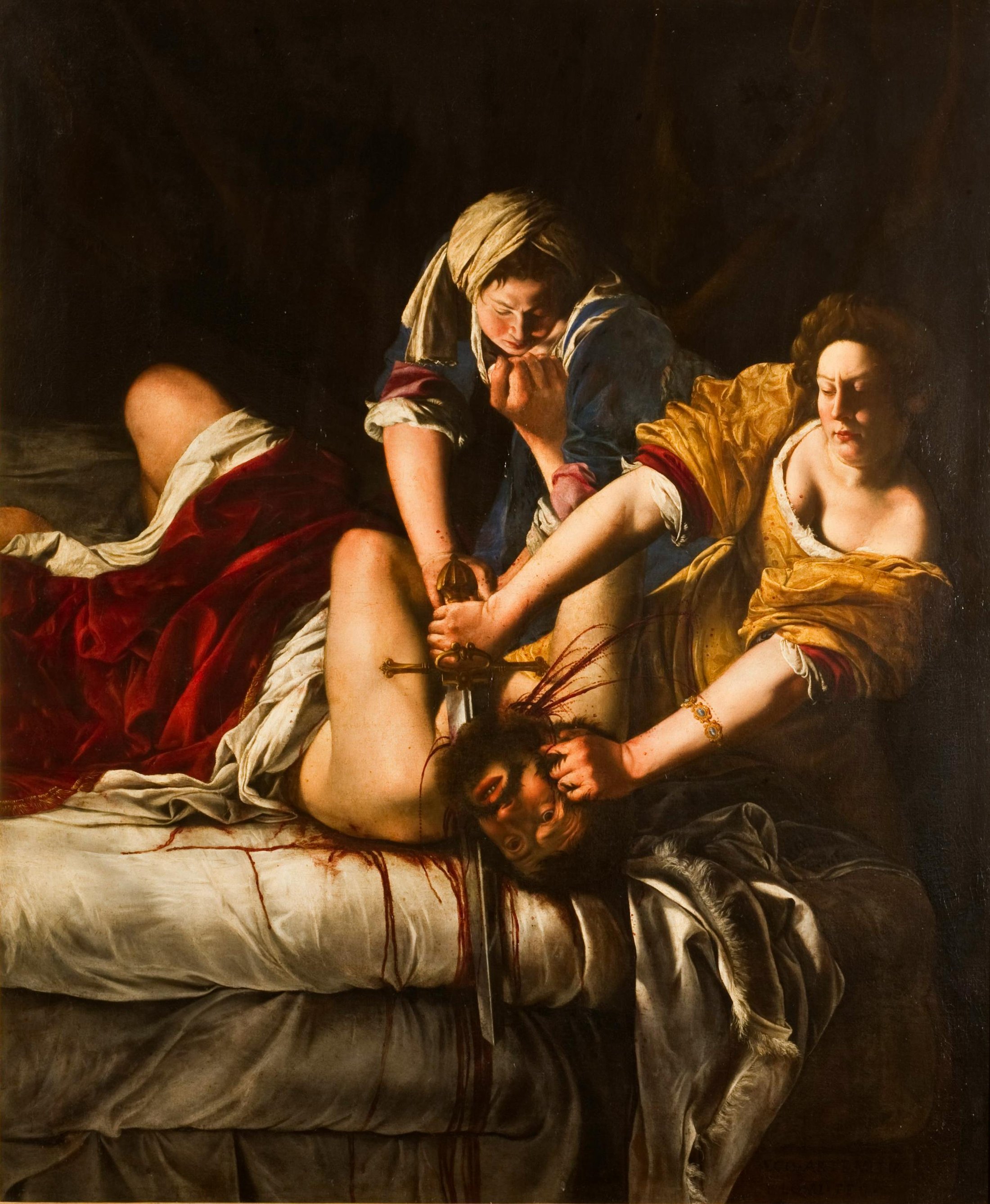
Cover the blood and follow the arms. Judith's limbs form a taut diagonal beam: one hand pins the head while the other drives the sword across the neck. The maidservant presses down from above; Holofernes pushes back toward the upper left. These are not posed bodies. They are three vectors colliding at the center.
The painting stays with us not simply because it selects the most violent instant, but because it makes effort believable. Rolled sleeves, whitening knuckles, bodies angled away from the spray, and a torso cut by the bed's edge insist that action has resistance—and consequence.
Composition: three diagonals turn looking into struggle
The group forms an inverted triangle. The women's heads create its upper corners, while the sword and neck force the eye toward the point below. Judith cuts down from the right, the maidservant presses in from the left, and Holofernes drives back against both. Crossing diagonals replace a calm horizontal with Baroque instability.
There is almost no safe viewing distance. The bed meets the lower edge, bodies are cropped on all sides, and the black field cancels the room beyond. The true focal point is not a face but the compressed knot of hands, blade, and neck. The eye travels from Judith's face to the sword, then follows the projected blood lines back across the body—a loop difficult to exit.
Color: warmth becomes a temperature of danger
Muted ochre and indigo act as near complements: gold advances, blue recedes, and the two women remain distinct in a crowded field. Carmine gathers in blanket, cuffs, and blood. This color echo links the scene's before, center, and aftermath.
Near-black actively compresses the gamut. Skin and linen leap forward through value contrast. The highest lights belong not to jewelry or blade, but to the working arms and receiving sheet: flesh appears before status.
Palette: candle black #17140F, linen #D8C4A0, ochre gold #A9792E, deep carmine #741F22, indigo #263B4A, warm flesh light #C98D63.
Light: illuminate only the chain of action
Side light catches shoulders, faces, forearms, and linen before the background, lower bodies, and folds fall rapidly into dark. Chiaroscuro becomes selective exposure, granting brightness only to links in the action.
The maidservant's head wrap, Judith's face, two pale arms, and the sheet form a broken vertical band. The blade's cool glint cuts horizontally through it. Light models volume and directs attention like stage blocking.
Technique: each material carries different resistance
Fact: The collection records an oil on canvas from about 1620, inventory 1890 no. 1567. Warm grays, earth tones, and high points model skin and linen; angular highlights make gold silk crackle; the blade contracts into a narrow, hard, cool reflection. Edge quality, value range, and brush direction distinguish the materials.
Reading: The blood obeys space rather than functioning as a pasted-on symbol. Jets cross the arm; rivulets descend with the sheet. Red acquires velocity, direction, gravity, and irreversibility.
Artist, context, and the limits of interpretation
Fact: Artemisia Gentileschi (1593–1652/53), born in Rome, became a major seventeenth-century painter. The museum notes her work across several courts and identifies her as the first woman admitted to Florence's Academy of Art and Design. She completed the canvas after leaving Florence and returning to Rome. It met strong reactions on arrival in Florence, and payment was delayed. Judith kills a besieging commander and saves her city.
Fact and limit: The violence is often reduced to a revenge allegory based on the artist's trauma. Her biography matters to the painting's reception, but that reading is neither exclusive nor provable from the image alone. Naturalistic violence had a strong market, while Judith signified piety, courage, and resistance to oppression.
Reading: The two women appear as people doing difficult work together, not poses offered to the viewer. Judith is not serenely triumphant; the maidservant is not decorative support. They focus, lean close, and exert force. Heroism becomes a collaborative process rather than a polished result.
Borrow the visual logic
- Palette: black 44% + linen 22% + gold 14% + carmine 10% + indigo 7% + flesh highlight 3%. Reserve red for the action path.
- Photography: use one hard side light; keep subjects at least 1.5 m from the background; make opposing arms cross at the focal point.
- Illustration: soft skin edges, hard metal edges, alternating cloth edges. Use value range—not surface noise—to describe touch.
- Layout: run a thin horizontal through two broad diagonals, keep type stable, and use a 44/22/14/10 balance of black, white, gold, and red.