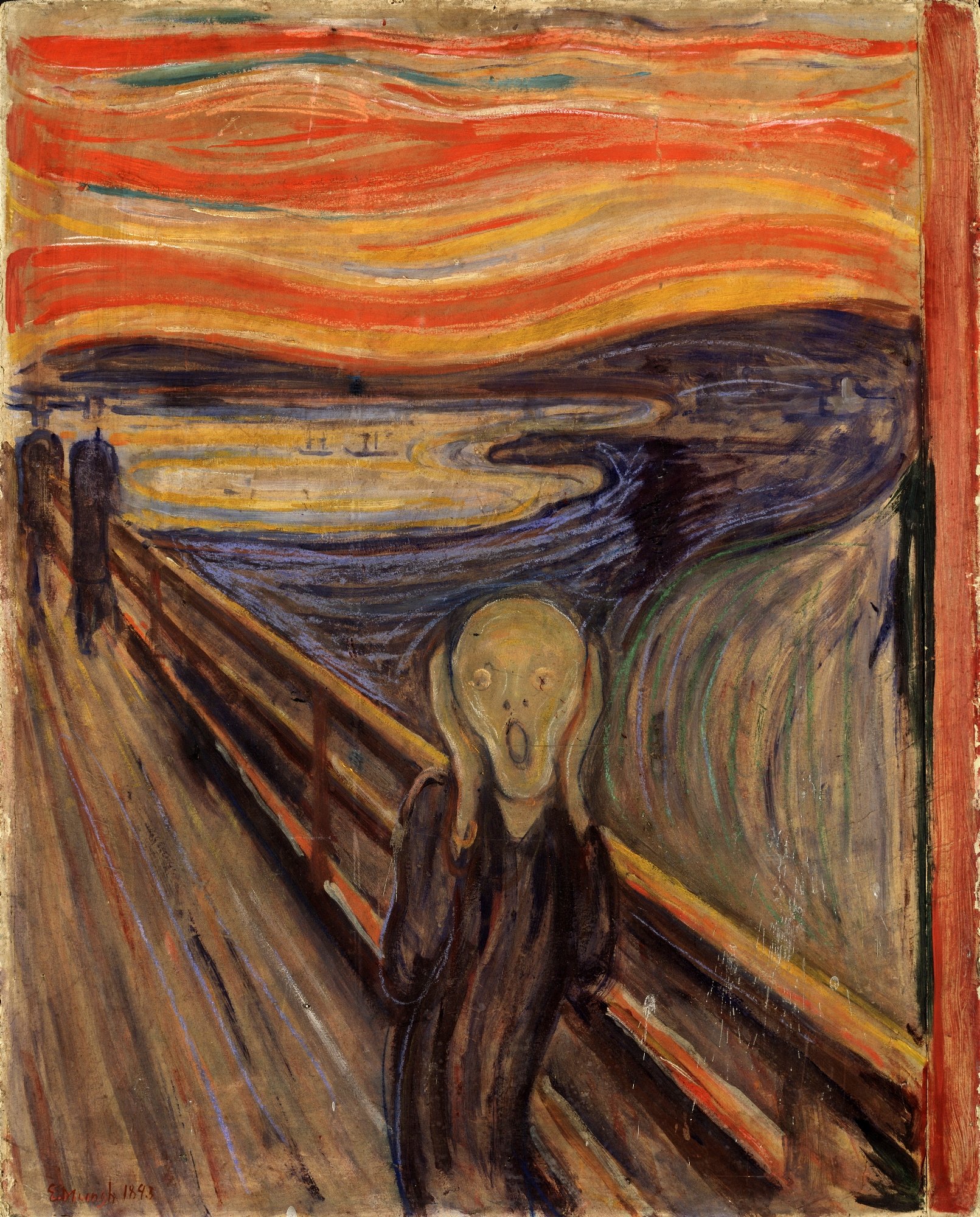
Look for ten seconds
Ignore the famous face for a moment. Follow the railing from lower right to upper left: hard diagonals throw space backward while two walkers continue as if nothing has happened. Then the foreground figure stops—and everything beyond the bridge begins to bend. Skull, shoulders, fjord, shoreline, and burning clouds appear crumpled by the same invisible vibration.
Emotion leaves the face and takes possession of the landscape.
Composition: straight lines hold; curves overflow
The bridge rail forces a rapid one-point perspective. The distant walkers obey its geometry: upright, narrow, moving on. The foreground figure faces us near the central axis, a punctuation mark blocking the route. Two visual grammars collide: the bridge belongs to straight lines, social order, and measurable space; figure and nature belong to continuous curves.
The oval mouth expands into the face, then echoes through cloud bands and shoreline. The figure is not placed in front of the landscape; the landscape passes through the figure. The diagonal pulls us away while the frontal oval drags us back.
Color: orange against blue-green turns dusk into an alarm
Vermilion, ochre, and dirty rose occupy the sky; blue-green, ultramarine gray, and near-black compress the lower field. Orange and blue-green create a near-complementary contrast, increasing each other’s intensity. Gray, brown, and black contaminate the hues, keeping the clash urgent rather than festive. Warm sky should advance and cool water recede, yet horizontal waves bind them into one pressing surface. The low-chroma bone face becomes both drained and luminous through simultaneous contrast.
#D95C3123%
#174A6318%14%9%6%
Light: emotional zoning, not illumination
There is no convincing single light source. The sky blazes without modeling the figure naturally; clothing, bridge, and water separate through contour and bands of value. Dark rails cut the field like black wedges. Pale face, near-black body, and burning sky create a three-step value jump that concentrates pressure around the head.
Technique: the stroke follows the nerve
The museum catalogs this 1893 version as tempera and crayon on cardboard, 91 × 73.5 cm, inventory NG.M.00939. Long looping bands, dry broken textures, and exposed ground remain visible. A rough sketch survives on the reverse; Munch later returned to the motif in paintings, pastels, and lithography.
Rails thrust backward, sky and water undulate laterally, and the figure’s contour contracts inward. Line is not an object’s shell; it is a trace of psychological velocity.
Artist and context
Edvard Munch (1863–1944) was a Norwegian artist associated with Symbolism in the 1890s and later recognized as a precursor of Expressionism. Museum research traces the motif to an 1892 diary entry describing a walk with two friends, a blood-red sky, and a vast scream passing through nature. The 1893 museum picture is the earlier of two painted versions; two pastel versions and an 1895 lithograph also exist. The work entered the collection as a gift in 1910.
The image renders the spatial experience of anxiety. Others keep walking and perspective still works, yet the acoustic wall between body and world has vanished. Hands pressed to the ears leave the central question unresolved: perhaps this is not a person producing the scream, but someone receiving it.
Borrow the method
- Palette: #D95C31 30% + #174A63 23% + #18232B 18% + #D79A43 14% + #81939A 9% + #E0D2B5 6%.
- Photography: Use a railing as a 25°–35° diagonal; hold the subject frontally while background figures move away. Try a 28–40 mm equivalent lens.
- Illustration: Straight strokes for built structures, horizontal waves for environment, closed ovals for the subject.
- Layout: Keep type level while the image moves; allocate cool darkness, warm conflict, and pale focus in a 60/30/10 hierarchy.
Source and rights
Edvard Munch, The Scream (Skrik), 1893, tempera and crayon on cardboard, 91 × 73.5 cm; National Museum of Norway, NG.M.00939. Collection facts and image credit: museum object page. Textual origin and version context: MUNCH museum feature. The 2123 × 2768 px collection image was downloaded from its Wikimedia Commons file page, which labels the underlying artwork Public Domain; museum image credit: Børre Høstland. Digital-image conditions may vary by source and jurisdiction. Image rights remain with the original creator and relevant rights holders. Commentary is original analysis by Daily Art; facts and interpretations are labeled separately.
