Look for ten seconds
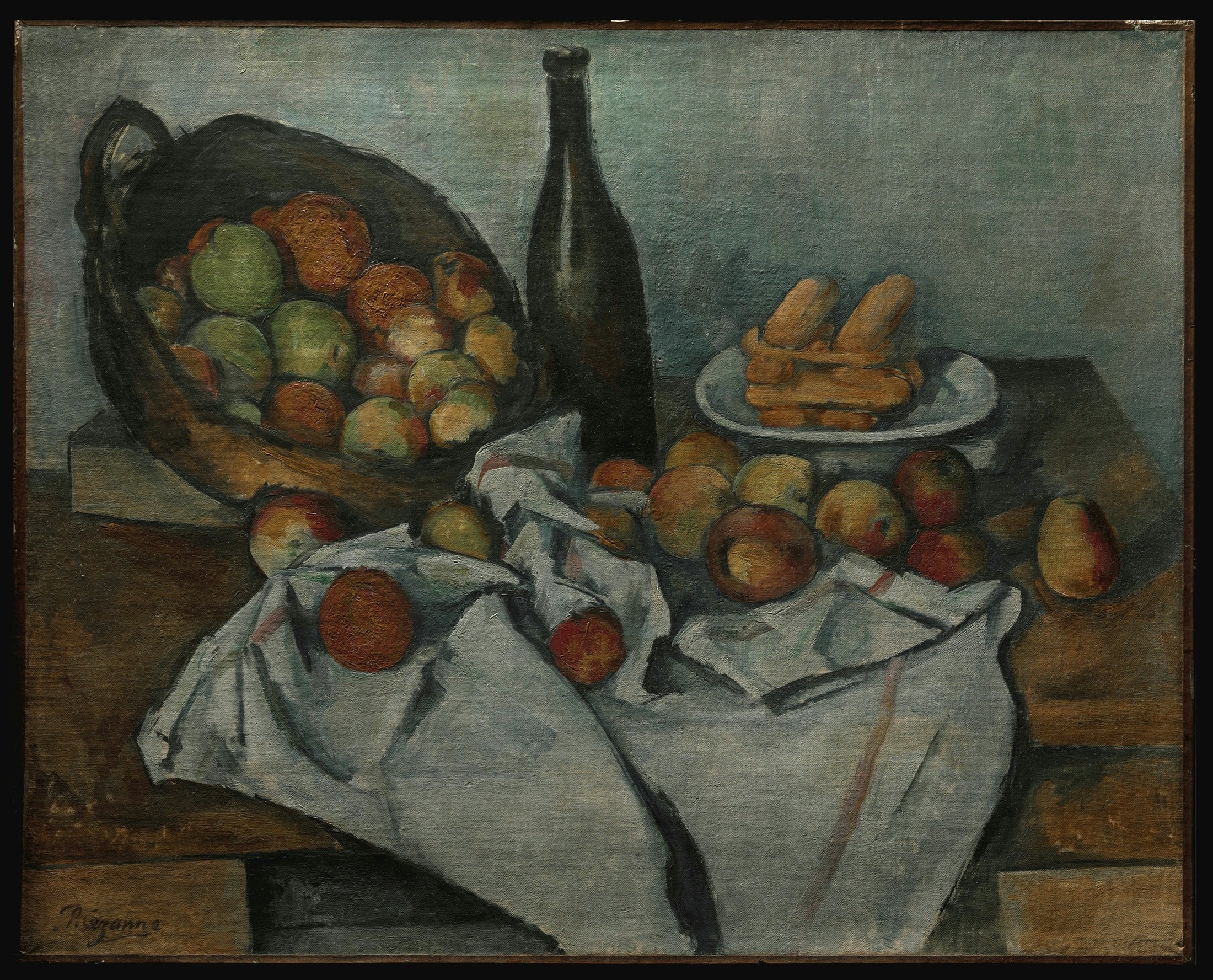
Do not count the apples yet. Follow the table’s front edge: it slopes down on the left, rises on the right, and never truly joins in the middle. The bottle leans, the basket rests on a wooden wedge, and the biscuits pause one second before collapse. A traditional still life should feel quiet and credible. This one is unstable everywhere—and somehow holds.
Cezanne did not forget perspective. He retained fragments seen from different positions and at different moments.
Composition: one table, at least three viewpoints
Three masses carry the image: the basket tipping outward at left, the dark vertical bottle, and the elevated white plate at right. The bottle acts as a hinge between a downward-left pull and an upward-right lift. The cloth surges toward us in angular folds, forming triangles that catch each scattered apple.
The broken table edge is decisive. Correct it to single-point perspective and the plate drops, the bottle straightens, and both halves align—but the tension disappears. Cezanne gives each object the angle from which it reads best: the basket opening is more frontal, the plate more overhead, the bottle nearer eye level. Space compresses and expands like an accordion.
Color: muted complements make the fruit glow
Blue-gray and blue-green establish the field; the apples move through rust red, ocher orange, and olive green. Red and green are complementary, but both are grayed down. The fruit gains intensity through warm–cool contrast and simultaneous contrast, not saturation. The cloth is never simply white: sage gray, blue-gray, creamy gray, and a few pink strokes form its highest-value area. The near-black bottle supplies the lowest value.
#87999A25%
#C4C9BD15%
#252A2712%
#8E46308%5%
Light: volume grows without a spotlight
Light enters softly from upper left. Cezanne does not blend each apple into a seamless sphere. He places short, differently directed patches together: yellow toward the light, red or green around the turn, cool blue inside the shadow. Each apple is both a globe and a small structure assembled from strokes. The bottle absorbs detail and keeps one pale reflection, a dark tuning fork that makes the cloth, plate rim, and skins feel brighter.
Technique: establish the structure, then let it move
Infrared reflectography published by the museum reveals a fairly detailed underdrawing in a dry, carbon-based material, possibly charcoal. The broken table edge and tilted bottle were planned from the outset, then revised during painting. Long, fluid black strokes create a second, painted underdrawing among the apples and cloth folds. The surface shifts between thick and thin, resolved and sketch-like: fruit and cloth become almost sculptural; peripheral edges stay loose.
Artist and context
Paul Cezanne (1839–1906) was a French painter who exhibited with the Impressionists before turning fleeting light into a slower investigation of structure. The Basket of Apples, c. 1893, is an oil on canvas measuring 65 × 80 cm, now at the Art Institute of Chicago, accession 1926.252. It is among the few paintings Cezanne signed, appeared in Ambroise Vollard’s first solo exhibition of his work in 1895, and became the museum’s first Cezanne acquisition in 1926.
The painting moves us because it admits that vision is unstable. Eyes travel, attention jumps, and memory folds one second into the next. The tilts do not describe a world falling apart; they preserve time honestly. Ordinary apples become monumental without allegory—only through sustained, repeated attention.
Borrow the method
- Palette: #87999A 35% + #C4C9BD 25% + #252A27 15% + #8E4630 12% + #899064 8% + #B07A3F 5%.
- Photography: Build three clusters around one dark vertical. Shoot at eye level and slightly overhead; combine them so only the table edge slips.
- Illustration: Use three to five warm and cool patches per rounded form. Break parts of the contour.
- Layout: Anchor one central vertical, then add two 3°–7° diagonals. Let the image tilt; keep the type readable.
Sources and rights
Paul Cezanne, The Basket of Apples, c. 1893, oil on canvas, 65 × 80 cm; Art Institute of Chicago, 1926.252. Collection facts and rights status: museum object page. Technical evidence: the museum’s open-access essay “A Harmony Parallel to Nature.” The source is a 3000 px collection scan downloaded from the museum’s digital-publication image service, with no content edits. The underlying work is in the public domain, and the museum marks its digital media Public Domain. Image rights remain with the original creator and applicable rights holders; verify the source page and local law for a particular use. Appreciation and interpretation are original to Daily Art; facts and interpretations are labeled separately.
