Look for ten seconds
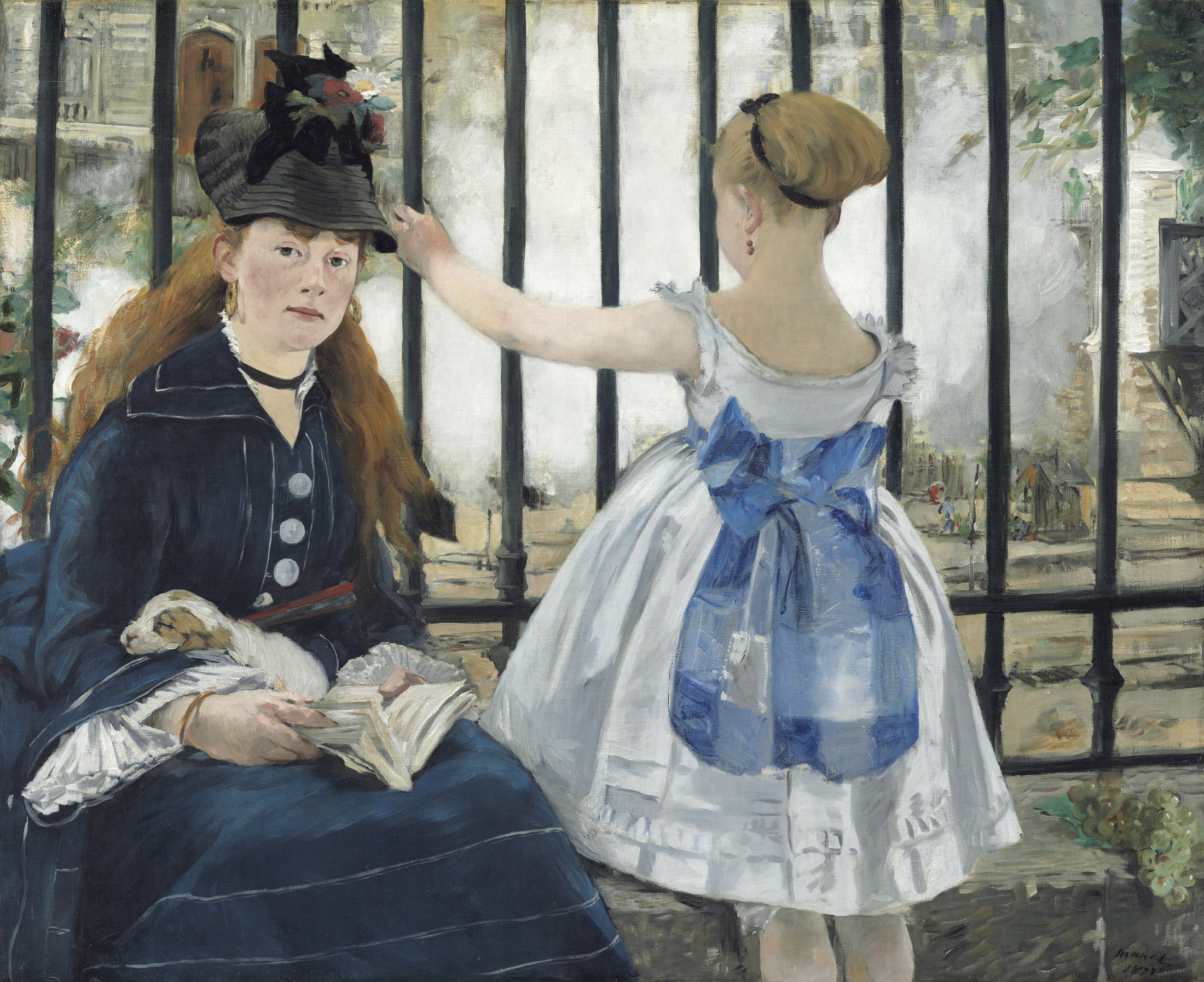
Do not search for the train. There is not a single carriage in view, only white steam lifting behind a black iron fence. The young woman pauses over her book and looks directly at us; the girl turns away, intent on the tracks below. One gaze pulls us into the painting, one back sends us beyond it.
Manet paints less a machine than the modern sensation of wanting to see and never receiving the whole view.
Composition: the fence is a metronome
Repeated iron uprights slice the width into narrow beats, while the woman’s skirt and the girl’s white dress form two broad triangular masses. The girl’s raised arm bridges the seated figure and the steam. Her head sits near the woman’s eye level, yet their attention moves in opposite directions.
The masterstroke is the absent locomotive. The fence compresses the foreground; steam erases the usual clues to depth. We know a railway lies below, but the view is denied. That obstruction feels more urban—and more psychologically exact—than a fully described train.
Color: blue and white trade places
The woman wears blue edged in white; the girl wears white tied with an enormous blue bow. The same pair reverses across their bodies, joining them formally while separating their roles. Value contrast supplies the structure, while warm–cool separation keeps it alive. Blue-black and gray-white establish order; ochres add warmth. The tiny poppy red sits against muted greens, a restrained red–green complement. Its higher chroma makes it the first visual stop.
#25384E32%
#E4E5DC15%
#232A2E13%
#A58D615%
Light: steam, not sunlight
The illumination behaves like diffuse overcast light, with no theatrical cast shadows. The girl’s dress and the vapor create one extended high-value field; edges sharpen, soften, and sometimes dissolve into it. The woman’s navy absorbs light and anchors the lower left. Illumination does not strike from one source—it seems scattered through the city air.
Technique: finishing the “unfinished”
Manet places broad, incompletely blended strokes side by side. Blue-gray, cream, and dry pale marks remain visible across the white dress. The fence is not mechanically precise; it is a heavy, slightly wavering black rhythm. Flat passages and omission compress depth and preserve the speed of something just seen. At the 1874 Salon, viewers were puzzled by the mismatch between title and subject and by brushwork they considered rough. That gap now reads as the painting’s modern intelligence.
Artist and context
The Railway was painted in 1873, oil on canvas, 93.3 × 111.5 cm. It belongs to the National Gallery of Art, accession 1956.10.1. The seated woman is Victorine Meurent; part of the Pont de l’Europe appears at upper right. Manet had just moved into the nearby studio, and this was the first painting made there. It was exhibited at the Paris Salon of 1874.
Édouard Manet (1832–1883) repeatedly made contemporary Paris his subject. Often understood as a hinge between realism and impressionism, he did not join the independent Impressionist exhibition of 1874; he submitted this painting to the official Salon.
The work moves us because it does not simply celebrate progress. Progress becomes an unreadable white cloud. The adult meets our gaze; the child’s curiosity reaches through the bars. Intimacy and isolation, looking and obstruction, occur at once.
Borrow the method
- Palette: #25384E 35% + #E4E5DC 32% + #232A2E 15% + #A58D61 13% + #9A463B 5%. Desaturate large fields; reserve clean red for one small accent.
- Styling: Navy outer layer + steam-white lower half, linked by gray-blue accessories. Use red once: pin, sock, or lip.
- Photography: Build six to ten repeated verticals from rails, blinds, or doorframes. Let one figure face the lens and another turn away.
- Design: Establish order with a 70% hard-edged grid; disrupt it with 30% haze, fade, or overlap.
Source and rights
Édouard Manet, The Railway (also Le chemin de fer), 1873, oil on canvas, 93.3 × 111.5 cm; National Gallery of Art, accession 1956.10.1. Factual source: museum object page. The source file is a 4000 × 3264 px copy of the museum’s digital image, downloaded through the Wikimedia Commons file page. That page marks it CC0; the museum identifies its media as Public Domain. Image rights remain with the artist and relevant rights holders where applicable; verify status for your jurisdiction and use. This appreciation is original analysis by Daily Art based on the museum’s factual record. Facts and interpretations are labeled separately.
