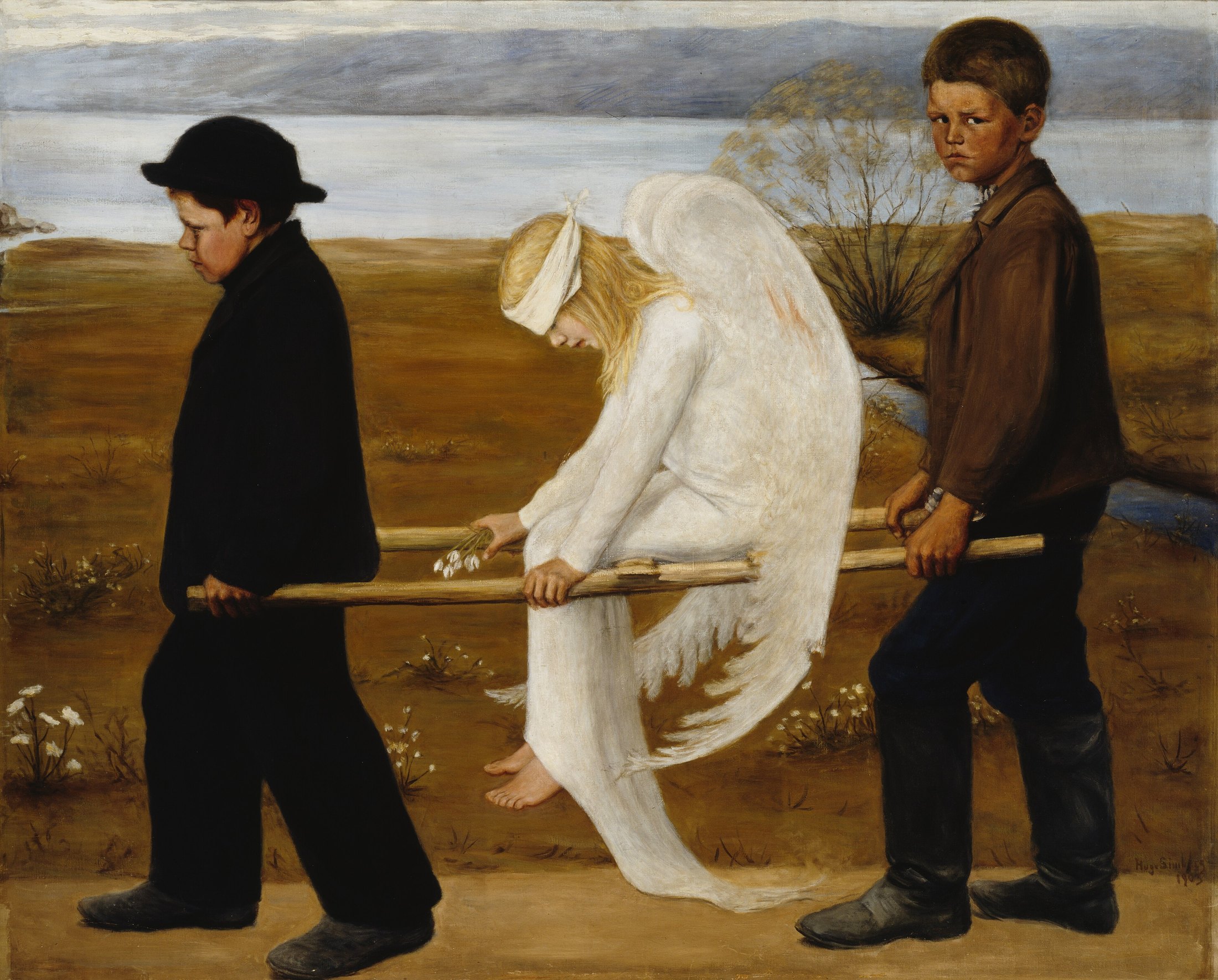
The first shock is simple: an angel can be hurt. Stay longer, and the two young bearers become harder to forget. The boy in front lowers his head and walks. The boy behind looks straight at us, as if asking: you have seen this—now what? Hugo Simberg turns grief into neither spectacle nor climax. He places it on a cold, nearly ordinary journey.
A procession that cannot stop
The stretcher poles and horizon run almost parallel, locking the figures into a right-to-left sequence. Their heads make a broken rhythm—low, lower, high. The front boy bows, the angel sinks at center, and the rear boy raises his face. That direct gaze acts like a nail: it pins a moving scene to the viewer.
The angel occupies the geometric center but has the least agency. White clothing, wings, and bandage compress the body into a descending mass of light. The dark boys become protective brackets, yet also close the figure in. A narrow road meets an emptied lake and sky; depth is suppressed, so transport begins to resemble ritual.
A white point of pain in a muted world
The palette is built from peat brown, mist blue-gray, charcoal, bandage white, and a trace of wound ochre. Brown and blue create a grayed cool–warm opposition. They never shout; they stretch the air into distance. Black carries visual gravity, while white—the highest value—holds the center.
34%#98A0A0
23%#171716
20%#E7E1CD
18%5%
Cream, gray, and faint pink enter the clothes, wing, and bandage, making white bodily, vulnerable, and capable of staining. The tiny ochre-red wound becomes acute against the low-chroma field: restraint gives the smallest warm note the greatest emotional weight.
Sacredness without a spotlight
Broad overcast light covers everything. There is no theatrical halo and almost no cast-shadow drama. Simberg constructs the sacred through value, not rays: the pale body rises from brown earth, while softened edges sometimes merge with the sky. Holiness does not descend from above; it barely persists in a body being cared for.
Making allegory feel witnessed
Restrained oil paint keeps a dry, matte surface. Sky, lake, and ground become broad bands; faces, hands, poles, and feathers receive firmer description. Flat background and observed detail coexist, so the scene feels both witnessed and inexplicable. Slightly rigid poles and flattened silhouettes suspend natural motion, creating the stillness of Symbolism.
Artist and verified facts
Fact: Hugo Simberg (1873–1917) was a central Finnish Symbolist whose angels, devils, and figures of Death often enter ordinary settings. Completed in 1903, The Wounded Angel is an oil on canvas measuring 127 × 154 cm. It belongs to the Ahlström Collection at the Finnish National Gallery / Ateneum Art Museum, inventory A II 1703. Museum material says the work developed over years. At its first exhibition, Simberg supplied only a long dash instead of a title, leaving interpretation open. Its landscape is based on a real Helsinki setting.
Not rescue, but shared weight
Interpretation: The painting refuses to make injury meaningful or beautiful. The boys may not understand what happened, but they still lift the stretcher. The angel has not recovered; the road offers no visible end. The rear boy turns looking into responsibility: compassion may begin not by explaining another person's wound, but by carrying some of its weight when answers fail.
The small white flowers repeat the angel’s fragility—slender, drooping, still held. They may suggest hope, but the painting never guarantees recovery. That refusal to exaggerate hope is exactly what makes it believable.
Borrow this restraint
- Palette: #745025 34% + #98A0A0 23% + #171716 20% + #E7E1CD 18% + #A45D42 5%.
- Frame: Link three figures with one horizontal line. Center the subject; place the direct gaze on the right third.
- Photography: Use overcast diffusion; flatten the background by 1–1.5 stops; separate white by value, not rim light.
- Styling: Peat brown 50% + charcoal 30% + bandage white 15% + wound ochre 5%; choose matte wool, worn cotton, and unpolished leather.