What is cropped becomes most visible
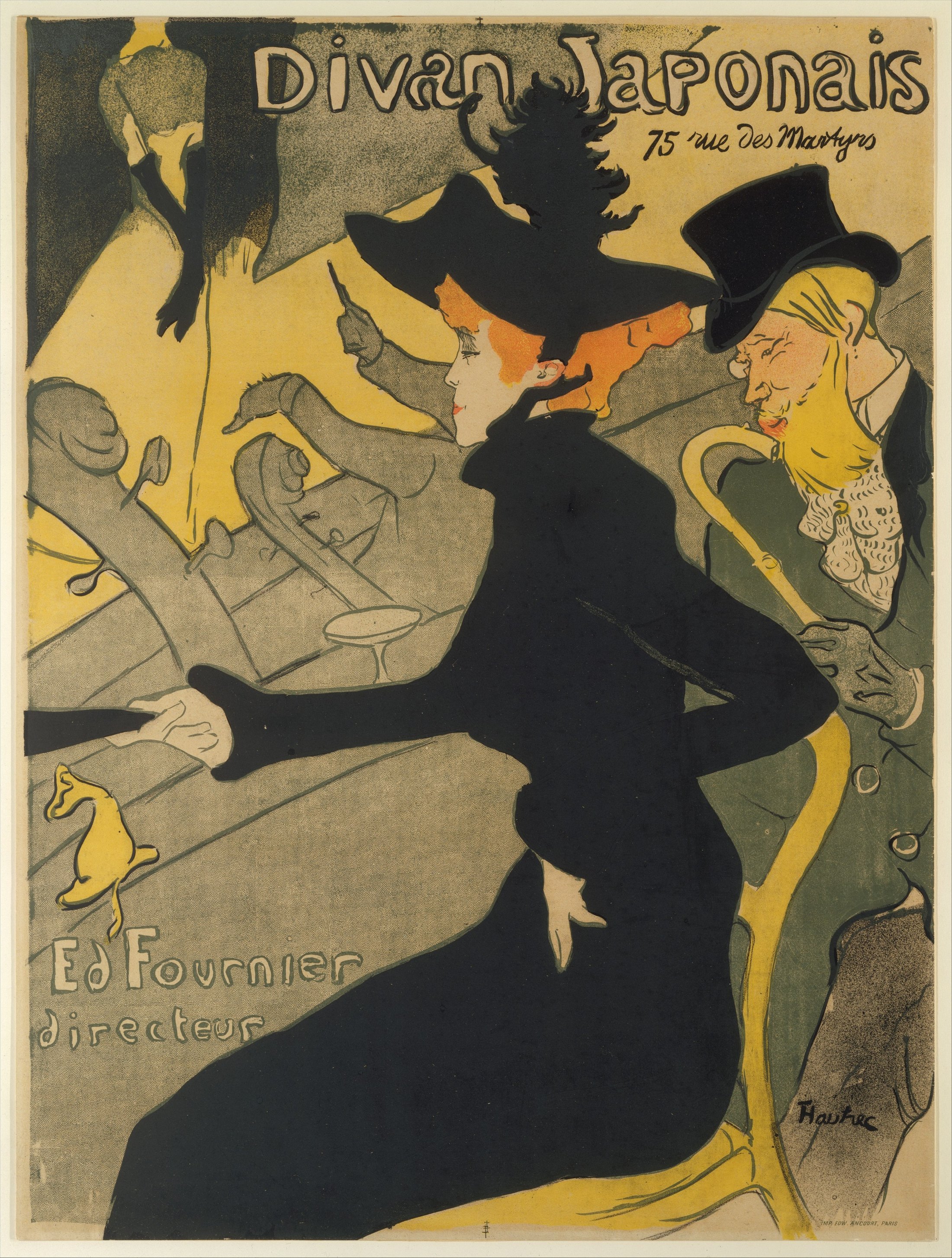
Jane Avril’s hat brim cuts diagonally across the center like black scissors. Édouard Dujardin is clipped by the right edge. Yvette Guilbert, at upper left, has no head at all—yet her long black gloves identify her instantly. No one exchanges a glance, but their poses electrify the room.
He did not draw center stage.
He drew the fewest clues needed to recognize a person.
Composition | Every important figure is incomplete
Three aggressive crops build the image: Guilbert loses her head, Dujardin loses half his body, and Avril’s brim slices through lettering and stage. Their black silhouettes interlock. The eye drops from gloves to brim, crosses face and hand, then follows the yellow chair curve back to Avril.
The star onstage becomes a fragment while the star in the audience commands the center. Spectators, performance, and title collapse onto one plane; the frame implies a crowd continuing beyond it.
Color | Black identifies; warm yellow summons
This is high-value contrast + warm analogy + low-chroma cooling. Black and yellow read across a street. Yellow-orange and vermilion supply heat; gray-green appears cooler beside warm yellow through simultaneous contrast. Large shapes seize the eye, then tiny orange-red notes pin it to hair, lips, and faces.
Light | Nightlife without modeled light
There is almost no conventional shading. Faces are assembled from paper tone, black line, and a little orange. Black is hat, clothing, and club darkness at once. It resembles remembered stage light: not every fold, only a bright face, a dark hat, gloves, and a profile.
Technique | Four colors print the speed of a city
Fact: The Met dates the work to 1892–93 and identifies it as a four-color lithograph on wove paper, 80.8 × 60.8 cm. Lithography preserves free line, spatter, and flat shape; separate color runs make the street poster reproducible.
Lettering is image, not caption: its wavering forms share a visual grammar with brim, glove, and chair. Flat color, emphatic outline, off-center balance, and radical cropping reflect Japanese ukiyo-e, an influence explicitly noted by the museum.
The artist | Nightlife’s visual director
Fact: Henri de Toulouse-Lautrec (1864–1901), associated with Montmartre, became a leading Paris poster artist. The Met identifies dancer Jane Avril and writer Édouard Dujardin in front; singer Yvette Guilbert is the cropped figure onstage, known by long gloves and a gaunt build.
He understood how celebrity images are built: one hat, two gloves, a flash of orange hair—already a visual identity system.
Why it moves | Precise loneliness inside spectacle
Interpretation: Guilbert has no face but feels legendary; Avril turns from the stage yet controls the sheet; Dujardin is half present yet seems to lean into conversation. We complete the off-frame space and become participants.
Three famous people share a room but point in separate directions. Black joins and isolates them. The advertisement promises sociability; the image delivers the exact, elegant loneliness of a city crowd. This is a “Daily Art” interpretation, not a museum conclusion.
Borrow the look | Fewer colors, stronger shapes, braver crops
- Palette: #171A18 38% + #DDBE69 27% + #858269 18% + #E9D9B3 10% + #C86D3D 7%; cap orange-red at 5–8%.
- Outfit: black 60% + tobacco yellow 25% + olive 10% + vermilion 5%; keep pattern to one item.
- Composition: let one silhouette occupy 35–45% and crop 15–25% of the figure; preserve one signature clue.
- Poster: test three-second readability in black silhouettes, then add color; overlap or align type with the figure.
Work and sources
Henri de Toulouse-Lautrec, Divan Japonais, 1892–93, four-color lithograph on wove paper, 80.8 × 60.8 cm; The Metropolitan Museum of Art, object 58.621.17.
Facts: The Met collection record; The Met’s artist essay. Original `DT224360.jpg` downloaded through The Met Open Access; the record marks it Public Domain.
Image rights remain with the original creator and any applicable rights holders; verify requirements in your jurisdiction. Museum facts and “Daily Art” interpretation are labeled separately. The critical text is original.