Darkness arrives before people do
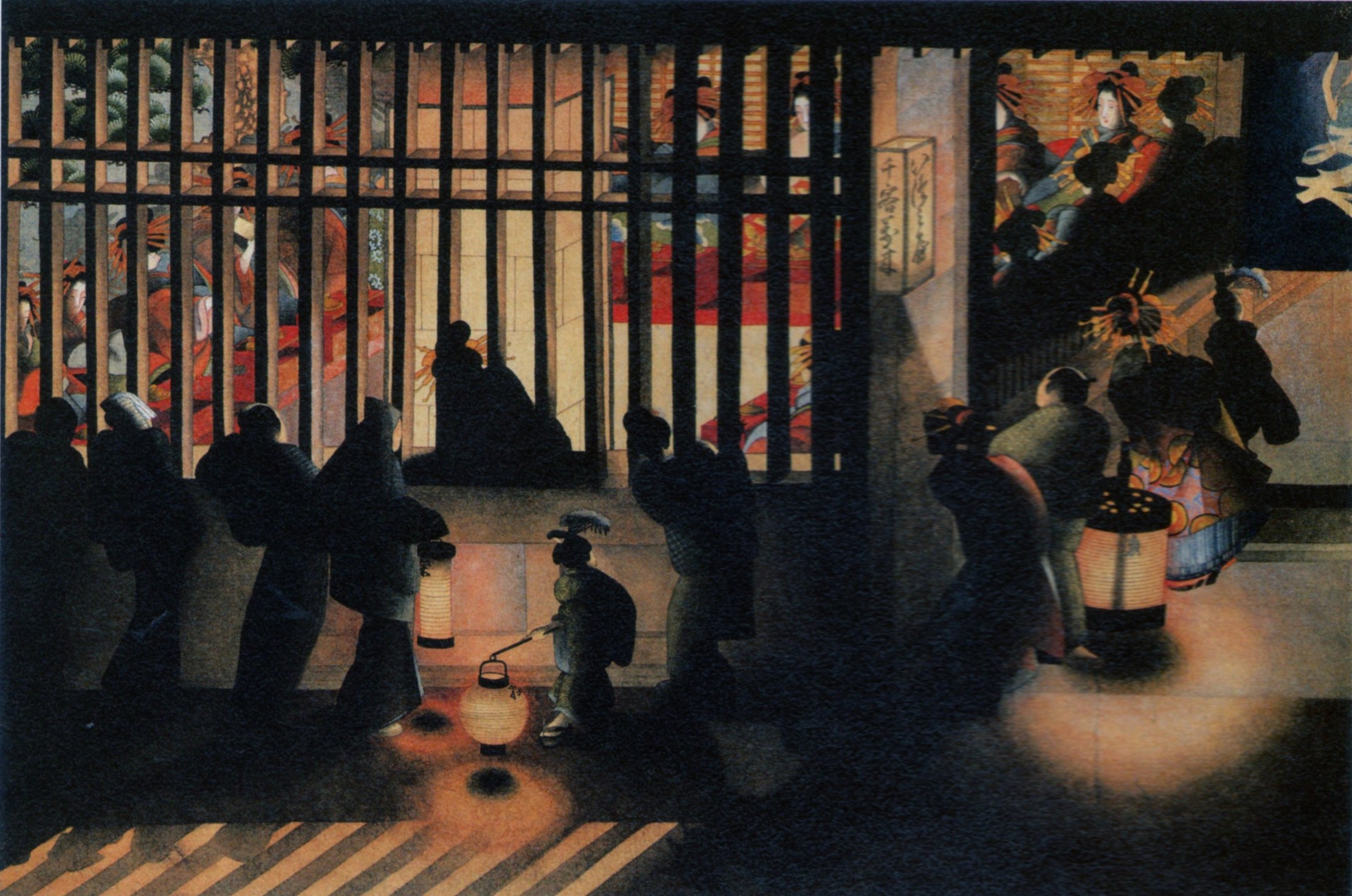
Street figures become near-featureless silhouettes, while a heavy wooden grille cuts the illuminated interior into intermittent frames. Hand lanterns reveal only small islands of ground. Faces, patterned robes, and a gold-toned screen emerge more slowly behind the bars. Katsushika Ōi refuses a single explanatory light; she offsets several sources and makes the eye walk through darkness.
The lanterns do not defeat the dark.
They make every boundary more visible.
Composition | One horizontal scene, sliced into vertical pictures
The broad horizontal field is repeatedly interrupted by dense vertical bars. Street traffic pushes sideways while the grille resists: the eye wants to travel right and keeps being stopped. A larger bright opening on the right stretches the rhythm; a monumental dark back in the center presses us toward the foreground.
Occlusion does the real work. We receive half a face, a sleeve, a hairpin. The grille is not neutral decoration: it separates customers in the street from women inside and places us among the watchers. Formal beauty and a social structure of looking occupy the same black lines.
Color | Warmth is cut from black
This is more exact than a generic “black and gold” scheme. Nearly half the field stays dark. Warm yellow is restricted to interior light and lanterns; muted vermilion and indigo create a cool–warm counterpoint. In color-theory terms: high value contrast + controlled chroma + a small complementary tendency. Light–dark drama leads; hue supplies temperature.
Light | Each lamp owns one small piece of reality
The museum notes several depicted sources, including customers’ lanterns and interior lamps. Ōi does not merge them into even illumination. Lanterns pool softly on the ground, interior light passes through the grille in narrow strips, and backlit bodies collapse into complete dark shapes. Thin gradations carry color into shadow, so darkness feels less like an empty backdrop than air with density.
Technique | Not a print, but a singular hand-painted work
Fact: The Ōta Memorial Museum of Art describes this as one of Ōi’s best-known works. The British Museum dates it to about 1844–1854 and identifies it as a hanging scroll in ink and color on paper. It is hand-painted ukiyo-e—a unique object made directly on paper—not a woodblock print multiplied by designer, carver, and printer.
Ōi could vary ink density directly, make gradients independent of carved blocks, and draw minute robe patterns, ornaments, and faces behind the grille. Black feels repeatedly deepened rather than mechanically filled. Light is not bare white paper; parchment yellow, ochre, and vermilion appear to carry it.
The artist | Making a night of her own beside a famous father
Fact: Katsushika Ōi (about 1800–after 1857), born Eijo, was Hokusai’s daughter. Raised in the family workshop, she returned after her marriage ended and spent roughly the last two decades of Hokusai’s life caring for him while working as an accomplished painter and collaborator. The museum notes that only about ten works by her have been confirmed worldwide.
Her biography is often eclipsed by her father’s. That makes the image resonate differently: its most luminous presences are fragments that win visibility from obstruction and darkness.
Why it moves us | Visibility is not freedom
Interpretation: Its first seduction is almost cinematic—silhouettes, backlight, multiple lamps, faces held inside frames. The deeper question is who gets to look. Customers watch through the grille; women inside are displayed; we stand outside the whole scene and watch them all. Vision crosses the bars, bodies do not.
Light reveals fabric, faces, and gestures, but also commerce, distance, and constraint. Darkness protects individuality; illumination exposes it to a public gaze. Beauty and unease remain true at once. This is a Daily Art interpretation, not an official museum reading.
Borrow the look | A dark–grid–ember formula
- Palette: #101416 48% + #D8B985 21% + #6B6252 14% + #A74632 11% + #304C5D 6%. Secure nearly half the frame for darkness first.
- Composition: Let a doorway, railing, or blinds occupy 25–35%. Withhold full faces; place the bright opening near a rule-of-thirds intersection.
- Lighting: Skip the ceiling light. Use a 2200–2700K warm practical and a dimmer side-back light; keep the background at least two stops under.
- Layout/interiors: Use black, lantern parchment, and vermilion at 7:2:1. Let vertical rules carry structure; reserve warmth for one title word, lamp, or textile.
Work and sources
Katsushika Ōi, Night Scene in the Yoshiwara (also Display Room in Yoshiwara at Night), about 1844–1854. Hanging scroll, ink and color on paper; Ōta Memorial Museum of Art.
Facts: Ōta Memorial Museum of Art feature and British Museum research article. Source image: Wikimedia Commons file page, 3449 × 2285 JPEG. The page marks the work public domain under Japanese copyright law and carries a Public Domain mark; verify terms in your jurisdiction.

Image rights belong to the original creator and relevant rights holders. Museum facts and Daily Art interpretation are labeled separately; the critical text is original.