How a new building became an old dream
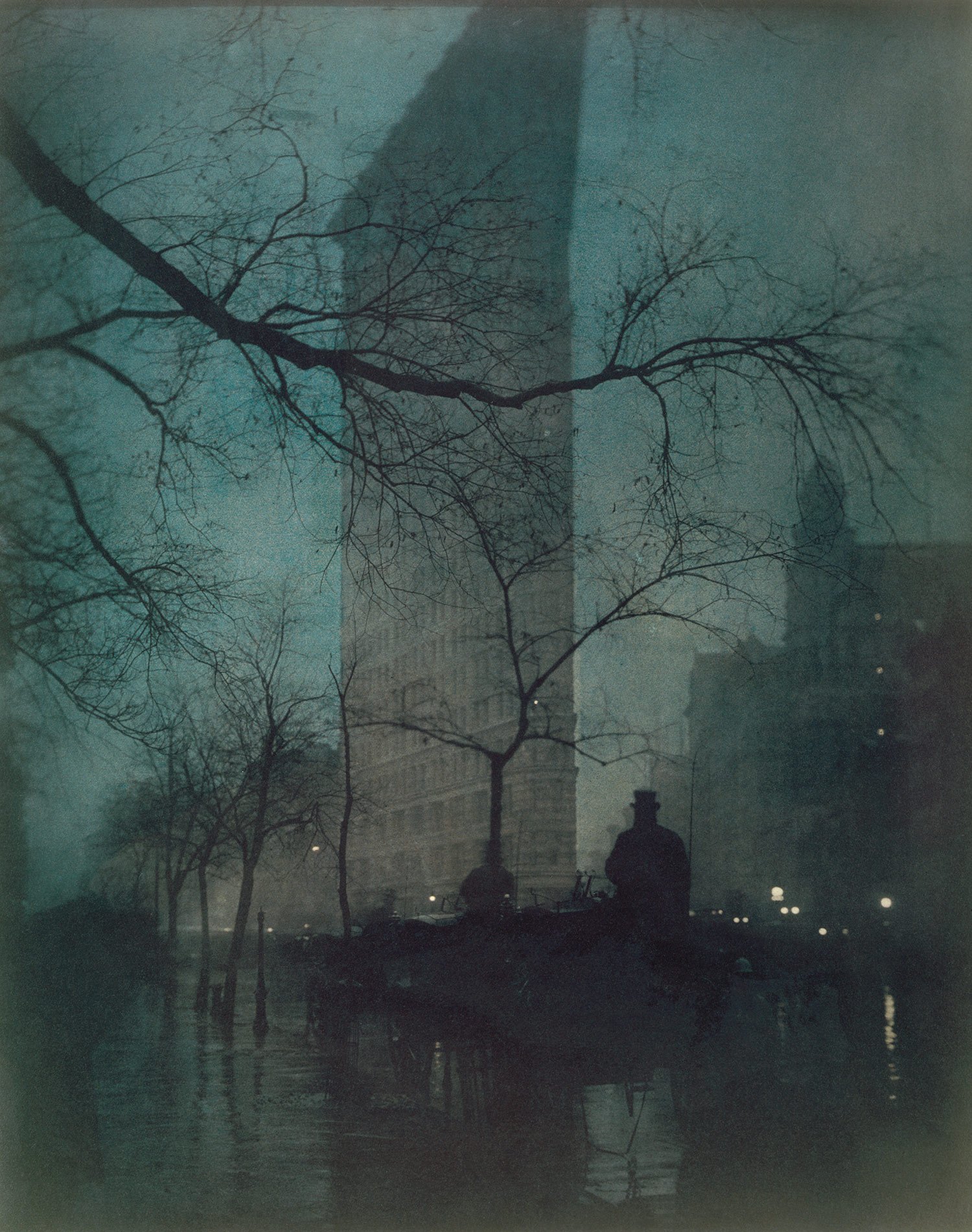
Do not look for the building first. The image reaches you as blue-green weather: branches descend like etched lines, carriages and pedestrians shrink into a few dark marks, and the Flatiron rises through the mist—part ship’s prow, part blade with its edge softened. Steichen did not treat it as a landmark. He made it feel like a thought still developing in the darkroom.
The hardest part of the city
becomes a breath at twilight.
01 | Let the tower appear, not conquer
The building is displaced to the right, its narrow profile climbing toward a point. A trunk and a full net of branches curtain the left side; open mist and roadway balance the right. Carriages cross the foreground as a low horizontal counterweight.
The tower fills most of the image’s height without overpowering its atmosphere. Tiny figures keep this phantom attached to ordinary street life. Cropping, asymmetry, layered silhouettes, and spacious emptiness echo the Japanese woodblock prints admired around the turn of the century.
02 | A muted cool–warm counterpoint
This is not simply color the camera found. It is color rebuilt in the print. Read it as a neutralized cool–warm structure: the blue-green field recedes while tiny orange-brown notes advance. Because both sides are muted, temperature replaces a loud complementary clash.
35%
29%
20%
95% atmosphere + 5% human warmth is the transferable lesson. Blue-green unifies the air; ember brown appears only in lamps and wet reflections, making the night feel deeper.
03 | Not illumination, but dissolution
There is no commanding light source. Sky, fog, and wet pavement form a broad diffuser. The building becomes legible through a faintly lighter plane and the pressure of its silhouette. Blacks are firmest in front; contrast, sharpness, and saturation decrease with distance—atmospheric perspective translated into photography. The lamps do not light the street so much as measure the fog.
04 | One negative, several twilights
Fact: The museum dates the negative to 1904 and this print to 1909; it measures 47.8 × 38.4 cm. Steichen began with a platinum print, then applied layers of pigment held in a light-sensitive mixture of gum arabic and potassium bichromate. The museum owns differently colored variants made from the same negative.
Platinum supplies a long, delicate tonal scale. Gum bichromate lets the printer alter pigment, edge, and local density by hand. The result keeps photography’s trace of light while gaining painterly color layers and object-to-object variation. This was central to Pictorialism’s claim that a camera could organize emotion, not merely copy appearances.
05 | Between photography and modern art
Fact: Edward J. Steichen (1879–1973), born in Luxembourg and active in the United States, worked as a photographer, painter, and curator. Closely associated with Alfred Stieglitz and the Photo-Secession, his early work drew on James McNeill Whistler’s nocturnes and Japanese print composition while arguing for photography as an independent fine-art medium.
06 | Modernity learns how to be lonely
Interpretation: The emotional force is not the building’s grandeur. It is Steichen’s willingness to let the new acquire memory. Steel softens in fog; horse-drawn traffic still moves below; an older street and a new skyline briefly share one layer of dusk. The photograph embraces progress and watches it from a distance at the same time.
Contemporary skyscraper images often prize sharpness, brightness, and certainty. Steichen lets architecture emerge from uncertainty. The building becomes psychological weather—monumental, strange, and unexpectedly tender. This is a Daily Art interpretation, not an official museum reading.
07 | A fog–depth–ember formula
- Palette: #D8CFB9 35% + #748F89 29% + #273F40 20% + #151A18 11% + #A66B3E 5%.
- Composition: Place the subject near the 60% vertical axis. Obscure 20–30% of the left edge with branches, a doorway, or shadow; add one low moving figure or vehicle.
- Post-production: Reduce saturation; bias blacks toward teal and highlights toward parchment. Lower clarity and contrast with distance. Keep warm color below 5%.
- Wardrobe/interiors: Fog beige + verdigris + deep teal at 5:3:2. Reserve ember brown for leather, lighting, or one accessory; favor matte wool, aged brass, and smoked glass.
