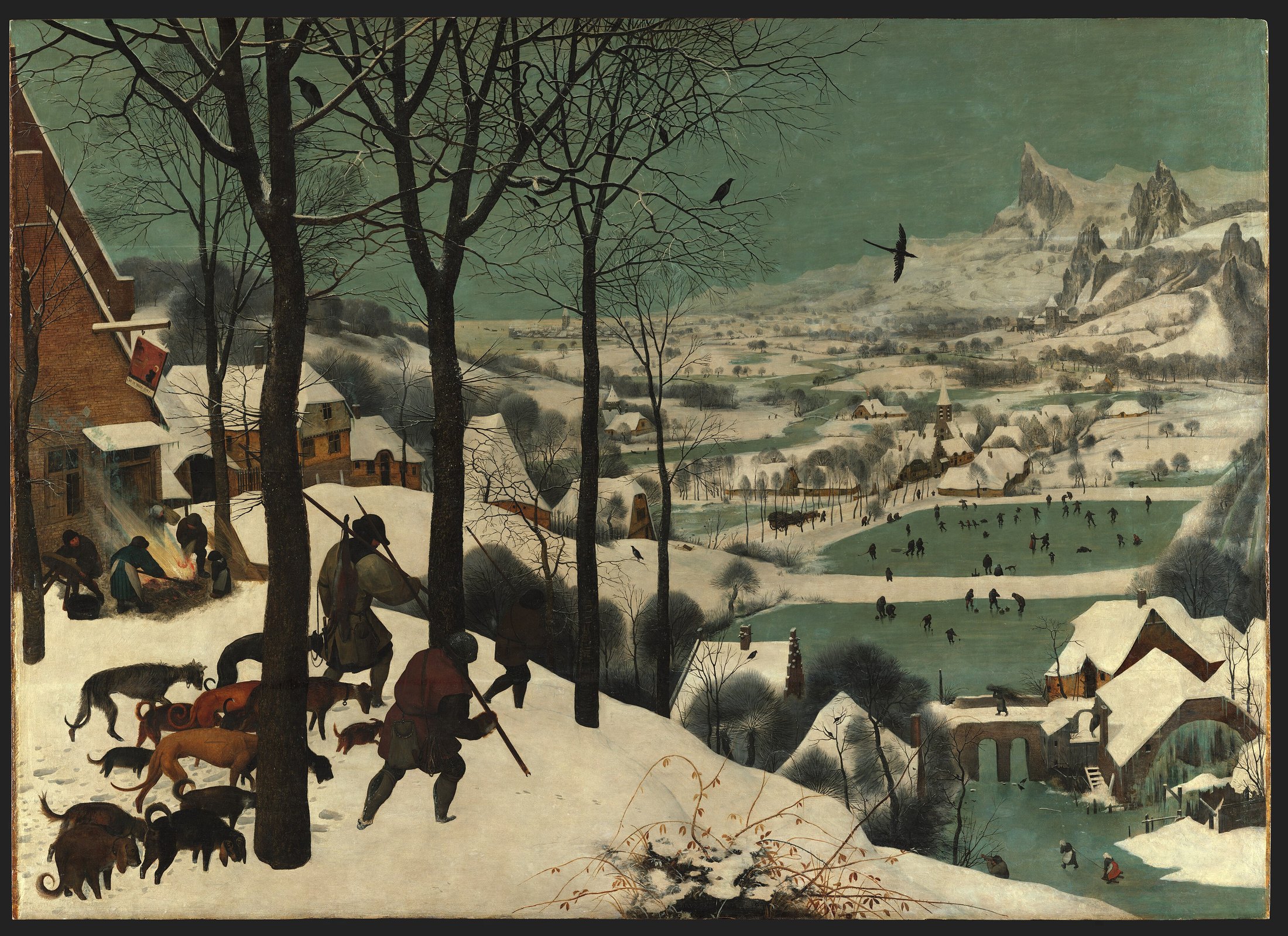
Begin at the lower left. Three hunters and a pack of drooping dogs trudge toward the village; their catch is a single fox. Lift your gaze and the frozen ponds are crowded with skaters, curlers, and walkers. Beyond them, roofs, steeples, mills, and cliffs recede into a pale horizon. There is no single protagonist. The painting behaves like a breath: weight first, then release.
Composition | From vertical trees into the valley
Four dark trees act like gateposts, pinning the foreground to the left. The hunters descend along a forceful upper-left-to-lower-right diagonal. Rooflines, banks, and a flying bird continue that motion toward the ice. The shore then bends back toward center, creating a loose S-shaped route through heavy foreground, busy middle distance, and silent mountains.
The high viewpoint makes people tiny without making them irrelevant. Scale, overlap, and fading atmospheric contrast produce extraordinary depth. The deeper intelligence lies in density: trees, roofs, people, and fire compress the left; sky and ice open across the right. Cold acquires physical area.
Color | One ember inside a grey-green winter
Paper white, ice green, haze blue-grey, and charred brown-black form the field; ember brown appears sparingly around fire and brickwork. The logic is low-chroma analogous cools plus a small warm accent. Neighboring blue-greens quiet the surface, while orange-brown activates the blue–orange complementary axis. Snow is never sterile white: beige, green, and smoke stain it with labor, dampness, and weather.
Light | No sun, only snow-amplified diffusion
Cloud cover seals the sky, leaving almost no cast shadows. Snow and ice act like enormous reflectors, lifting cool light from below. People become crisp dark silhouettes. Contrast is strongest among trees, hunters, and roofs, then weakens and cools into the distance. The fire is the only explicit pocket of warm light: it does not illuminate the scene; it punctures the cold system.
Technique and context | Turning the calendar into landscape
Fact: Painted in 1565 in oil on oak, approximately 116.5 × 162 cm, the work is held by the Kunsthistorisches Museum in Vienna. It belonged to six seasonal landscapes made for the Antwerp merchant Nicolaes Jonghelinck; five survive. The six-part year roughly followed agricultural rhythms, and this panel represented December and January. The museum identifies it as one of Europe’s earliest and most important large-scale winter landscapes.
Bruegel was born around 1525/30 and died in Brussels in 1569. He pushed landscape out of its supporting role: rural work, play, and weather became the main drama of human life inside nature. Oil on oak supports crisp contours, restrained cool layers, and dense miniature incidents. Dark foreground shapes establish the skeleton; progressively softer contrast expands the valley.
Why it moves us | A poor return inside a life that continues
Interpretation: The painting holds two truths at once. The hunt has yielded little: heads bow, dogs sag, and the slope presses every body downward. Yet below, people skate, work, carry, and gather. Bruegel neither turns failure into spectacle nor lets the wider view erase it.
We walk behind the hunters and overlook them from above. Their disappointment no longer fills the entire field, but it remains visible. Winter is vast and people are small; that scale makes every fire, footprint, and continuing gesture matter more. This is an original reading by “Daily Art,” not an institutional conclusion.
Apply it | A formula for cold, depth, and human warmth
- Palette: use the five colors above at 38:27:18:12:5. Desaturate the cool field and reserve warmth for action.
- Composition: lock roughly 30% of the left edge with dark verticals; descend on one diagonal, then return toward center with an S-curve.
- Photography: keep highlights creamy, shift shadows toward green-black, and reduce clarity and contrast with distance. Never force snow to pure white.
- Posters and interiors: 70% pale cool ground + 25% dark structure + 5% clay orange. Anchor the title near the dark edge; let the information field breathe like ice.
Artwork and sources
Pieter Bruegel the Elder, The Hunters in the Snow (Winter), 1565. Oil on oak; approximately 116.5 × 162 cm; Picture Gallery, Kunsthistorisches Museum, Vienna.
Museum artwork interpretation · Seasonal-cycle context · Image and Public Domain Mark

Image rights belong to the original creator and any applicable rights holders. The artwork is in the public domain, but rules for reproductions may vary by jurisdiction; verify before publication. Facts are attributed to the museum and image record. Unmarked interpretations are original analysis by “Daily Art.”