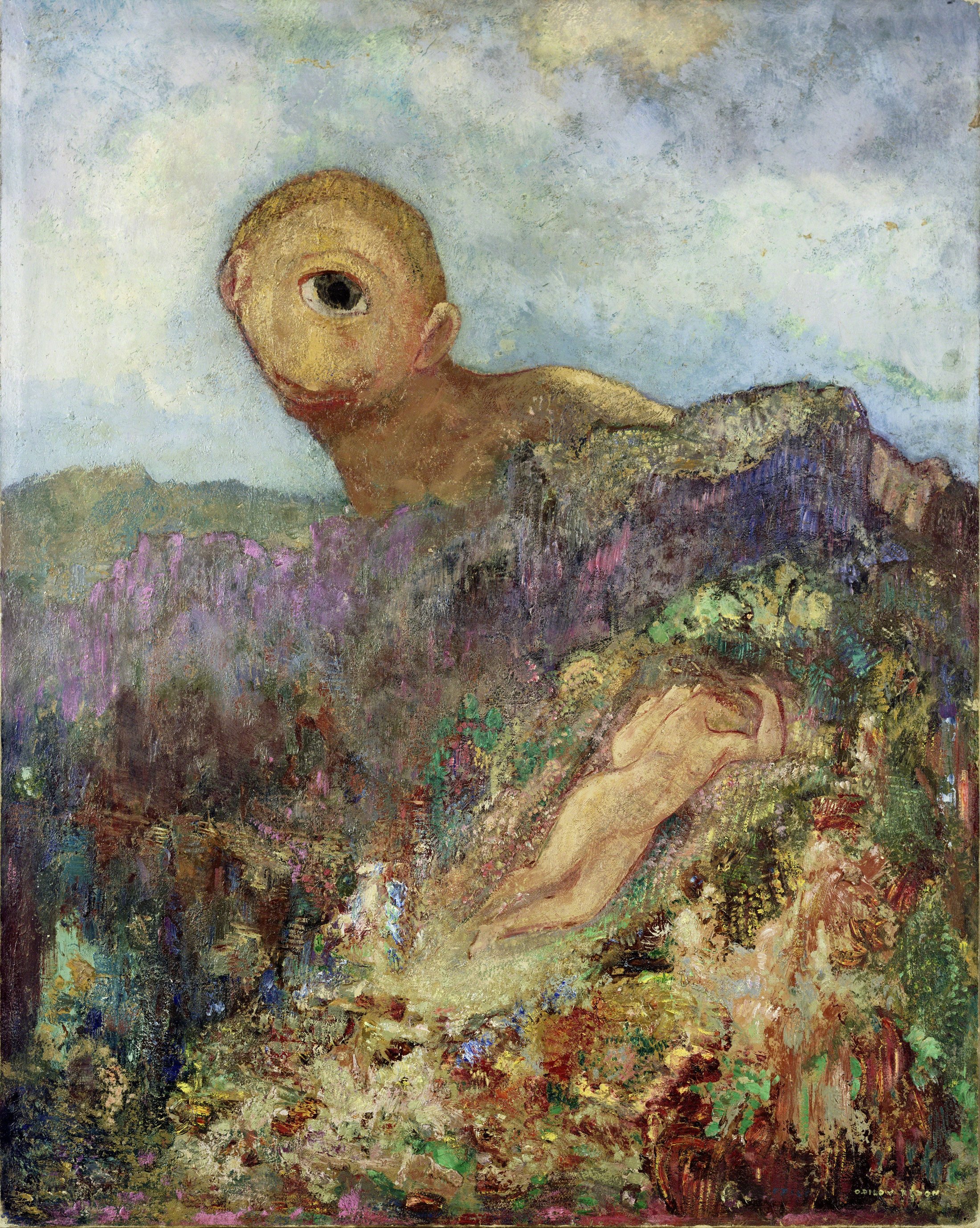
The eye takes you first. It is anatomically impossible, yet the face is not conventionally savage: the mouth seems almost shy, the shoulder grows out of the hill. Below, the Nereid Galatea sleeps among flowers. She and the giant occupy incompatible scales, as if they belong to adjacent layers of reality.
Composition | One ridge, two presences
The vertical field falls into three loose bands: thin sky; Cyclops and violet-black ridge; dense, wet, jewel-like vegetation. Galatea rests near the lower-right third, her body a soft diagonal. The giant's head sits upper left; his eye draws an invisible line toward her.
Occlusion does the real work. Only his head, shoulder, and arm clear the ridge. The hidden body has no measurable limit, so imagination enlarges it. The ridge is both blind and eyelid. He peers over it; we peer at him. Three layers of looking make tension without action.
Colour | Muted complements make threat a dream
Redon binds blue, violet, yellow, and earth green with grey. Mist blue and ochre establish a cool–warm polarity; violet-black and yellow-green sit close to a yellow–violet complementary axis. The complements keep tension alive, while reduced saturation makes it feel dream-filtered. The warmest, brightest zones are the eye and the sleeper: observer and observed share one temperature.
Light | Psychological exposure, not daylight
There is no convincing solar direction. The giant's forehead shines; Galatea seems lit from within; the valley remains compressed in shadow. Redon distributes value by psychological importance. Eye and body are developed like photographic exposures while the rest stays unresolved. Light behaves less like illumination than thought surfacing.
Technique and artist | From the noirs to luminous colour
The absorbent board, veils of paint, rubbed passages, and broken marks turn the sky to powder and the foreground to mineral bloom. Softened edges let figure and landscape transform into one another. Redon selects not a mythic climax but the suspended instant in which Polyphemus watches Galatea. The museum notes that she prefers the river god Acis, and that eyes in Redon's work often signify the soul and an unknown inner world.
Why it moves us | Strength made vulnerable by an eye
Redon does not resolve that gaze. Threat, desire, embarrassment, and grief occupy the same pupil. The painting stays inside the complicated second before judgement. This is original analysis by Daily Art, not an institutional position.
Practical notes | Designing “tender unease”
- Palette: #B9C8C6 32% + #40334A 24% + #B28A4C 18% + #92905A 16% + #D6B184 10%.
- Composition: Place subjects upper left and lower right. Separate them with a horizontal occluder around 45% of frame height; let eye direction complete the diagonal.
- Photography/poster: Keep foreground grain and 25%–30% open sky. Lift only an eye or hand, not the whole environment.
- Styling: Mist-blue outer layer + violet-black base + ochre-gold accessory at roughly 6:3:1; use blush only as a transition.
Odilon Redon, Le cyclope (The Cyclops), c. 1914; oil on cardboard mounted on panel; 65.8 × 52.7 cm; KM 103.098. Collection record · image and rights record.

Image rights belong to the original creator and any applicable rights holders. The file page marks the original work as public domain; verify status for your jurisdiction. Facts follow the museum and image record; interpretations are original analysis by Daily Art.