Look for three seconds
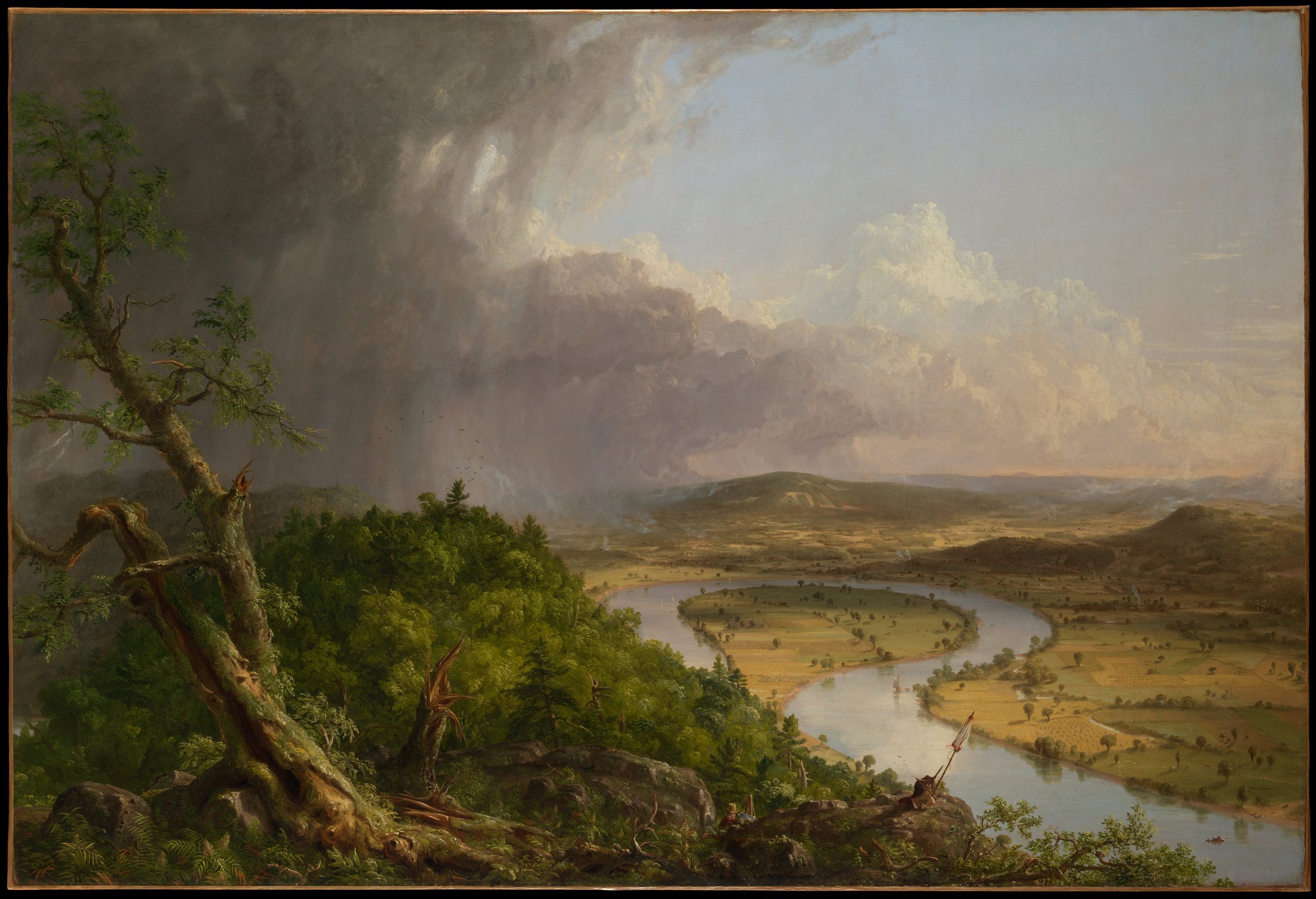
Treat the painting as a map torn open by weather. The near left is dark and wet, its broken tree driving diagonally downward. On the right, the Connecticut River closes into an almost perfect omega, while sunlight divides fields into tiny patches. The drama is not merely dark versus light: at the rotating cloud wall, both worlds keep leaking into each other.
Composition | A diagonal turns landscape into a question
The structural line runs from the upper-left storm to the lower-right valley. Tree, rock, and forest compress the left foreground; river bends, a low horizon, and diminishing fields release depth on the right. The eye catches on the tree, slides down its trunk, then rides the river’s S-curve into the distance.
The oxbow is geography and a huge eye. Near the lower center-right, Cole paints himself at minute scale—red clothing, easel, and a face turned toward us. The panorama suddenly acquires a human measure.
Color | Muted complements share one atmosphere
Olive and sun-dried wheat form the chromatic base, supported by low-chroma river blue and storm gray. Green and yellow-orange establish natural continuity; gray-blue water and sky softly oppose wheat across a blue–orange axis. The left is deep moss, bark brown, and lead gray rather than black. The right is grayed yellow-green, ochre, and mist blue rather than pure yellow.
Practice: 28% dark neutral + 24% moss + 18% mist blue + 20% wheat + 10% warm white. Concentrate darkness on one side, then open cooler and warmer lights across the other. Avoid pure black and saturated yellow. Values are visually sampled by Daily Art.
Light | Not day and night, but weather moving through time
Light sweeps from the right across fields, river, and distant hills. The left forest remains under cloud shadow. Warm light catches the central cloud rim: the storm may be retreating, or blue sky may be disappearing. Because the boundary softens through cloud, ridge, and valley, the painting feels temporal rather than collaged.
Technique | Observed outdoors, orchestrated in the studio
The museum records a clear working chain. Cole drew the view in pencil on site, made a small studio oil sketch to test composition, color balance, and internal rhythm, then completed the large canvas. The result is not photographic transcription: foreground trees become larger and darker, the valley more legible, and the weather more theatrical.
Visual observation: layered brown-greens deepen the left shadows before short light touches pick out leaves and wet surfaces. Thinner, flatter patches articulate the fields, while distant contours soften in haze. This is image-based analysis, not a museum conservation finding.
Artist and context | Landscape as a moral stage
Thomas Cole (1801–1848) was born in England, moved to the United States in 1818, and became a leading American landscape painter whose influence shaped what later became known as the Hudson River School. He wanted landscape to carry historical, religious, and social meaning—not simply offer a pleasing view. The Oxbow was made alongside his five-part Course of Empire cycle; both ask what happens when nature, development, and a nation’s imagined future collide.
The museum describes untamed wilderness at left and cultivated land in sunlight at right, while noting that the contrast supports competing interpretations. The work can celebrate abundance and warn against expansion at the same time.
Why it moves us
The moving boundary—not triumphant sunlight—is the emotional center.
Viewpoint | Daily Art: Cole reduces himself to a speck on the ledge and makes seeing the true subject. When land is understood at once as home, resource, and something sacred, where should a person stand? Beauty arrives with responsibility attached.
Sources and rights
Thomas Cole, View from Mount Holyoke, Northampton, Massachusetts, after a Thunderstorm—The Oxbow, 1836, oil on canvas, 130.8 × 193 cm; The Metropolitan Museum of Art, 08.228.
- Object page and open-access API record
- Preparatory oil sketch and process
- Work context and artist history
- Artist background
The local source is the original JPEG supplied by the museum’s open-access API, downloaded August 24, 2026; the record states isPublicDomain: true. Image rights remain with the original creator and relevant rights holders; verify Public Domain status in your jurisdiction. Object facts are sourced. Composition, color, light, and emotional interpretation are original Daily Art analysis.