The three-second read
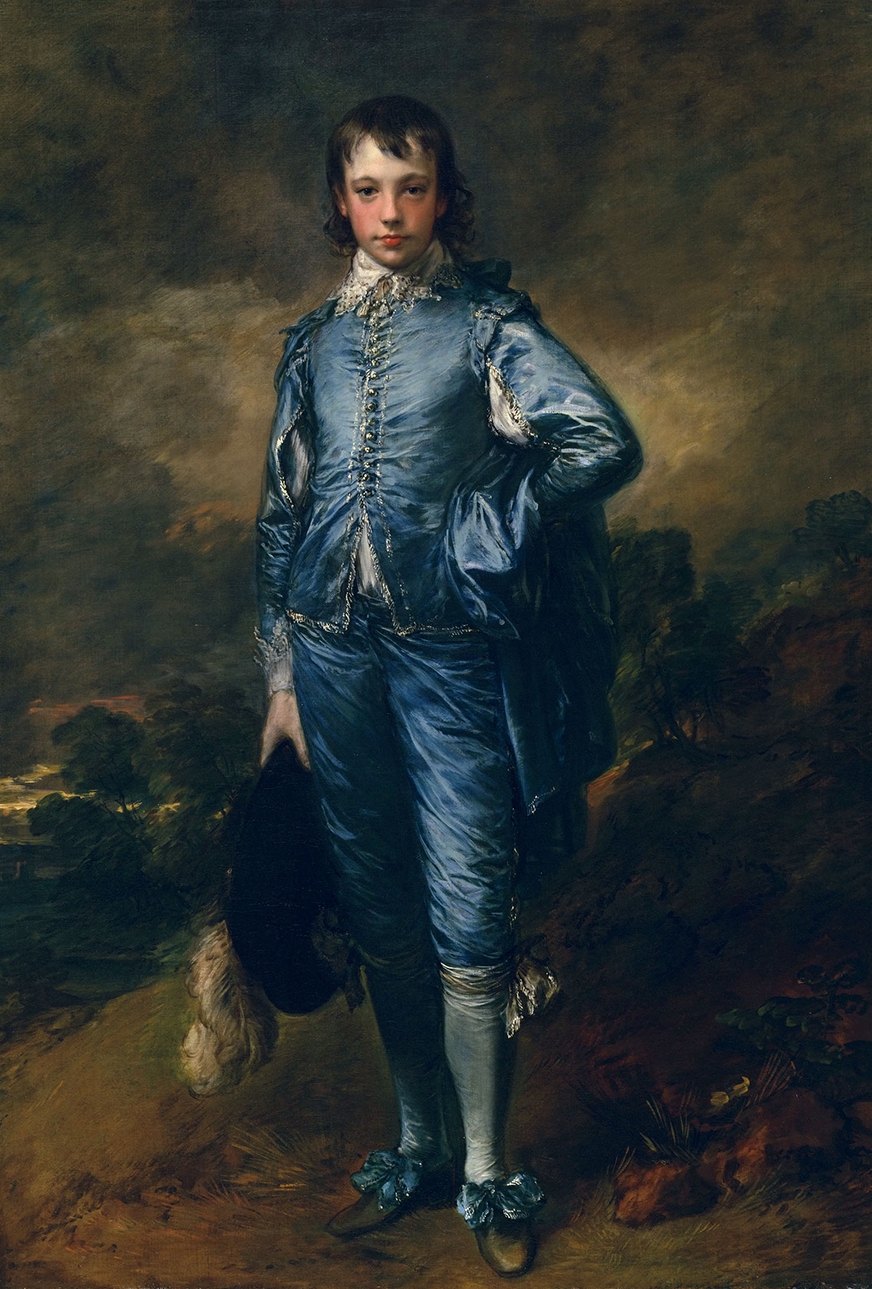
Forget the sitter’s name for a moment. Follow the hand braced at the waist, the advanced left leg, and the dark hat dropping toward the lower edge. The body is still, yet shoulder, elbow, knee, and hat produce a syncopated contour. His frontal gaze holds us while the limbs open diagonally, turning composure into theatre.
Composition | One firm axis, two unequal sides
The figure nearly spans the tall canvas. Head, silver buttons, and forward leg establish a stable axis. The raised elbow expands the right silhouette; the lowered arm and hat add weight to the left. The areas are asymmetrical, but hat, cape, and advanced leg counterbalance one another. It is the confidence of “grand manner” portraiture, with a stance indebted to Van Dyck’s George Villiers.
A low horizon around the waist magnifies the sitter. Water at lower left and the bank at lower right create opposing diagonals. A paler cloud behind the head becomes an atmospheric halo. Landscape advertises stature while preserving the natural world Gainsborough personally preferred.
Color | A blue–orange axis, saturation turned down
The costume moves through an analogous scale from near-black indigo to silver-blue. Technical study identified at least four blue pigments: ultramarine, azurite, Prussian blue, and smalt. Differences in value, temperature, and transparency make the satin rotate through its folds. Smoky brown, olive, and burnt umber occupy the opposite, orange side of a complementary axis. Muting both sides makes the contrast deep rather than loud.
Try it: related blues 65% + smoky brown 20% + warm ochre 10% + silver-white 5%. Wear an indigo coat over slate blue, add brown shoes, then one silver accent. In UI, reserve ochre for controls or captions. Values are approximate screen samples by Daily Art, not pigment measurements.
Light | Not a spotlight—satin making its own weather
Upper-left light reaches forehead, nose, lace, and chest first, then breaks into discontinuous flashes along sleeves and breeches. The face is softly modelled; urgent, elongated strokes cut across the garment. Hard gleam alternating with soft shadow makes us register fabric before outline.
Technique | Satin at a distance, direction up close
Vigorous slashes and fine strokes redirect themselves around chest, elbow, hip, and knee. Step back, and the scattered blues crystallize into satin. X-radiography revealed an abandoned male portrait beneath the image. Infrared and X-ray study also found a dog later covered by foliage. Its removal intensified the sitter’s isolation and monumentality.
Artist and context | Portraits paid; landscape pulled
Thomas Gainsborough (1727–1788) was a leading portraitist in late eighteenth-century England and a founding member of the Royal Academy. He built a successful practice in Bath and later became a favorite of George III and the royal family. Privately, he preferred landscapes and rustic subjects. The Blue Boy compresses both desires into one canvas: courtly scale and pose, surrounded by living cloud, tree, and earth.
Fact boundary: the sitter was traditionally identified as early owner Jonathan Buttall, and the current collection record retains that attribution. The Huntington’s research also stresses uncertainty and cites a scholarly proposal naming Gainsborough’s nephew, Gainsborough Dupont. The 1770 exhibition title—Portrait of a Young Gentleman—remains the safest description.
Why it moves us
Clothing stages a hero; the face keeps a young person’s flush, restraint, and trace of unease.
Interpretation | Daily Art: Blue is both armor and a pocket of cold air around vulnerable skin. We see the person he is expected to become and the person who has not yet finished becoming.
Sources and rights
Thomas Gainsborough, The Blue Boy, 1770, oil on canvas, 179.4 × 123.8 × 2.5 cm; The Huntington, accession 21.1.
- Collection record: object facts and label
- Project Blue Boy: history and sitter identity
- Project Blue Boy: conservation and technical imaging
- The National Gallery: artist background
- Source image: Wikimedia Commons, Public Domain Mark 1.0

Image rights remain with the original creator and any applicable rights holders. The artwork and faithful reproduction used here are marked public domain at the source; verify reuse rules in your jurisdiction. Collection, date, medium, and technical findings are sourced facts. Visual and emotional readings are original analysis by Daily Art.