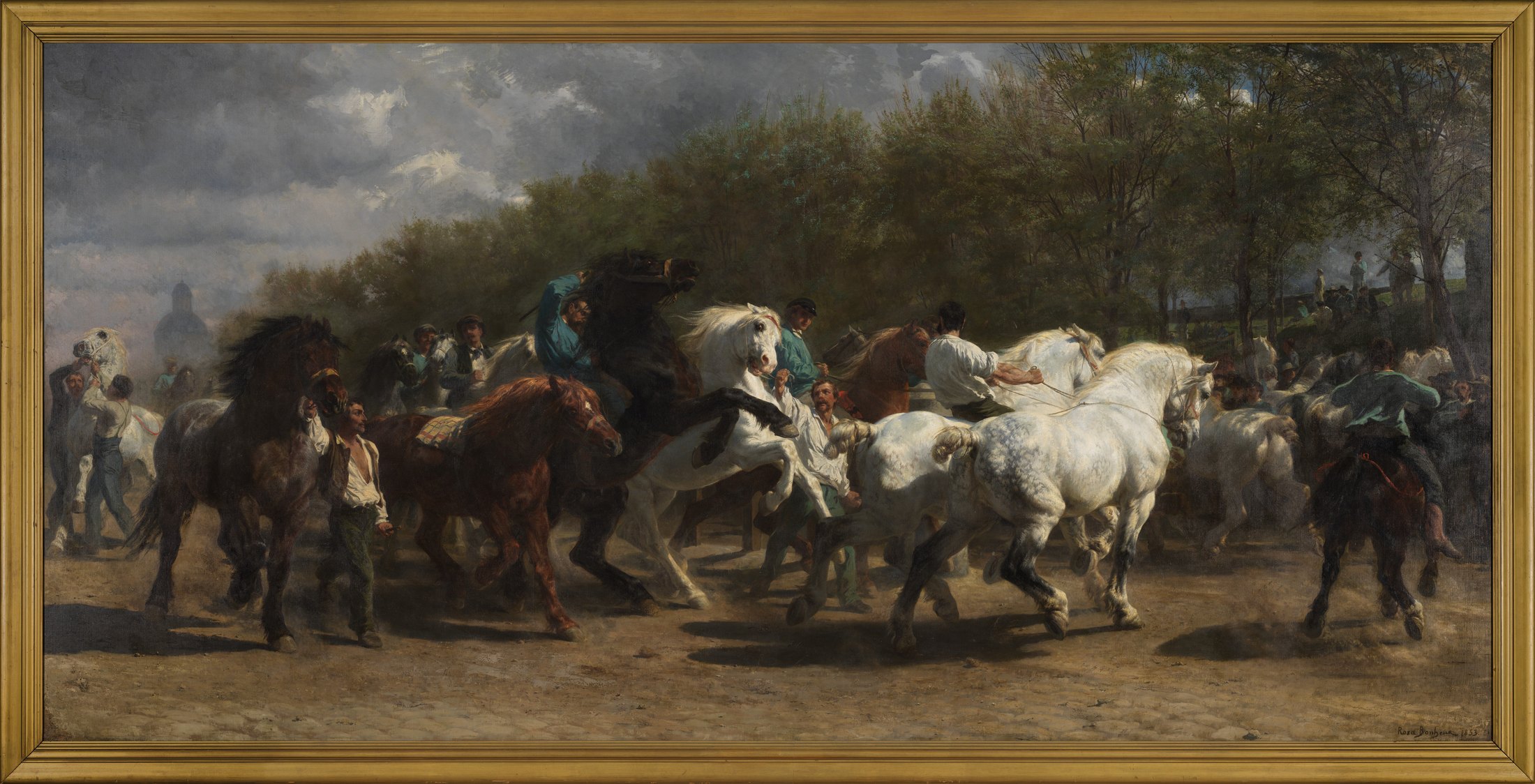
The Horse Fair: A Gallop Across Five Metres of Canvas
Object file | Fact
Rosa Bonheur (1822–1899) began the painting in 1852, showed it at the 1853 Paris Salon, and revised it through 1855. The canvas measures about 244.5 × 506.7 cm and depicts the Paris horse market near Boulevard de l’Hôpital. The museum records that she sketched there twice weekly for a year and a half, dressing in men’s clothing to avoid attention. The painting is held by The Metropolitan Museum of Art as object 87.25.
Composition | A horizontal current bent into a curve
The herd turns along a shallow arc: dark horses anchor the left, raised black and white heads crest near the centre, and two luminous horses drive the force beyond the right edge. A high horizon and low viewpoint enlarge chests and legs; the grove acts as a dark curtain behind the pale horses. Cropped bodies imply continuation beyond the frame.
Daily Art reading: speed comes from the alternating rise and fall of backs, necks, arms, and reins.
Colour and light | Cool resistance inside warm grey
Muted ochres, olive, and charcoal form a warm, low-chroma field. Blue-grey sky and peacock-blue cloth add cool resistance. Rust red and blue green approach a complementary pair, but both are greyed down. The horses are not pure white: warm grey, cool grey, and reflected umber make the eye jump white–black–white.
Cloudbreak light edits the crowd: it skips minor figures and selects raised faces, pale manes, and swelling muscles. Dust dissolves hard edges at ground level, making legs feel anatomically present and motion-blurred at once.
Technique and artist | Animal painting at the scale of history
Bonheur built poses through sustained observation and drawing, then unified the ensemble in oil. Heads and shoulders sharpen; legs, dust, and shadow loosen. Hard edges locate, soft edges accelerate. A monumental format associated with history painting is given to contemporary labour and animal bodies.
One of the nineteenth century’s most successful animal painters, Bonheur repeatedly entered a male-dominated market to draw. That fact explains the work’s observational authority and the gendered public space she navigated.
Why it moves us | Order never erases wildness
Handlers tighten reins and maintain a circuit, yet every horse keeps a direction of its own. From afar, one disciplined curve; up close, raised heads, sidesteps, dust, and refusal. We enjoy the velocity first, then notice that “control” means getting enormous lives to agree only for a moment.
This is a Daily Art interpretation, not an attributed statement by the artist.
Borrow the method | Motion and palette
- High horizon + low viewpoint + one shallow arc; place the brightest mass just right of centre and crop bodies at the edges.
#A47B5535% +#24252225% +#D8D2C220% +#3F463512% +#176B735% +#8B3F2B3%.- Keep faces and shoulders crisp, soften legs and dust. For an outfit: bone base + harness-black accessories + warm-earth outer layer; reserve peacock blue for one accent.