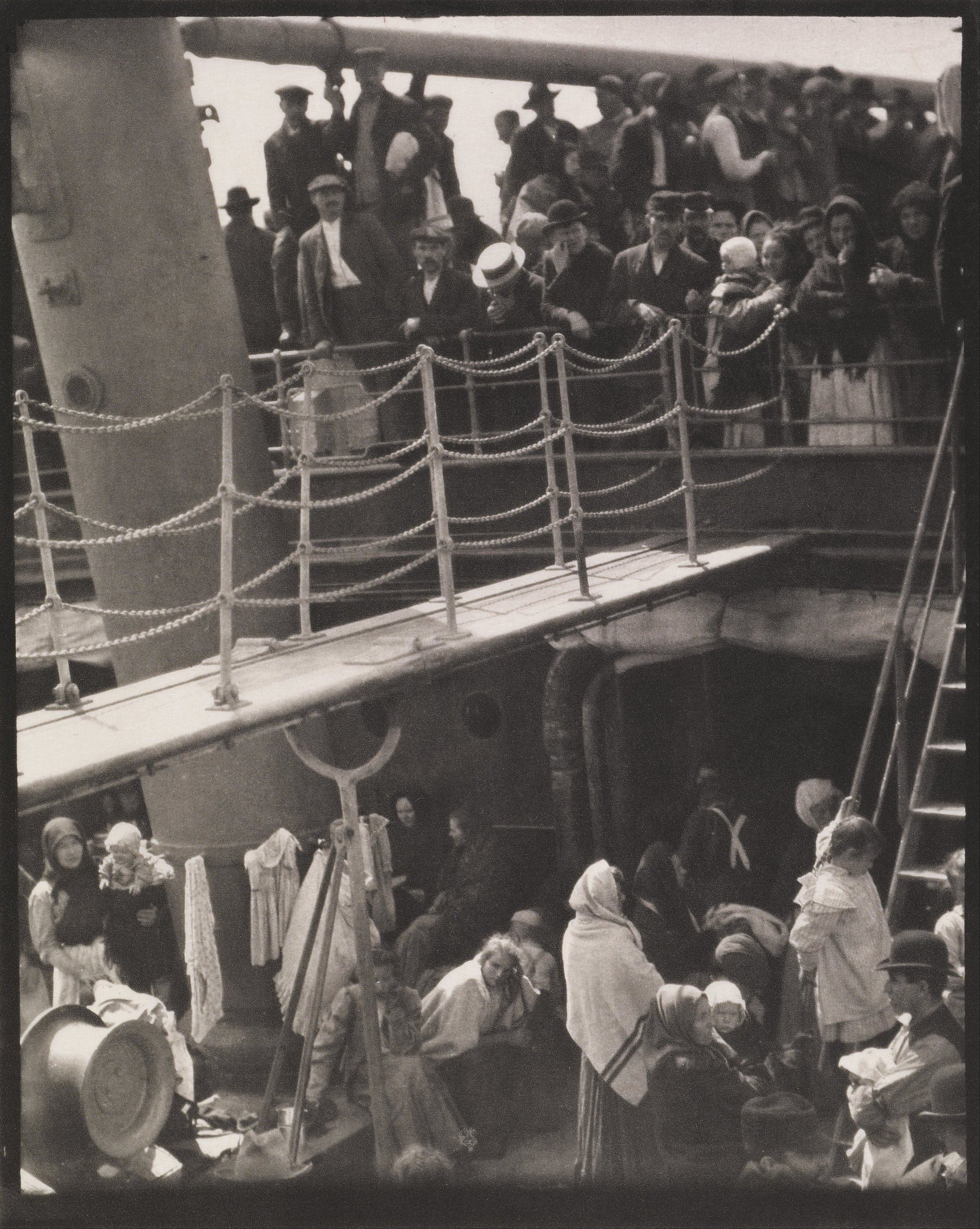
Two decks stitched by a diagonal
Horizontal decks divide the frame; the white gangway reconnects them. A circular hatch, curved rails, and an upright structure form a relay of circle, diagonal, and rectangle. No figure owns the center. People sit like notes of different lengths on a rigid score.
The eye enters along the bright diagonal, scans left, then drops into the denser lower deck. One pale, calm plane near the upper center balances dozens of small incidents.
Monochrome still has temperature and weight
Warm paper gray, charcoal, smoky gray, and a small ivory highlight make a low-chroma value system. Contrast sets the hierarchy; warm support softens the ship's cold geometry.
Design estimate: warm gray 55% + smoke 15% + charcoal 25% + aged ivory 5%; not a conservation color report.
Hard deck light lifts the gangway and metal edges; brims and equipment make short, deep shadows. The strongest highlight falls on a route, not a face: passage is bright, while access stays unresolved.
From instant exposure to modern printed image
Stieglitz exposed the negative in 1907 aboard the Kaiser Wilhelm II while traveling to Europe; museum collections hold later photogravures. The process translates tonal gradation into ink on paper, lending grain and physical weight to the darks. Geometry was recognized at exposure, then unified through cropping and print tone.
Alfred Stieglitz (1864–1946) was an American photographer, publisher, and exhibition organizer who helped place photography inside modern-art discourse. Moving beyond Pictorialism, he increasingly stressed the medium's own clarity and formal power.
Beauty and unease arrive together
We enjoy the precision first, then realize that precision is organizing unequal spaces.
The image does not reduce the lower-deck passengers to a ready-made object of pity. Both levels contain people, while rails, pipes, and gangways remain more legible than faces. Form does not hide humanity; it makes distance tangible.
Fact: the ship was traveling from New York toward Europe, not carrying immigrants into the United States. Interpretation: class, passage, and distance are readings prompted by the divided frame, not claims about every passenger.
Take the visual grammar with you
- Run one high-value diagonal through the frame; stabilize it with two or three horizontals.
- Use 55% warm gray, 25% charcoal, 15% middle gray, and 5% ivory. Check values in grayscale.
- Find an elevated view where stairs, rails, bridges, and crowds overlap. Put the brightest value on the route.
- For layouts, pair warm-gray space with a white line tilted 3–5 degrees; keep type charcoal and metadata smoky gray.
The Steerage, 1907
Alfred Stieglitz (1864–1946); photograph, with cited museum objects in photogravure. Image file: 4150 × 5203 px, from an open-image file page marked Public Domain Mark 1.0.
Art Institute of Chicago · Metropolitan Museum of Art · Open-image file page

Image rights remain with the artist and applicable rights holders. The source marks this file as public domain; reuse rules may vary by jurisdiction. Object facts follow museum records. Composition, palette, light, and emotional readings are original analysis by Daily Art.