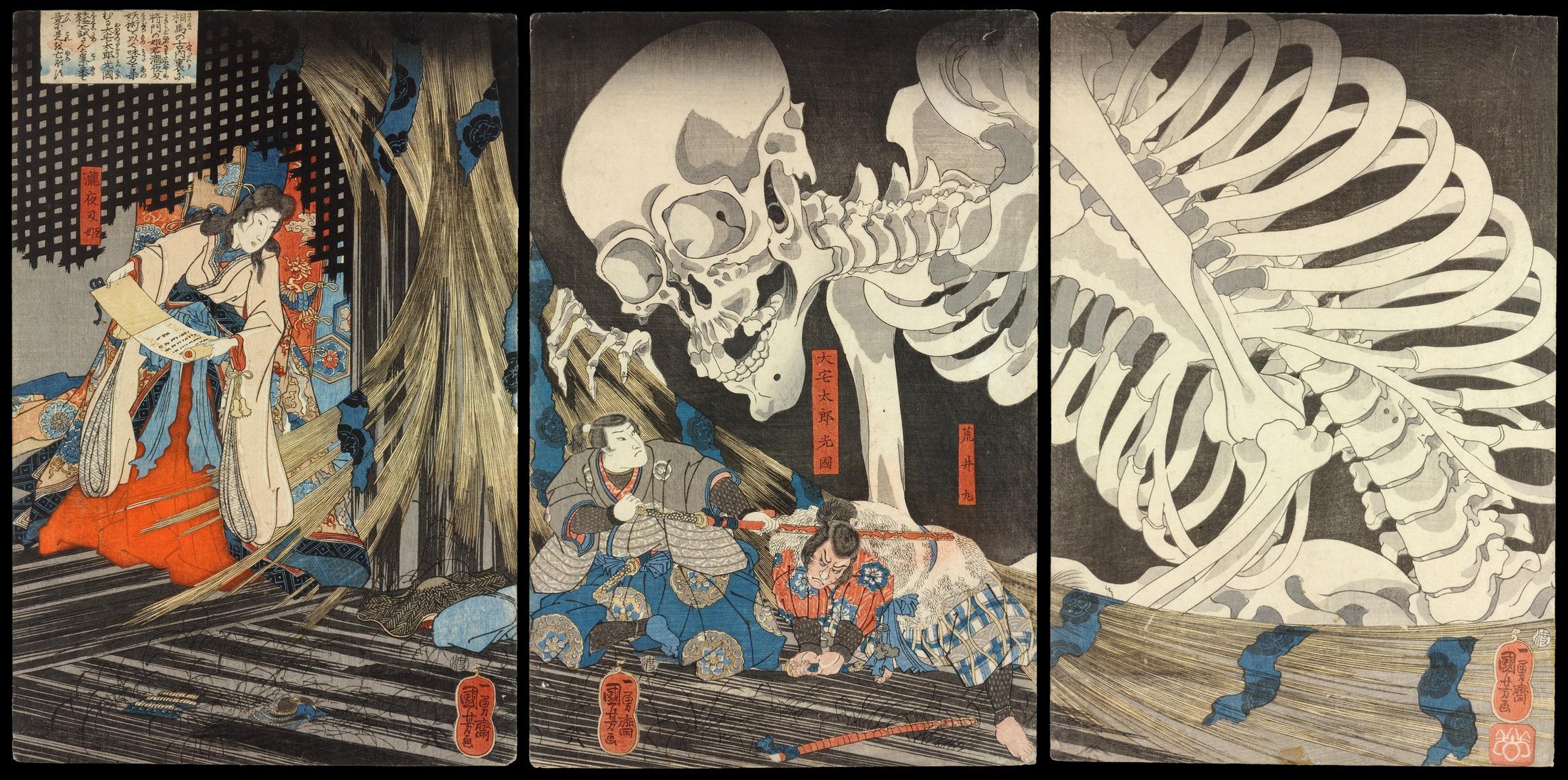
A colossal skeleton tears through ruined blinds and looks down with empty sockets. Princess Takiyasha reads an incantation at left; Mitsukuni stands his ground at right. Ribs, fingers, and skull cross the seams, giving fear a scale the triptych can barely contain.
Three sheets,
one breath
The vertical joins could split the scene into episodes. Instead, the skeleton becomes a horizontal hinge. Its skull bears down near upper centre, the spine arcs right, and a hand reaches into the room. Torn blinds drive down one diagonal; garments and weapons answer on the reverse, forming an interlocked X.
Living figures occupy the lower half: small in scale, quick in movement. The spectre is vast and slow. The eye meets the immeasurable before returning to human conflict.
“Horizontal hinge” and “X-shaped field” are Daily Art's visual analysis, not an artist's diagram.
A muted
split complementary
Warm beige and iron red sit on one side, cool indigo on the other, while charcoal stretches the values. The skeleton is nearly the colour of the paper, as if growing from it. Broken red accents pulse like warnings; blue-grey makes the bodies recede and the bones advance.
#D8C6A0
Ratios and hex values are screen-based estimates. Impression, paper ageing, and digitisation vary.
The void arrives
before the highlight
Weight comes from contour, overlap, and black cavities. Sockets, nasal opening, and mouth become visual wells. Below, forms are dark and fragmented; above, the skull is broad, pale, and still. Terror is a calm shape held in darkness.
Museum records describe a colour woodblock triptych on paper. A key block holds the ink contour; separate blocks register the restrained colours. Lines tighten around teeth, sockets, and joints, then relax along long bones: anatomy becomes rhythm.
Courage is
unequal scale
Utagawa Kuniyoshi (1797–1861), a pupil of Utagawa Toyokuni I, became a major late-Edo print designer celebrated for warriors, bizarre invention, and comedy. He renders the spectre as a legible skeleton, not a chaotic heap of bones. Restraint makes the impossible persuasive.
Mitsukuni is not calm because he is large enough to win. His courage exists because the thing above him is irrationally immense.
The seams remain visible. Illusion crosses three sheets while the medium honestly reveals its boundaries. This is Daily Art's interpretation, not a documented statement by Kuniyoshi.
Borrow its scale for
posters, outfits, and film
- Palette: paper beige 65% + charcoal 18% + faded indigo 10% + iron red 5% + old gold 2%.
- Composition: span one large form across two or three columns; compress people into the lower 35%; counter one dominant diagonal.
- Suspense: skip gore. Make sockets, doorways, or shadows the largest black shapes; keep the pale subject's contour complete.
- Outfit: beige outerwear 60% + charcoal trousers 25% + blue-grey layer 12% + dark red accessory 3%.
Utagawa Kuniyoshi, The Old Palace at Soma, 1845–46. Colour woodblock triptych on paper; one museum impression measures 36.8 × 74.1 cm overall. British Museum, 2008,3037.20106.
Facts: object record, artist record. Image: Wikimedia Commons, 7139 × 3550, Public Domain Mark 1.0. Reuse rules may vary by jurisdiction.
