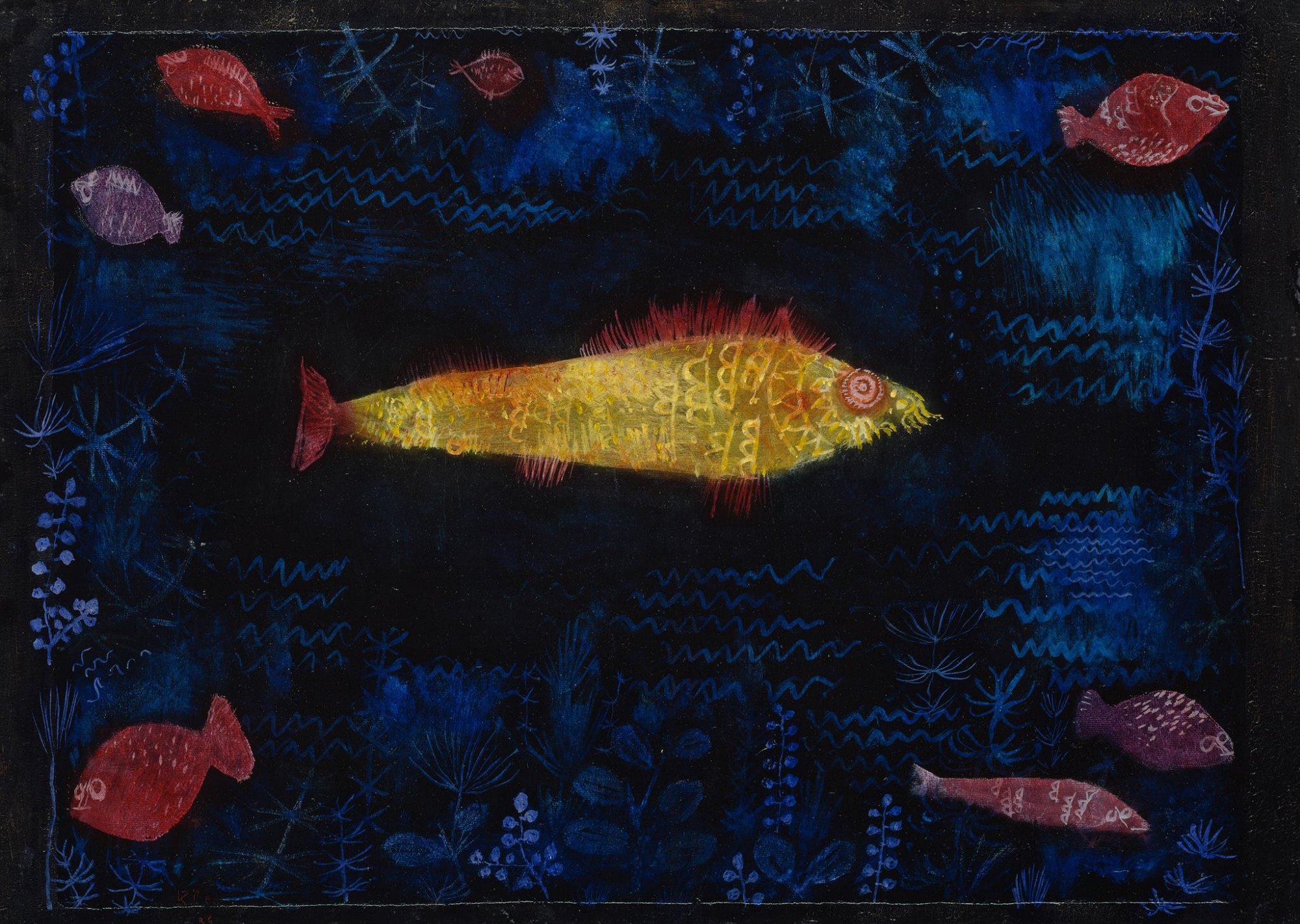
A goldfish seems to switch itself on. Smaller fish, plants, and ripples become a hushed chorus around one gold-red note.
Paul Klee paints not the transparency of water, but its mystery. The space reads at once as pond, blackboard, and cosmos.
A center with
forward thrust
The main fish sits just below center, its long axis spanning the sheet. The pointed mouth pushes right while tail and fins radiate backward. Seven smaller fish gather at the edges in a loose orbit. A broad zone of negative space insulates the protagonist from visual noise.
Viewing analysis: the aquarium-like frame and orbital perimeter are readings by Daily Art, not diagrams supplied by the artist.
Unequal areas make
the gold luminous
Blue-black and ultramarine occupy roughly four-fifths of the image. Ochre gold, lemon yellow, and vermilion concentrate in the main fish. Near-complementary blue and orange, plus the large low-value field, intensify yellow through simultaneous contrast. The brightest yellow belongs to one body alone.
No lamp—
only relationships
No visible source or cast shadow creates the glow. It comes from value, temperature, and saturation contrast. Dense marks inside the fish—strokes, dots, curls, translucent layers—make it optically advance.
Collection records identify oil and watercolor on paper mounted on board, 49.6 × 69.2 cm. Watercolor supplies bloom and transparency; oil adds coverage and density. Lines, circles, zigzags, and plant signs form a concise visual grammar instead of naturalistic description.
The brightest body
is also the farthest apart
Made during Klee's Bauhaus tenure, the painting reflects an artist steeped in music and formal teaching. His images often work like scores, arranging rhythm, accent, and pause instead of copying appearances.
The largest fish owns the brightest color and richest texture, yet black water separates it from the group. Difference looks proud and lonely at once. Darkness is not defeated; it becomes the condition for radiance. This is a perspective by Daily Art, not a quotation from Klee.
An inner-glow formula
for image and wardrobe
- Palette: blue-black 55% + deep ultramarine 25% + ochre gold 10% + vermilion 7% + lemon yellow 3%.
- Glow: low-value cool field → ochre edge → yellow-orange core → very little bright yellow. Skip the white halo.
- Composition: one horizontal form at about 55% of the width, just below center; 5–7 small perimeter forms and a clean central buffer.
- Wear it: ink navy 70% + ultramarine 20% + ochre gold 8% + vermilion 2%; keep gold to one accessory.
Paul Klee, Der Goldfisch (The Goldfish), 1925. Oil and watercolor on paper mounted on board; 49.6 × 69.2 cm. Hamburger Kunsthalle, HK-2982.
Facts: collection record, Bildindex, and Zentrum Paul Klee. Image: Wikimedia Commons, Public Domain Mark 1.0; verify reuse rules in your jurisdiction.
