A human ladder
growing upward
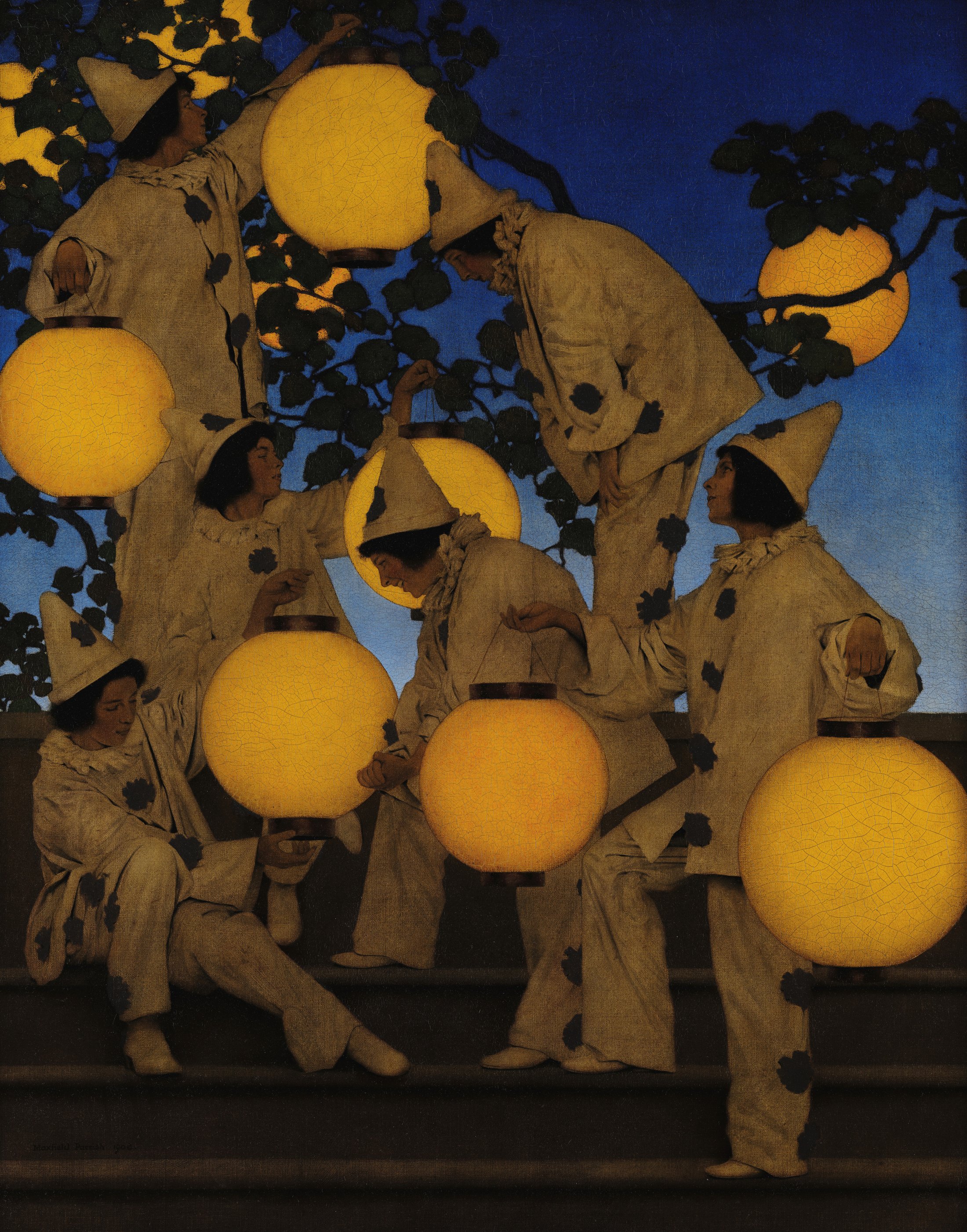
The figures climb from lower left to upper right along a dominant diagonal. Arms, legs, and cords subdivide the ascent into linked triangles. The largest lantern sits near the visual center, yet no face fully confronts us: action carries the eye onward before portraiture can stop it.
Horizontal steps stabilize the lower half; canopy and sky become nearly flat fields above. Masonry reads as a stage, tilted bodies as an improvisation. Four distant spheres remain unresolved—even the museum asks whether one is the moon. Ambiguity gives the shallow set unexpected depth.
Complementary blue and orange,
softened
Deep cobalt #163B67 and lantern gold #F2B53F form the main complementary pair. Low-value blue fills the field and recedes; high-value orange-gold advances in small doses. Dusty violet, rose gray, and graphite bridge the opposites, keeping the palette atmospheric rather than harsh.
It is a nocturnal 70/20/10 rule: about 70% blue-black atmosphere, 20% muted figures and stone, and 10% golden light. Warm marks recur like beats.
A gradient,
not a white dot
Pale yellow centers shift into amber and caramel before dissolving into blue. Nearby limbs catch warmth; unlit faces become silhouettes. One bright lantern anchors the center while the others ascend along the diagonal, leading the eye like a phrase of rising notes.
The radiance comes mainly from value contrast plus simultaneous warm–cool contrast, not from large areas of white. This is Daily Art’s visual analysis, not a documented palette statement by the artist.
Painting with
a printer’s intelligence
The collection page notes that Parrish layered pure pigment and varnish to create brilliant depth. Transparent layers let lower colors remain visible, approaching stained glass; crisp contours and staged color masses stay legible when reduced in print. The oil painting—canvas mounted on board—was completed in 1908 and reproduced for the December 10, 1910 issue of Collier’s.
Stagecraft, illustration,
and “Parrish blue”
Maxfield Parrish (1870–1966) was an American painter and illustrator whose career crossed books, magazines, and commercial imagery. He combined academically modeled bodies, theatrical space, and controlled glazing into an instantly recognizable language of blue nights and dreamlike illumination. The work is now at Crystal Bridges Museum of American Art, accession 2006.71.
The glow belongs
to a chain of cooperation
Nothing monumental is happening: a group is simply putting up lights. Yet every figure must receive another person’s weight, cord, or glow. Clown costumes suggest play; taut poses reveal effort. Joy and risk, ornament and labor, all share one diagonal—and that tension keeps the image alive beyond its beauty.
Bring this blue-gold light
into your own frame
- Night palette
Deep cobalt 55% + blue-black 15% + dusty violet 15% + rose gray 5% + lantern gold 10%. - Glow recipe
Center #FFE7A0 → middle #F2B53F → edge #B56B21; add one low-opacity amber halo. - Group composition
One rising axis + 3–5 body triangles; horizontal lines stabilize, circles create pauses. - Outfit translation
70% midnight blue + 20% dusty violet + 10% amber. Scarcity makes the warm note shine.
Facts, credit, and rights
- Maxfield Parrish, The Lantern Bearers, 1908; oil on canvas mounted on board, image area approximately 101.6 × 81.3 cm.
- Crystal Bridges Museum of American Art, accession 2006.71. The museum’s 139.1 × 116.8 × 11.4 cm measurement includes the frame.
- Fact sources: Crystal Bridges collection record; Christie’s object record.
- Image: Standard Ebooks high-resolution image and public-domain research, 7890 × 10054. It reports no US copyright restrictions and cautions that other jurisdictions may differ; Wikimedia Commons likewise marks it public domain in the US.

Image rights remain with the original creator and any applicable rights holders; verify status for your jurisdiction and use. The appreciation is original analysis by Daily Art, with facts and interpretation distinguished above.