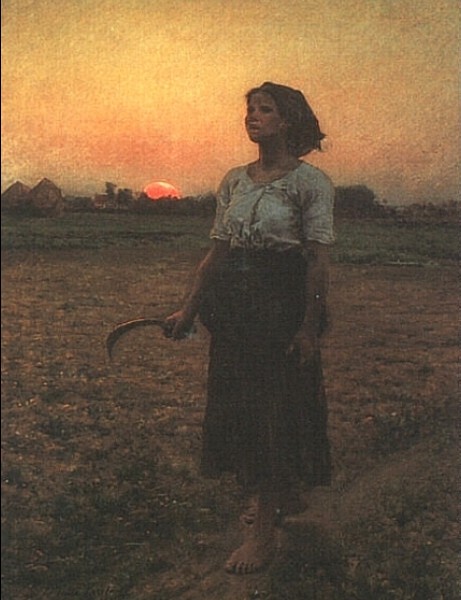
A barefoot field worker stands in harvested earth, her sickle still hanging at her side, her body suddenly paused. Breton never paints the lark. The real subject is the act of hearing: her lifted face, interrupted step, and the red sun breaking at the horizon turn a few seconds between tasks into an immense interior space.
Composition | One figure, two scales
Set just right of centre, the figure rises from the lower edge deep into the sky. Her upright body counters the low horizon. The sickle, lowered arm, and forward foot retain the momentum of walking, while her gaze pulls us beyond the upper frame. An invisible bird gains a precise location.
The horizon sits near the lower third. Roofs and trees compress into a dark band; furrows converge gently without spectacle. The broad sky is not empty background. It is room for sound to travel.
Colour | Warm and cool tones changing shifts
The sky moves through honey gold #D7A04F and apricot orange #C87943 into smoky blue-green #66756F; earth and skirt settle into peat brown #40382B. Greyed green mediates the temperature change, keeping the image warm but never sugary.
The faded blue-green blouse is the hinge, gently complementing the orange sun while sharing the earth's low saturation. The red sun takes less than one percent of the image, yet its warmth and clean circle make it the secondary focal point.
Light | Backlight turns a face into listening
The sun rises behind and to her left. Face and skirt stay largely in shadow; blouse, cheek, and arm catch a thin wash of ambient light. The sky holds the brightest values, the lower figure the darkest. Luminosity descends like a day not fully open.
Technique | Academic realism, modern restraint
The museum records oil on canvas. Figure, anatomy, and folds are carefully modelled; field and distance become broader and quieter through horizontal strokes and reduced contrast. Detail thins outward from the body. Breton's rural vision is idealized: materially attentive to tool and posture, but shaped into poetry rather than offered as documentary evidence.
Artist and context
Jules Breton (1827–1906) was born in Courrières in northern France and became known for idealized scenes of rural labour. The museum identifies this as a young worker pausing at dawn to hear a distant lark. Painted in 1884 and shown at the Paris Salon in 1885, the canvas later entered the Art Institute of Chicago.
Why it moves us
Hope appears here not as triumph, but as attention. The sickle stays in her hand; the hard field does not disappear. Only her gaze changes. One unseen note briefly allows her to belong to more than the task in front of her.
This is Daily Art's interpretation, not a quotation from the artist. Dates, medium, dimensions, and collection details follow the museum record.
A formula to borrow
- Palette: peat brown 45% + honey gold 25% + smoky blue-green 20% + faded sage 9% + sunrise red 1%.
- Frame: horizon on the lower third, figure about 5% off-axis, open sky above the head at roughly 35% of figure height.
- Backlight: background 1.5–2 stops brighter than the subject; retain a fine edge reflection and resist lifting every shadow.
- Outfit: peat-brown bottoms + greyed sage top + honey scarf; reserve orange-red for one tiny accent.
Work and sources
Jules Breton, The Song of the Lark, 1884, oil on canvas, 110.6 × 85.8 cm. Art Institute of Chicago, Henry Field Memorial Collection, 1894.1033. Facts: collection record and museum essay. Image: Wikimedia Commons, 461 × 600, Public Domain Mark 1.0; the museum record also marks the image CC0. The museum IIIF download returned HTTP 403 in this environment, so the downloadable reproduction above was used. Image rights belong to the creator and any applicable rights holders. Appreciation text is original Daily Art analysis. Verify reuse status for your jurisdiction and intended use.
.jpg)