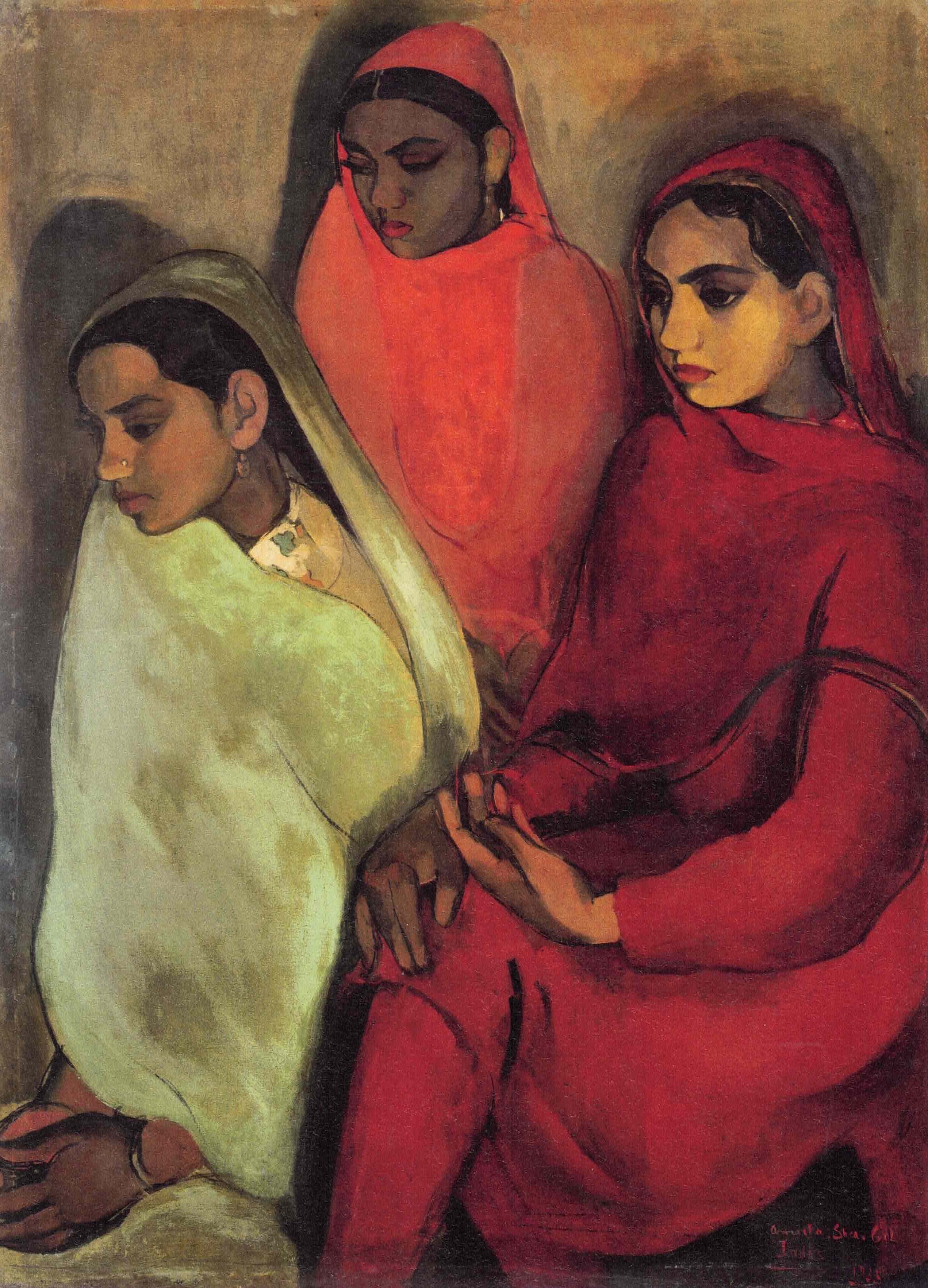
Begin with the eyes: none meets ours. Three bodies press close enough to fill the frame, yet each gaze settles in a different inward direction. No incident drives the picture. Downcast eyes, overlapping colour fields, and weighty hands already carry its quiet intensity.
Composition | Three masses, one descending rhythm
The figures form an uneven triangle. The central head sits highest; the flanking bodies open downward, stable but slightly off-axis. Legs and setting are cropped away, pushing the sitters toward us like three compressed sculptures. Pale green is the largest light field, deep crimson the heaviest dark, and coral binds them.
Left looks down and outward, centre drops almost vertically, right turns across the picture. Their glances circulate inside the group but never exit toward us. Overlapping hands act like a delayed full stop, returning the eye from face to body.
Colour | Complementary, never festive
Red and green create complementary tension. Yet the green is desaturated and every hue is held inside a brown-grey atmosphere, turning opposition into a grave harmony. Value, chroma, and weight belong to different figures: left is lightest, centre most saturated, right darkest.
#8A7256
#C84F3D
#8F2638
The group coheres without giving any one sitter total control. Saturated colour functions as structure, not a mood label.
Light | Volume grows from inside colour
There is no theatrical spotlight. Foreheads, noses, and hands lift slightly; eye sockets, necks, and folds settle into charcoal brown. Faces and cloth turn through broad, slow bands of value. Three dark halos read as cast shadows and as silence spreading beyond each body.
Even the palest green is dusted with grey. Light does not stage an event here; it gives skin, shawl, and robe tactility and weight.
Technique | Firm structure, flattened fields
Fact: the collection lists oil on canvas pasted on board and describes the flattened figures as part of Sher-Gil's changed visual language after returning to India. Heads, hands, and shoulders retain volume, while garments expand into broad fields and spatial detail recedes.
Visual analysis: contours alternate between incision and absorption; thin background meets denser cloth. Pattern is withheld. Pose, skin, and colour carry presence instead. This is a modern group portrait organised by weight and withheld gaze.
Artist | Resetting coordinates between Europe and India
Amrita Sher-Gil (1913–1941) was born in Budapest to an Indian-Hungarian family. From 1929 to 1934 she studied in Paris at the Académie de la Grande Chaumière and the École des Beaux-Arts, returning to India in 1934.
The collection identifies this as her first painting after that return and records a gold medal from the Bombay Art Society; the accession is 982. It also notes flatter figures and a newly emphatic brilliant red. Sher-Gil died at twenty-eight, already a central coordinate of Indian modernism.
Why it moves | Intimacy is not arrival
The women sit close, but the image gives us no conversation to overhear. It supplies no fixed cause for sadness and does not ask us to speak on their behalf.
This is the reading of “Daily Art”: the sitters are not waiting for our explanation. Within a shared frame, each retains a space we cannot enter.
Borrow the visual logic
- Palette: 35% warm umber + 25% coral vermilion + 20% deep crimson + 15% greyed olive + 5% charcoal brown.
- Styling: grey-olive wrap + deep-crimson dress + one coral layer; keep metal jewellery to a single accent.
- Portrait: stagger three head heights and direct gazes down-left, straight down, and toward another sitter; crop close at 50–85mm equivalent.
- Layout: assign the largest light, highest chroma, and deepest dark to separate modules.
Object, sources, and rights
Source facts: Amrita Sher-Gil, Group of Three Girls (also titled The Three Women), 1935, oil on canvas pasted on board, National Gallery of Modern Art, New Delhi, accession 982. The public file measures 2542 × 3528 px. Secondary records conflict on object dimensions, so no unverified measurement is repeated here.
Collection and artist context · Image and rights

Rights: the file page marks the artwork and faithful reproduction as public domain / Public Domain Mark, while noting possible exceptions in a few longer-term jurisdictions. Verify the rules for your location and use. Image rights remain with the original creator and applicable rights holders.
Fact and interpretation: date, medium, collection, education, return, award, and the collection's formal description are source facts. Composition, palette ratios, light, tactility, and emotion are original visual analysis by “Daily Art.”