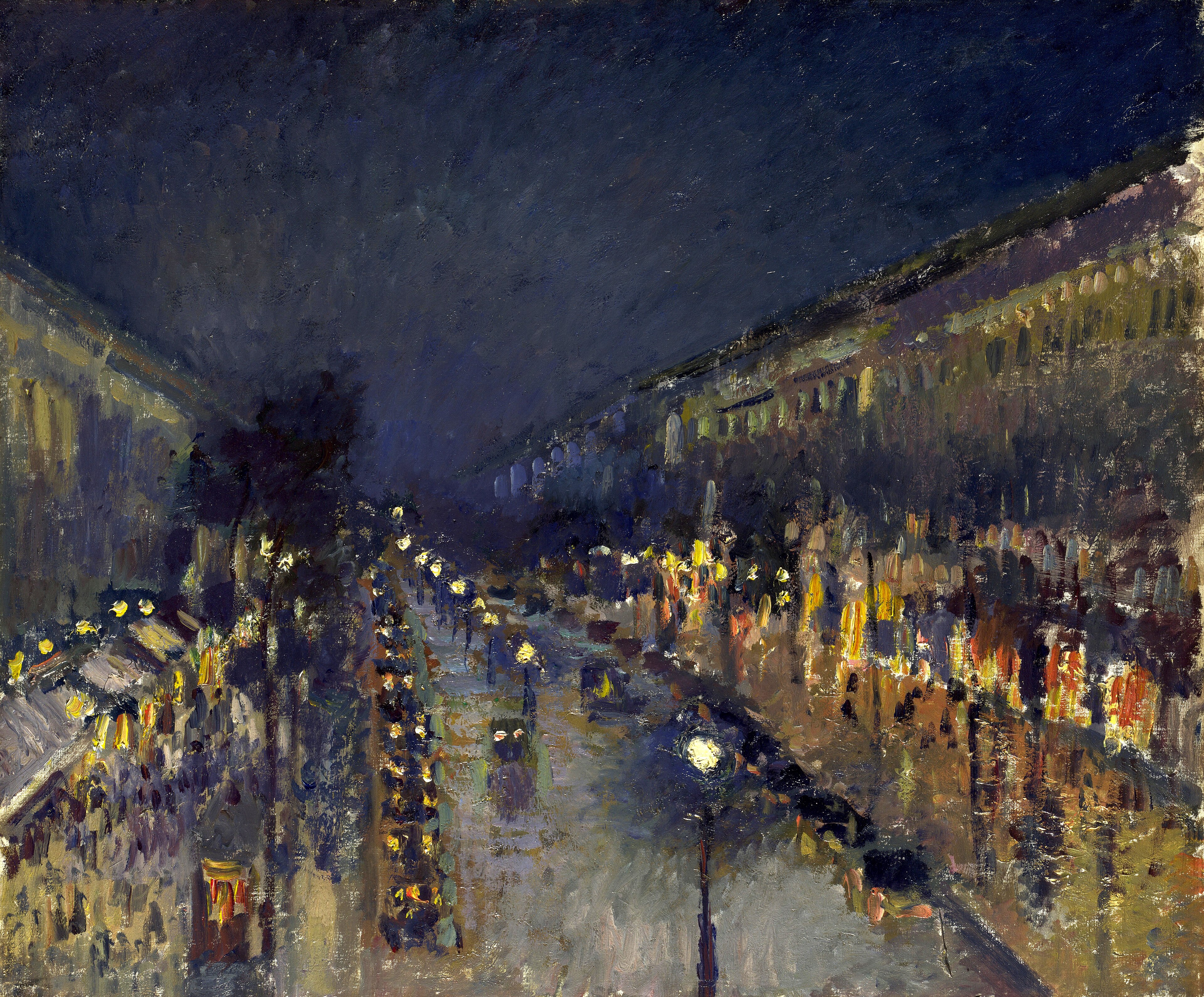
Forget the street name for a moment. Squint, and the scene almost becomes abstraction: a blue-violet wedge narrows toward the distance while white, amber, orange, and red pulses stream along its edges. This is not postcard romance. It is a sensation held together by perspective.
Composition | Two V-shapes pull the city into night
The elevated view comes from a hotel room. Rooflines, pavements, carriages, trees, and lamps converge at a vanishing point just left of centre, forming a V that tightens into the distance. Above it, the night sky opens as an inverted V. The street pulls inward; the sky releases upward.
The balance is deliberately uneven. Brighter, denser shopfronts activate the right, while darker architecture gives the left more weight. People are reduced to marks, yet broken strokes retain the rhythms of waiting, passing, and near-collision.
Colour | Small warm lights puncture a large cool field
The ground note is ink blue, indigo violet, and wet slate. Amber, cream, and signal red arrive as small, high-value accents. Blue-violet and yellow-orange are near complements, but never equal partners. Warmth behaves like a pulse, not a filter.
The collection record distinguishes the cool white of electric lamps from warmer gaslit shops and oil lamps on waiting cabs. Technology becomes visible as colour temperature. Rain doubles those points into reflections, adding lateral shimmer to the diagonal perspective.
#17233B
#34324A
Light | No moon, yet the painting glows
This is an almost entirely artificial night. A foreground street lamp is built from thick, pale paint and edged with indigo, making the white feel brighter. Farther lamps shrink and multiply, opening depth. Buildings are never fully illuminated; light registers as partial signals on windows, cornices, and wet stone.
Pissarro avoids a single dead black. Blue, violet, and grey-green remain active inside the shadows, so darkness still contains air. This is not a black ground with lights added on top, but a full set of low-value colour relations.
Technique | From Pointillist discipline to breathing marks
Pissarro experimented with Neo-Impressionist divisionism in the 1880s, then moved away from its strict procedure. Here, dashes, daubs, and thicker touches coexist. Up close, the surface breaks apart; at distance, it resolves into traffic, trees, crowds, and glare. The collection notes repainted passages, so its immediacy is constructed rather than careless.
Direction does the descriptive work: lamps become dots, reflections become vertical strokes, and traffic becomes lateral or diagonal fragments. The brushmark itself performs light and speed.
Artist | A painter of fields confronts the electric city
Camille Pissarro (1830–1903) was born on Saint Thomas in the Caribbean and worked mainly around Paris. A central Impressionist organiser, he was the only artist to exhibit in all eight Paris Impressionist exhibitions from 1874 to 1886.
In 1897, nearing seventy, Pissarro rented an upper-floor hotel room and painted fourteen views of this boulevard in snow, rain, fog, morning, sunset, and other conditions. This is the only nocturne in the group—and his only night painting. The fixed viewpoint became an experimental apparatus; weather, time, and activity were the variables.
Why it moves us | Structure holds; experience flickers
Perspective makes the city rational, then rain and fractured paint make that order shimmer. A precise vanishing point anchors the distance, while no foreground passer-by receives a face. We occupy two positions: observer above the flow and participant caught in its velocity.
The seduction and solitude of modern life share one wet surface.
A visual recipe to borrow
- Palette: 45% ink blue
#17233B+ 25% indigo violet#34324A+ 15% slate#59606C+ 10% amber#D89B42+ 5% signal red#A64B36. - Photography: Shoot a diagonal street from one storey above after rain. Underexpose roughly 1/3–2/3 stop to protect lamps and signs.
- Styling: Ink-blue coat + charcoal trousers + one amber scarf or bag; reserve red for a tiny detail.
- Layout: Aim a V-shaped leading line at an off-centre vanishing point. Keep warm information to 10–15% on a deep cool field.
Object record, sources, and rights
Source facts: Camille Pissarro, The Boulevard Montmartre at Night, 1897, oil on canvas, 53.3 × 64.8 cm, The National Gallery, London, NG4119.
Collection record · Artist profile · Image and rights

Rights notice: The public file page marks the artwork and its faithful two-dimensional reproduction as public domain / Public Domain Mark. Verify reuse conditions for your jurisdiction and context. Image rights remain with the original creator and applicable rights holders.
Analysis boundary: Date, medium, dimensions, collection, series size, lighting types, and biography are sourced facts. Composition, palette ratios, brushwork rhythm, and emotional reading are visual analysis by “Daily Art.”