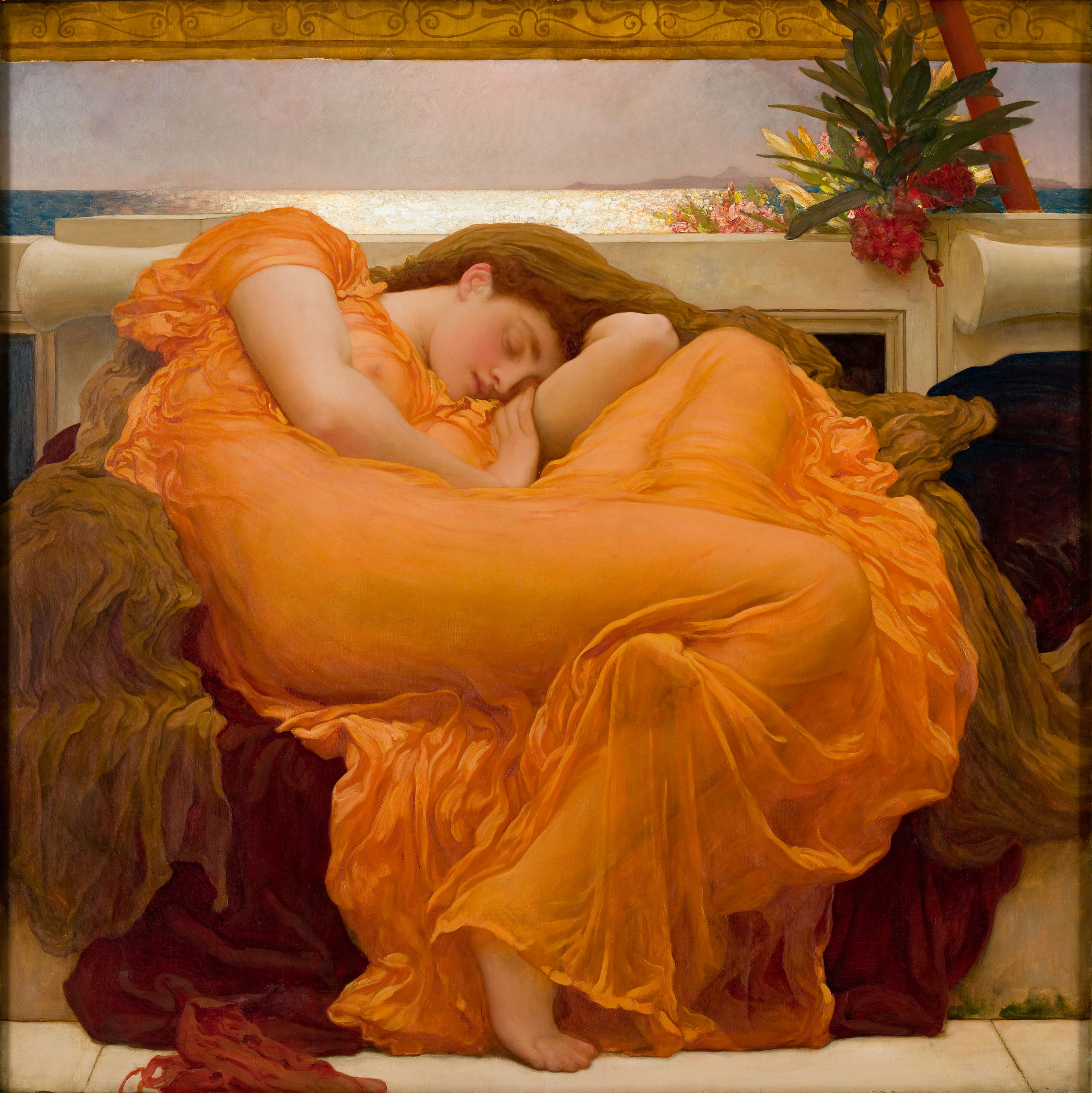
She is asleep, yet the painting seems to burn. The pose rests while the colour moves and radiates heat.
Composition
Circle / Square
Inside the nearly square canvas, head, back, arm, knees, and bare foot connect into an almost sealed oval. The stable square and circulating curve turn a plausible sleeping pose into a precise ornament. A forearm crosses the centre like a latch; the leg and balustrade provide verticals that steady the whirl of drapery.
The figure presses against the frame, trapping heat, while the narrow sea above becomes a visual vent. Oleander echoes the curve of the back. Its presence is fact; latent danger remains an interpretive association.
Colour
Warm Dominance
Apricot, flame orange, and burnt umber create a temperature gradient. Peach skin bridges body and cloth. Misty blue-grey and muted green-grey occupy little space but provide essential cooling.
Orange and blue form a near-complementary relationship, but not an equal one: warm colour claims roughly seventy percent and cool colour stays at the edge. That imbalance makes orange hotter and sleep deeper. Face, shoulder, and knee form three pale islands that move the eye around the circular pose.
Light
Through Gauze
Soft light produces almost no theatrical cast shadow. It passes through gauze: one layer glows, overlaps deepen, and folds gain weight without losing their flame-like lift. The distant landscape lowers contrast and saturation. Cool distance is what pushes warm proximity forward.
Technique & Artist
Classical / Aesthetic
Frederic Leighton (1830–1896) was a British painter and sculptor who served as president of the Royal Academy. Academic training and classical figure study supply a convincing armature; thin, controlled oil layers distinguish skin, gauze, stone, and air.
The collection record places the work within Aestheticism, where form, colour, and sensory beauty matter more than a complete narrative or moral. Completed in 1895, this late work compresses decades of figure study into one gesture. Its broad orange field and emphatic contour can feel unexpectedly modern.
Why It Moves Us
Our Reading
The painting gives the body a moment in which it need not perform: colour strikes first, then silence keeps us.
The sleeper does not return our gaze or carry a clear dramatic role. Her curl can suggest protection or surrender; orange can read as summer heat or an inner ember. The work refuses to decide for us.
Steal the Formula
Practical Recipe
- Poster or interior: flame orange 70% + apricot 15% + mist blue-grey 10% + burnt umber 5%. Give a hot field one cool breathing seam.
- Outfit: orange hero piece + peach-neutral base + blue-grey bag or shoe. Keep the cool accent near 10%.
- Photography: shape the subject into a closed C-curve; use broad soft light and preserve translucent overlaps.
- Layout: centre a square image and use a slim cool-grey margin to temper saturation.
Object & Sources
Documented facts: Frederic Leighton, Flaming June, 1895, oil on canvas, 119.1 × 119.1 cm, Museo de Arte de Ponce, object 63.0406.
Collection record: Museo de Arte de Ponce · Image and rights: Wikimedia Commons file page. Original image: 2550 × 2552 px, downloaded from that page.
.jpg)
Rights: The artwork and faithful two-dimensional reproduction are marked public domain / Public Domain Mark on the source page. Rules may vary by jurisdiction and purpose; verify where necessary. Image rights remain with the original creator and relevant rights holders.
Boundary: Date, medium, dimensions, collection, and biography are sourced facts. Formal, colour, light, emotional, and symbolic readings are analysis by Daily Art.