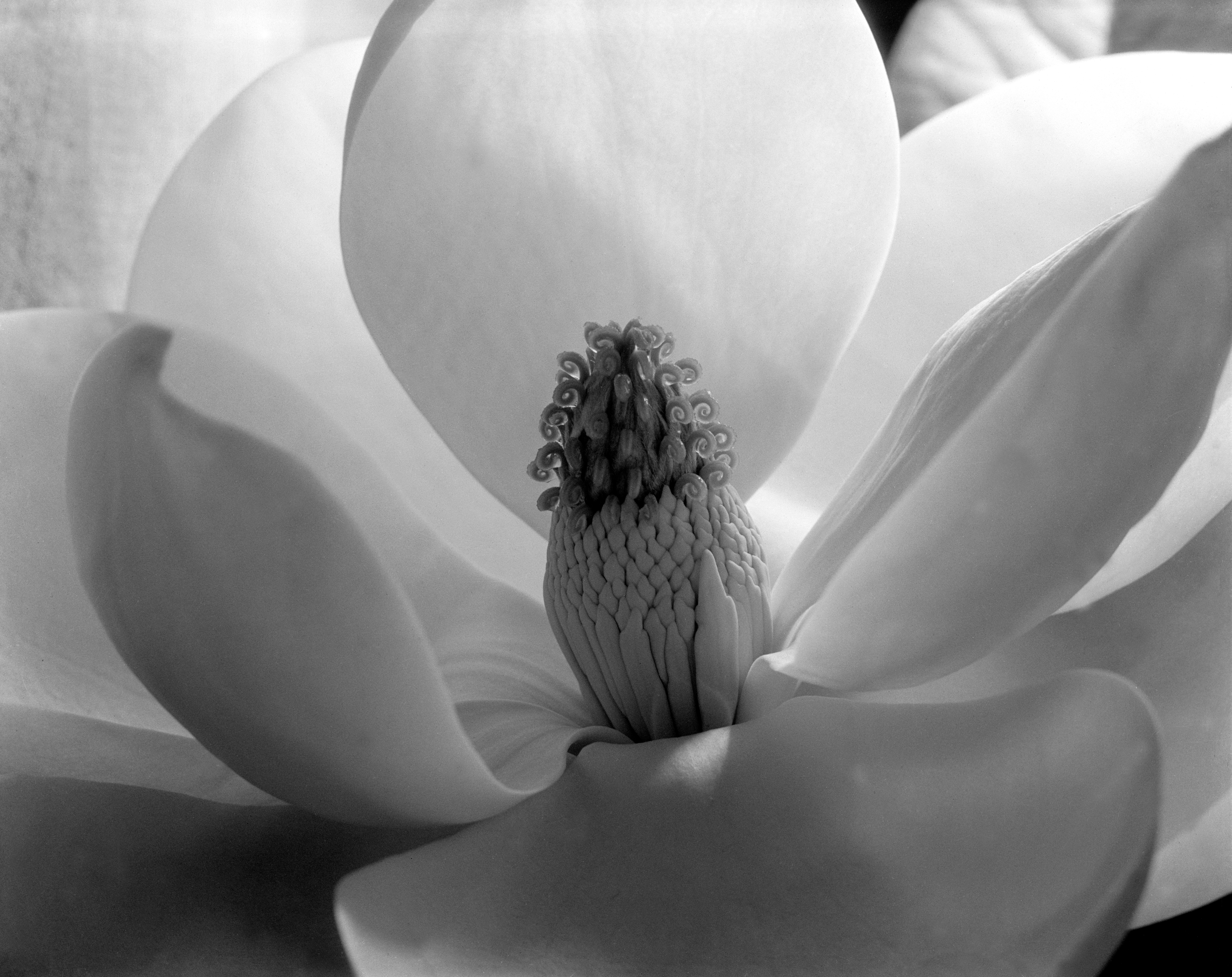
At first glance, it barely behaves like a flower. Petals fill the frame and vanish beyond its edges; the pistil rises like a tower from soft terrain. Cunningham removes scale and turns looking into an act of entry.
Fact: Print dates and dimensions vary by collection. MoMA’s print is approximately 17.1 × 21.6 cm; SFMOMA’s is approximately 23.6 × 29.5 cm.
Composition | A soft field, a hard center
Five broad petals radiate outward in an imperfect symmetry. The front-left petal curls inward, the right cuts diagonally away, and the upper petal becomes an oval screen; the pistil rests below the midpoint. Cropping removes stem, background, and perimeter, allowing a structure only centimeters wide to feel monumental. Dense, dark, vertical detail opposes broad, pale, lateral curves: the eye locks onto the center, then slides outward.
Color | Black and white translates hue into value
This achromatic palette has almost no hue noise and a wide value span. With hue competition removed, value, surface, and edge carry the image. The petals are never simply white: lit areas approach warm white, midtones preserve skin-like texture, and folds descend into silver and charcoal. The small center holds the darkest darks and densest local contrast, giving it the greatest visual weight.
#E7E6E2
#969696
#4B4B4B
#161616
Light | Illumination becomes touch
Soft directional light passes from above and behind and grazes the petals. Thin areas glow; thick folds produce slow tonal transitions. A narrow highlight on the right balances the deep arc on the left. The upper petal becomes a quiet bright ground that silhouettes the pistil. Light is less a spotlight than a hand moving over the surface, making waxiness, thickness, and creases tactile.
Technique | From Pictorialist haze to photographic clarity
Cunningham’s early work used the soft-focus language of Pictorialism. Getty notes that after moving to San Francisco in 1917, she turned toward sharply delineated pictures, cultivating and photographing plants in her garden; her magnolia studies began in 1923. Close focus, crisp detail, and the tonal reach of gelatin silver let photography speak through its own optics and paper. She co-founded Group f/64 in 1932. Because this image predates the group by seven years, it is best understood as anticipating that later modernist declaration.
Why it moves | Intimate, yet impossible to possess
Closeness normally promises familiarity; this photograph grows stranger the nearer it gets. The magnolia can resemble an organ, landscape, fabric, or building. We are welcomed close yet denied a total view. Soft petals surround us while the center stays exact and irreducible. Tenderness and strength coexist in one living form. No plot tells us what to feel; the photograph simply slows the act of looking.
The artist | Between the garden and modernism
Imogen Cunningham (1883–1976) studied chemistry at the University of Washington and worked across botanical studies, nudes, portraits, industrial subjects, and street photography. Getty identifies her as one of the few women who helped shape early modernist photography in the United States. She sustained her garden studies while raising three children: daily limits did not shrink the subject; they made the interior of one flower large enough to become a world.
Borrow the visual logic
- Palette: 60% warm white + 25% silver + 10% charcoal + 5% near-black. Keep both extremes and generous midtones.
- Photography: move close → crop identifying edges → place dense texture below center → rake with side-backlight → shape values first.
- Layout: one full-bleed detail + warm-white space + a fine black rule; reserve 1% darkroom red #8E2E2A for folios.
- Outfit: warm-white knit + silver-gray trousers + charcoal coat + one near-black accessory; separate tones through texture.
Sources and rights
Object records: MoMA, SFMOMA, and LACMA. Artist context: Getty retrospective and the Imogen Cunningham Trust. The source image was downloaded from Wikimedia Commons, whose file page marks it public domain in the United States under PD-US-expired.

Several museums and the artist’s trust still display © Imogen Cunningham Trust. Rights may vary by jurisdiction, print, and use; verify before publication or commercial reuse. Image rights belong to the artist and relevant rights holders. Facts are compiled from the institutions above; commentary is original analysis by Daily Art.