Composition: Move the center, and time begins
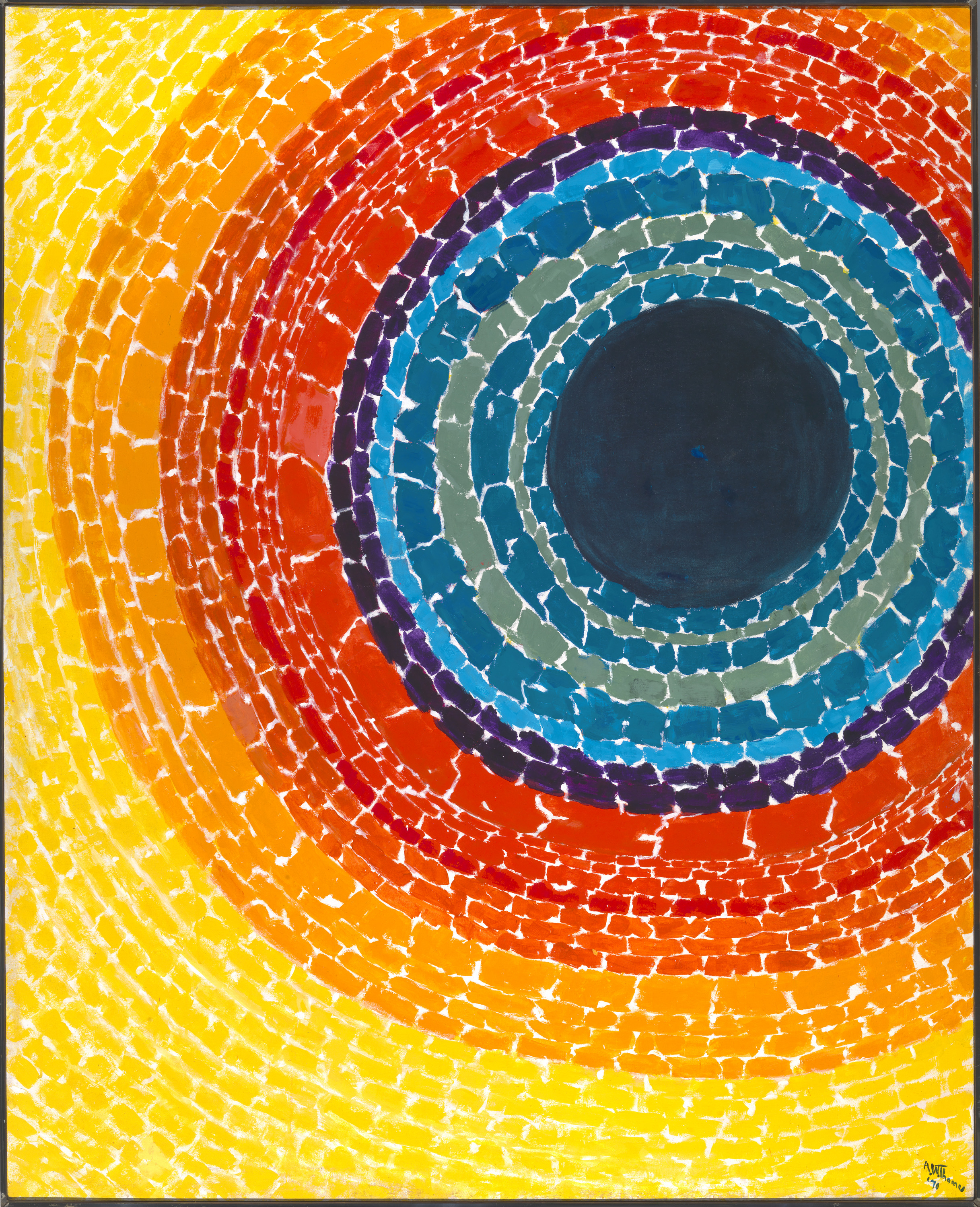
Concentric rings organize the image, but the navy core sits high and right while the outer bands are cropped on every side. The museum connects this offset to the moon's passage across the sky. Formally, it turns a static target into an event in progress.
Uneven rectangular marks assemble each orbit, with raw white ground flickering between them. The eye cannot take in a complete ring; it keeps bridging the gaps, so looking becomes a rotating action.
Color: Complements vibrate; navy absorbs
Blue and orange form the main complementary axis. Midnight navy pulls vision inward; orange-red bands radiate out. Lemon yellow, teal blue, coral, and cool green widen the spectrum. Simultaneous contrast makes the white ground appear alternately warm and cool.
#F4C542
#E33E2B
#187EA0
#122A5A
Practical ratio: 35% yellow/orange + 25% coral + 20% blue-green + 12% white + 8% navy. Let warm color become the field and cool color the core.
Light: No modeled volume, only chromatic radiance
Thomas largely rejects conventional chiaroscuro. Light comes from value contrast, optical vibration where complements meet, and white seams that keep every mark aerated. Blue-green marks are broader and denser near the core; outward, warm marks become smaller and more fragmented, making the corona expand beyond the frame.
Technique: Improvisation on top of a plan
Her mature language is built from short, mosaic-like acrylic strokes. Museum conservation research found complex pencil underdrawings, ruled guides, and color notations beneath related paintings. Moving from oil to acrylic emulsion helped pure hues flare against white ground.
In The Eclipse, that system bends into concentric tracks: geometry supplies the armature; hand-painted edges keep it breathing. Width, spacing, and angle never repeat mechanically. Order makes the image legible; variation makes it alive.
The artist: Near eighty, she made the cosmos feel botanical
Fact: Alma Thomas (1891–1978) taught in Washington for decades and devoted herself fully to painting after retiring in 1960. She was the first graduate of Howard University's art department. In 1972, she became the first Black woman to receive a solo exhibition at the Whitney Museum of American Art.
Painted in 1970, The Eclipse closed her Space series and responded to the total solar eclipse visible across the eastern United States on March 7 that year. Her sources moved among gardens, music, and space exploration: the corona can read as petals or as a segmented musical phrase.
A reading by Daily Art: darkness is not color's absence. Thomas puts darkness at the center so every surrounding hue gains intensity. Occlusion becomes the condition in which light regroups.
Borrow the idea
- Layout: place the center 68% from the left and 38% from the top; crop the outer rings.
- Styling: midnight-navy outerwear + canvas-white base + corona-orange bag or shoes.
- Painting or layout: draft tracks first, then vary unit width and spacing by 10–20%.
- Color: use 35% yellow/orange + 25% coral + 20% blue-green + 12% white + 8% navy.
Work and sources
Object record: Alma Thomas, The Eclipse, 1970, acrylic on canvas, 157.5 × 126.4 cm; Smithsonian American Art Museum, Gift of the artist, 1978.40.3.
Image: museum object page and download. The museum labels image rights “Undetermined”; availability does not mean public domain.
Background checked against: museum artist biography, museum conservation research, and the National Gallery of Art artist page.
Date, medium, dimensions, series, and biography are sourced facts. Composition, color, light, and emotional interpretations are original analysis by Daily Art. Image copyright belongs to the artist and relevant rights holders; reproduced here for art appreciation and source reference.