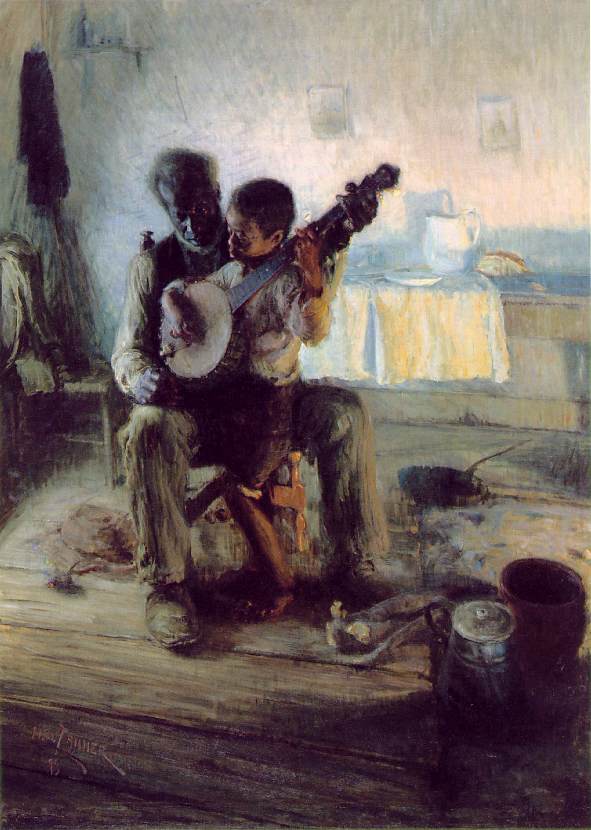
Composition: two figures become one shape
The elder’s open legs form a stable triangle around the child. The banjo neck cuts toward the upper right, gently opening the compact figure group. Four hands are the hinge: the elder’s surround from outside; the child’s test from within. Our gaze loops through faces, fingers, and strings. Attention, rather than theatrical action, carries the narrative.
The figures sit left of center. A luminous table and bare wall occupy the right, creating a visual breath rather than an imbalance. Pots, boards, and utensils make a low threshold across the foreground. We seem to have entered the room, but hesitate to interrupt.
Color: cool and warm tones pass knowledge between them
Muted blue-gray, smoked brown, and charcoal create a restrained split-complementary harmony. Cool blue-greens are tuned by ochre and orange-brown wood. Cream lifts the value without becoming harsh. Inside the dark figure mass, the banjo head behaves like an indoor moon.
#A8B8B2
#302629
#DED7BE
#B58A55
Formula: 55% cool gray + 30% dark structure + 10% cream lift + 5% ochre accent. Reserve the highest value for what needs to be “heard.”
Light and technique: illumination arrives in touchpoints
Diffused side light pauses on cloth, sleeve, fingers, and instrument. The brightest passages avoid the faces and land on the tool of learning. The elder remains in shadow; warmer light reaches the child. Experience does not seize the spotlight—it supports from behind.
Tanner’s academic realism meets a sensitivity to colored light. Hands and posture stay legible, while wall, floor, and vessels dissolve through dragged and layered strokes. Hard edges gather around the neck and fingers; soft edges belong to the room. The eye follows rhythm almost as an ear would.
The artist: restoring ordinary life to a stereotyped subject
Fact: Tanner (1859–1937) studied with Thomas Eakins at the Pennsylvania Academy of the Fine Arts, went to Paris in 1891, and later lived mainly in France. He painted The Banjo Lesson in 1893. Major museum biographies emphasize his dignified, sympathetic depictions of Black life and his standing among the first African American artists to achieve international acclaim.
Nineteenth-century American imagery repeatedly paired Black figures and the banjo as stereotyped entertainment. Tanner removes the performative grin and leaves practice, patience, and bodily memory. The instrument is no label; it carries knowledge from one set of hands to another.
My reading: support is the true subject. The elder does not play in the child’s place. Love appears as calibrated distance—protective, yet spacious enough for another person to become themselves.
Borrow the visual logic
- Photography: place figures in the left two-fifths and reserve a bright still-life zone on the right; use soft window light without making faces the brightest point.
- Styling: mist blue
#A8B8B2top + charcoal#302629trousers + old-wood#7A5A3Baccessories + cloth cream#DED7BEbase. - Interiors: pair cool gray walls with dark wood, limiting cream and ochre accents to roughly 10% and 5%.
- Composition: set one pale circular object inside a dark figure mass to create an immediate, quiet focal point.
Work and sources
Work: Henry Ossawa Tanner, The Banjo Lesson, 1893, oil on canvas; collection of Hampton University Museum.
Image: Wikimedia Commons file page, Public Domain Mark 1.0; identified there as a faithful reproduction of a public-domain two-dimensional work.

Background checked against: Hampton University Museum, National Gallery of Art, and Smithsonian American Art Museum.
Object data and biographical details are factual. The discussion of composition, color, light, and emotion is original analysis by Daily Art. Image rights remain with the artist, photographer, and relevant rights holders.