The material makes the silhouette
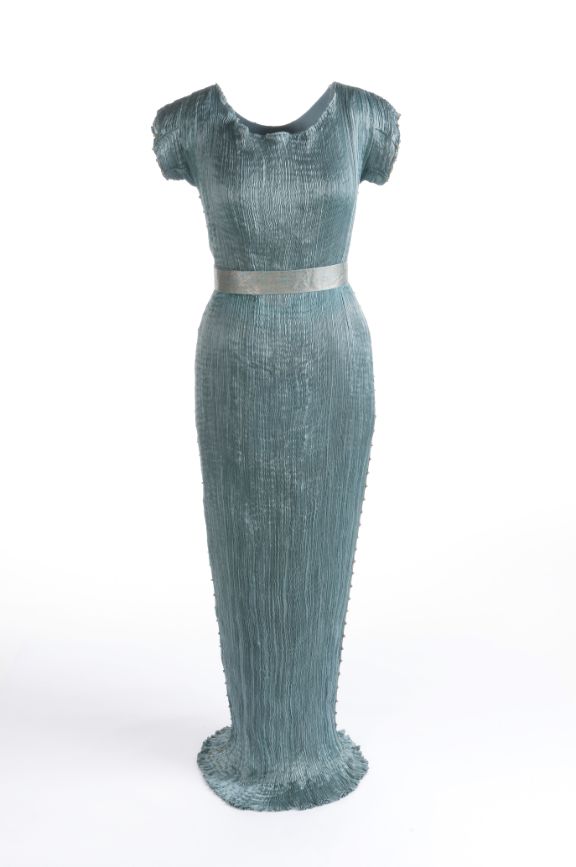
Celadon silk falls from shoulder to floor in one lucid column. Light catches hundreds of narrow ridges and turns a flat textile into moving water.
A pale belt makes one horizontal pause. Glass beads along the edges quietly restore weight to the vertical. Its impact comes through subtraction—material is allowed to carry light, body, and time at once.
One horizontal line disciplines the vertical
The frontal outline is nearly symmetrical. A boat neck opens the shoulders, short sleeves flare slightly, and the skirt resolves into a continuous pillar. Dense pleats lengthen the body and pull the eye down. The belt behaves like a rest in a musical score: it interrupts speed without breaking the whole.
At the floor, the hem pools into a small oval and releases the strict descent. Side beads act as ornament and visual ballast, punctuating a soft edge with measured rhythm.
Cool restraint, warmed by reflection
Blue-green neighbours form a low-saturation analogous harmony. Cool hues normally recede, but satin repeatedly lifts them into highlights: cool colour, warm light. Form comes through value shifts between mist silver and celadon; aged gold supplies one restrained warm accent.
#78999A
#456F73
#C8CECA
#A99162
Wearable formula: celadon dress or tailoring + mist-grey layer + aged-gold jewellery. Choose deep teal shoes or bag instead of black, keeping the darkest note in the same hue family.
Pleating is an optical instrument
Shading is generated by structure. Every ridge receives a highlight and every channel holds shadow. As viewpoint or body changes, the sequence rearranges itself. Soft frontal light turns the torso silver-green while the sides and neckline deepen, giving a minimal outline sculptural volume.
Fact and interpretation: the garment does not emit light. “Liquid metal” is my reading of satin reflection, pleat frequency, and photographic light acting together.
Shape through material, not rigid structure
The museum records celadon pleated silk satin edged with glass beads and a belt with a gold-stencilled border. The Delphos type emerged around 1907 and was patented in 1909. Inspired by the Greek chiton, it uses simple rectangular lengths falling from the shoulders. Beads weight the edges; fine pleats provide expansion and body-responsive relief.
Granada-born Mariano Fortuny (1871–1949) later worked in Venice across painting, stage lighting, textiles, and dress. Fontainebleau-born Adèle Henriette Elisabeth Nigrin Fortuny (1877–1965) was his creative and life partner. This object is catalogued under Mariano; for a comparable example, The Metropolitan Museum of Art names both designers. This feature uses a joint credit and presents both records.
Freedom hidden inside discipline
From a distance, one restrained column. Close up, hundreds of slightly irregular lines. Standing still, sculpture; in motion, water.
My reading: the dress does not prescribe an exaggerated body. It waits for a body to enter and complete the form. Clothing stops being a shell and becomes a layer of breathing light.