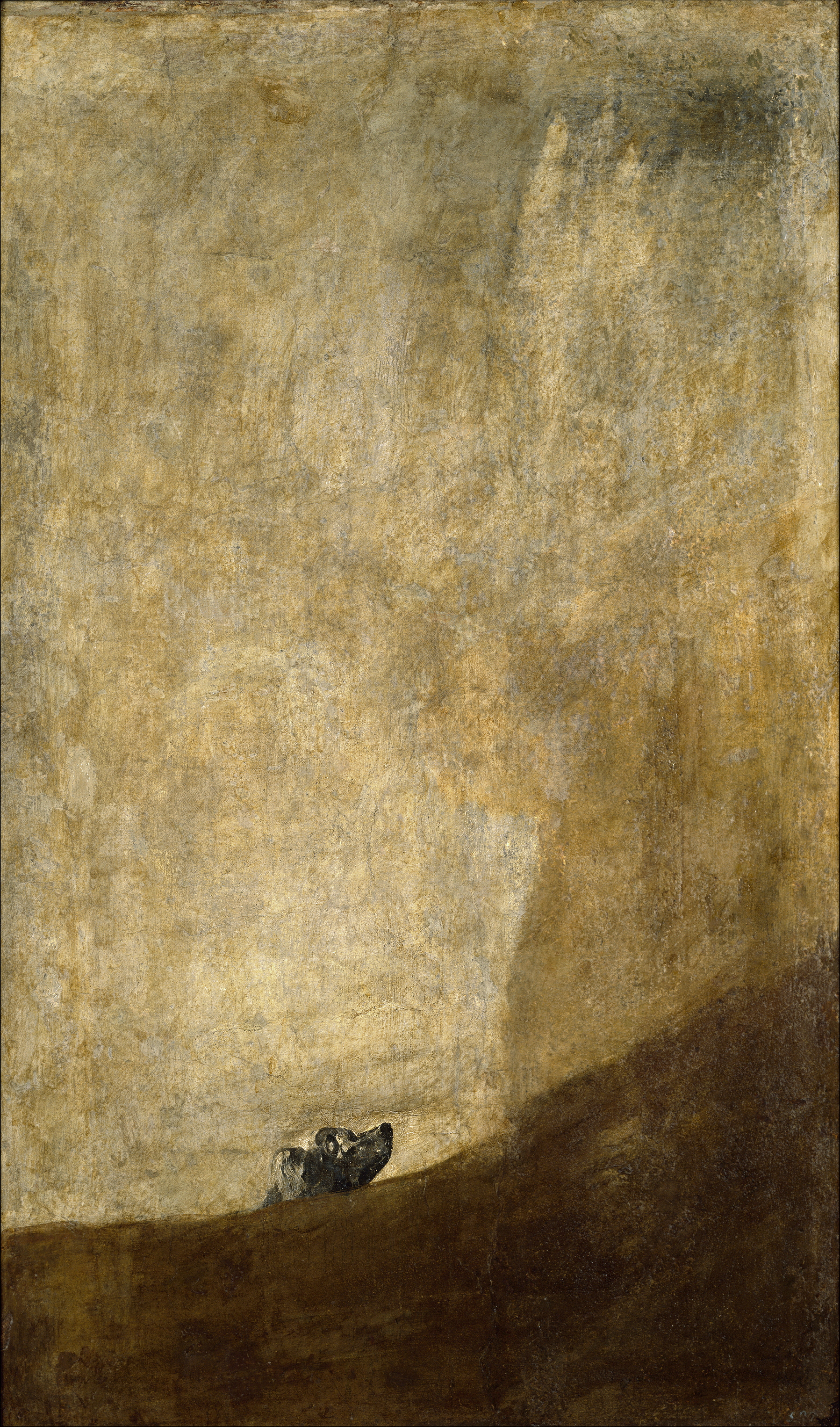
Almost eighty percent of the image refuses incident. With the story removed, looking up becomes the painting’s last surviving verb.
Composition|Asymmetric weight
The head sits low and left, neither centered nor comfortably secured by a rule-of-thirds grid. A dark, bank-like diagonal presses it toward the edge; the immense negative space above turns viewing into waiting. Portrait format usually elevates a figure. Here, height becomes unreachable distance.
The muzzle points up and left while the dark plane falls down and right. One force sinks; the other rises. The emotional charge hangs between them.
Colour|Warm hues, cold feeling
Yellow ochre, smoke brown, and charcoal form a muted analogous harmony. Neighboring hues should feel warm and cohesive, yet the absence of a bright complement makes the field feel depleted. Near-black accents on the dog create a tiny, intense value anchor; the ochre expanse behaves like silent air.
Wear it as a camel coat, smoke-brown knit, charcoal shoes and bag, with bone only at the collar. For a poster, reserve the darkest value for one very small subject; scale contrast will carry the emotion.
Light|Value rubbed open
There is no legible sun or lamp. Stains, scumbles, and small value shifts move through the ochre as though light had been absorbed by the wall. A few lighter marks on the forehead, ear, and muzzle give the head volume. It is not spotlit; it barely resolves from the haze.
Technique|The surface is history
The Prado identifies this as one of Goya’s Black Paintings, made around 1820–1823 on the walls of his home, the Quinta del Sordo, in a mixed mural technique and later transferred to canvas. Uneven paint, exposed-looking ground, and rubbed passages resemble psychological weather more than finished narrative. The image also carries the distance of transfer, conservation, and digitization; not every visible mark can safely be treated as untouched original gesture.
Why it moves us|Hope as a posture
Fact: Francisco de Goya (1746–1828) made the murals later called the Black Paintings late in life, inside his own home. The later titles Perro semihundido and The Drowning Dog do not settle whether the dog is in water, behind earth, or in another undefined setting.
My reading: we cannot even confirm a danger, yet we instinctively search for the object of that gaze. Hope shrinks to one upward tilt of the head; the world expands until it offers almost no reply.
Object facts: Museo Nacional del Prado collection record. Image: Wikimedia Commons file page, downloaded August 5, 2026; the page marks the public-domain artwork and its faithful two-dimensional reproduction with Public Domain Mark 1.0. Rules can vary by jurisdiction and use. Image rights remain with the artist and relevant rights holders. Appreciation is original analysis by Daily Art; facts and interpretations are identified separately.
