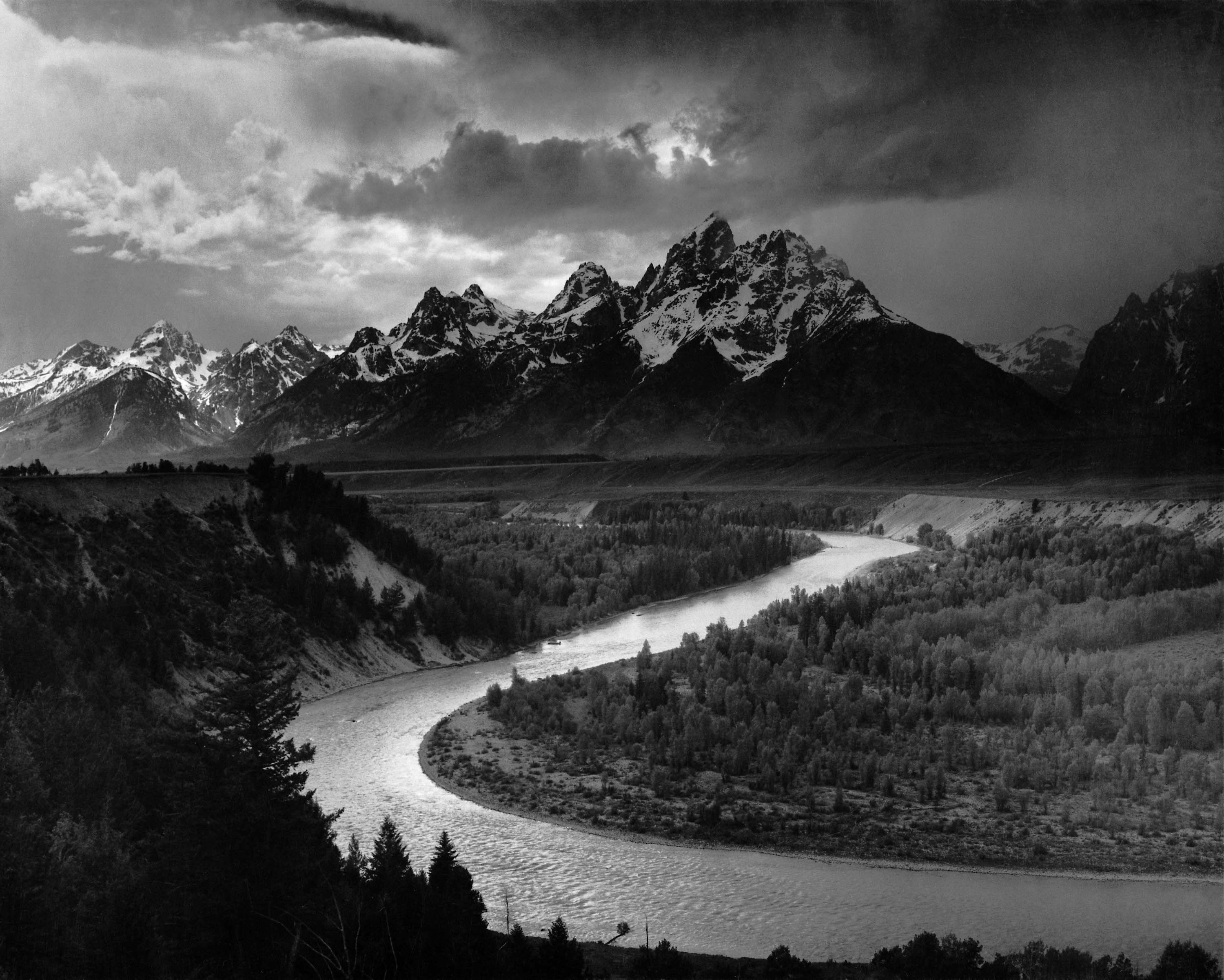
The Tetons and
the Snake RiverANSEL ADAMS · 1942
It turns “grandeur” from an adjective into a route the eye can travel.
Composition
Foreground trees, middle-distance valley, mountains, and cloud open in layers. The river’s S-curve catches the eye at lower left, releases it into the bright centre, then disappears before the foothills. Visible route and imagined continuation create depth together.
The tallest peak sits right of centre, balanced by the heavy cloud at left. Near-black trees act as stage wings, obstructing the view while giving the river and snowline scale. Monumentality comes from three measures of distance, not merely a large mountain.
Colour and value
This neutral monochrome is organised through value contrast and simultaneous contrast. Black foliage carries weight, middle greys bridge the valley, and silver water, snow, and cloud edges flash only where needed. The river can feel luminous without being the palest area.
Try charcoal field + stone layers + mist-silver texture + one paper-white accent. Keep at least two distinct greys between black and white.
Light
Dark cloud lowers the ceiling; bright cloud edges answer the snow. Patches of light move across the valley and let the river surface from shadow. Highlights circulate among water, snow, and cloud, keeping the image alive rather than monumental and still.
Technique
Deep focus, dense detail, and controlled perspective reflect large-format landscape practice; the archive page does not provide exposure settings. Around 1940, Adams and Fred Archer developed the Zone System to anticipate how luminance would translate through negative and print. Canopy shadows retain modulation and bright cloud keeps texture. This digital surrogate also reflects the print, scan, and screen.
Artist and feeling
Archival fact: Ansel Adams (1902–1984) was an American photographer and environmental advocate. The National Park Service commissioned a nature mural series from him in 1941. World War II halted the project; the photographs later entered the National Archives. This image dates to 1942.
Interpretation: the river invites entry, trees interrupt it, and the peaks remain unreachable. The eye completes a journey while the body stays still—the quietest version of the sublime.
Source and rights
Work: Ansel Adams, The Tetons and the Snake River, 1942. Holding: U.S. National Archives, Records of the National Park Service, NAID 519904 / 79-AAG-1. Image downloaded from the Wikimedia Commons file page on 2026-08-04; the page identifies it as public domain in the United States as a U.S. federal government work. Check the source for other jurisdictions and uses. Copyright belongs to the original creator and relevant rights holders where applicable. Original analysis by Daily Art; facts and interpretation are identified separately.
