The Sleeping Gypsy
Moonlight turns the desert into a room without walls; the lion passes, and the dream holds.
Begin with the black ring of impossible calm
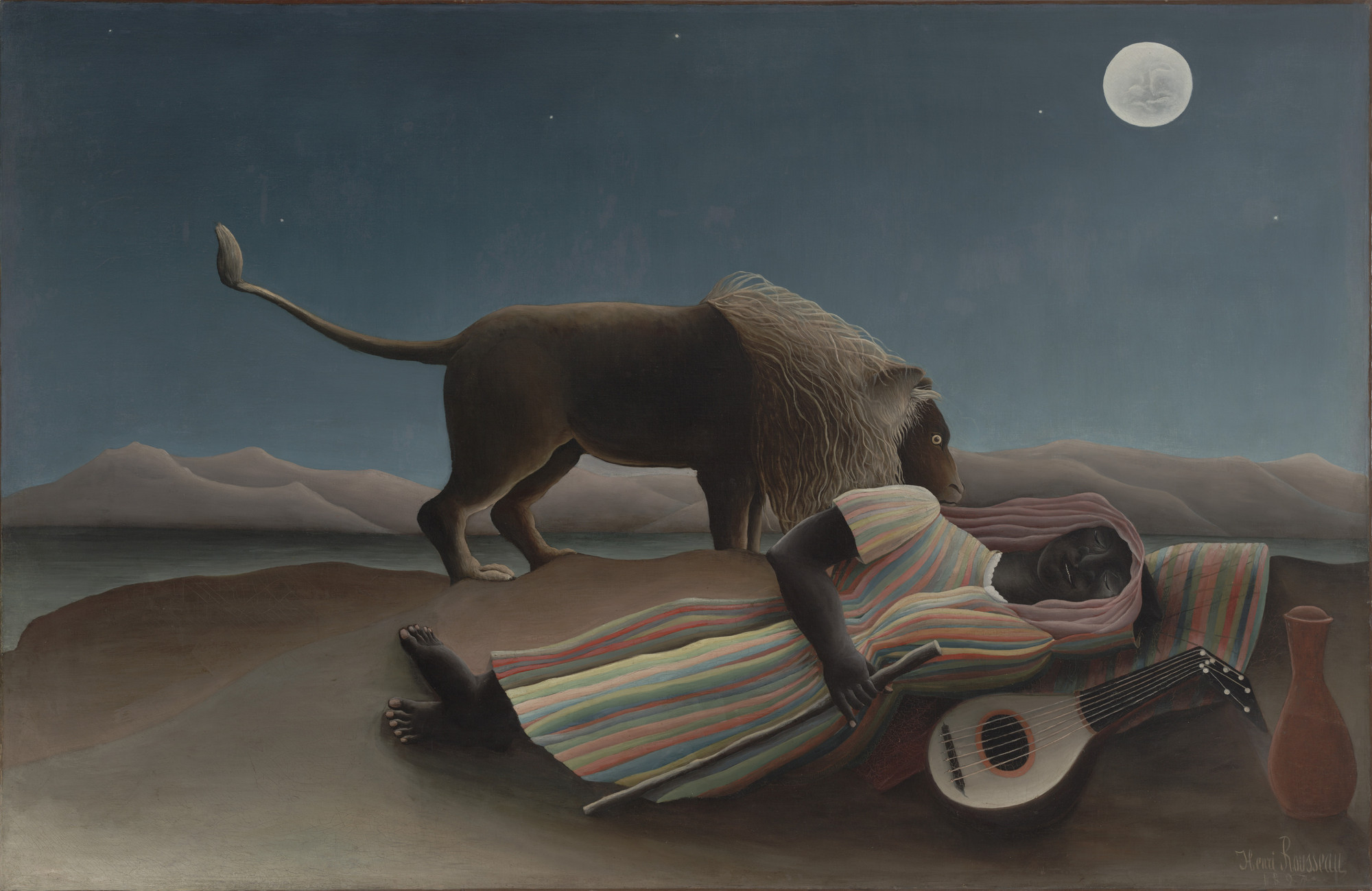
A traveller sleeps in the desert with a mandolin and a water jar. A lion leans in from the right. The moon is a clipped silver coin: it illuminates the ground, then pulls the scene from reportage into fable. Danger has arrived, yet the painting makes no sound.
Composition: one diagonal stitches dream to alertness
The body travels from lower left toward upper right; the lion's back and tail answer with a counter-curve. Between them sits a dark interval—part breath, part withheld event. A flattened horizon presses the desert into silence, while the moon acts as a geometric anchor. The eye moves from ivory dress to ochre contour, then returns through the moon: a slow, closed circuit.
Colour: complementary heat inside a cool night
Deep blue-black #101A2B and indigo #263B61 build the night; muted ivory #D9D6C8 holds moon and dress; ochre #B77A36 and earth gold #D2A34A animate lion and sand. Blue-violet and orange-gold approach a complementary relationship. Cool hues deepen the field; warm hues give the animal a pulse. Low value against small high-value accents is the painting's quiet engine.
#101A2BIndigo
#263B61Ochre
#B77A36Muted ivory
#D9D6C8
Light and technique: unreal, exact in the language of dreams
Moonlight is flat, almost stage-like illumination: lucid planes and contours replace elaborate naturalistic modelling. Fur is arranged in rhythmic strokes; plants and instrument become pattern. Rousseau deliberately removes perspectival noise in favour of symbolic relations.
The artist and the historical frame
Rousseau worked in the Paris customs service and only turned fully to painting in his forties. Without academic training, he developed a frontal, anti-naturalist language that fascinated modern artists. MoMA describes him as a self-taught painter who captured the imagination of Paris's younger artists and writers. The title's use of “Gypsy” belongs to its period and deserves contextual care; more enduring is the solitary sleeper and wild animal sharing one field of silence.
Why it moves
Protection and threat occupy the same second. The lion may be predator, or guardian of the dream; the traveller may be unaware, or simply asleep beyond fear. Rousseau refuses to settle the reading. We watch as if holding our breath: too close to leave, too quiet to interrupt.
A practical palette: let one warm figure rise from a cool field
Use 55% #101A2B and 25% #263B61 for the nocturnal field; 12% #B77A36 and 8% #D2A34A for one subject or gesture; reserve #D9D6C8 for moonlight. In design or dress: night blue base + one ochre piece + a small ivory note.
Facts and image: [MoMA object record](https://www.moma.org/collection/works/80172) · [MoMA image](https://www.moma.org/media/W1siZiIsIjE1MTQzNCJdLFsicCIsImNvbnZlcnQiLCItcXVhbGl0eSA5MCAtcmVzaXplIDIwMDB4MjAwMFx1MDAzZSJdXQ.jpg?sha=f32cd1f6f243cdc6). Reproduction, redistribution and commercial use remain subject to MoMA licensing notes, source-page terms and local law. Copyright belongs to the original artist and relevant image-rights holders; appreciation by Daily Art.