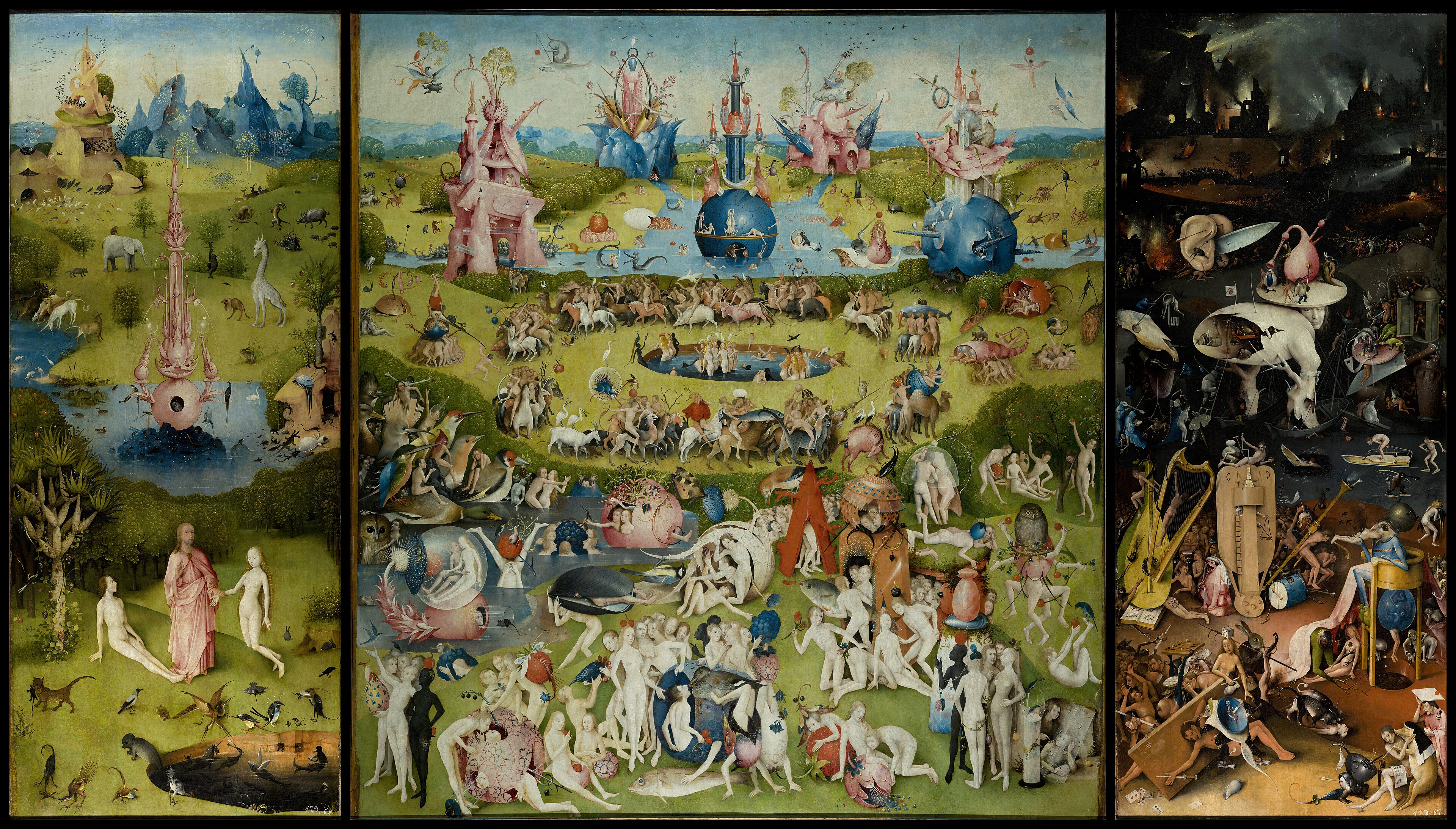
The Garden of Earthly Delights
One painting, three kinds of time
Read it as an extremely wide visual map: Eden on the left, a world crowded with desire in the centre, and pleasure folded into hell on the right. Bosch builds hundreds of small events, so the eye moves like a visitor who keeps taking the wrong turn—and is glad to. The central panel’s low horizon lifts the gaze toward pink and blue constructions while tiny people and animals form an entire ecosystem.
Colour: a cool sugar coating over unease
Pale cyan, lake blue, milky pink and leaf green own the field; warm red, ochre and flesh pull desire toward the foreground. Cool–warm contrast makes small figures pop, while near-complementary notes give fruit, skin and fire their charge. A useful ratio is 55% cyan/grey-green, 25% milk-white/pink, 15% flesh/ochre-red and 5% deep umber-black. Keep the pastels slightly milky rather than pushing every colour to full saturation.
Technique, background and why it moves
Fine oil handling on oak describes feathers, scales, fruit skins and translucent water. Detail is the viewing engine: once each hybrid creature seems to possess its own physics, the absurd garden feels capable of growing beyond the frame. Bosch worked in ’s-Hertogenbosch within family-workshop and religious-image traditions, yet turned moral allegory into something close to speculative creature design.
Its power is not only the quantity of wonders. It refuses to let wonder be consumed in one pass. Candy colours invite us in; the dark right panel reminds us that desire also belongs to the act of looking.
Practical takeaways
- Use a low horizon and 3–5 micro-events instead of one oversized focal point.
- Put the lightest colour in the distance and the deepest dark at the narrative endpoint.
Work facts: Museo del Prado. Image: Wikimedia Commons. The original is public domain; digital-image terms vary by source and jurisdiction. Copyright belongs to the original author and relevant image rightsholders. Original appreciation by Daily Art; not an official museum interpretation.
