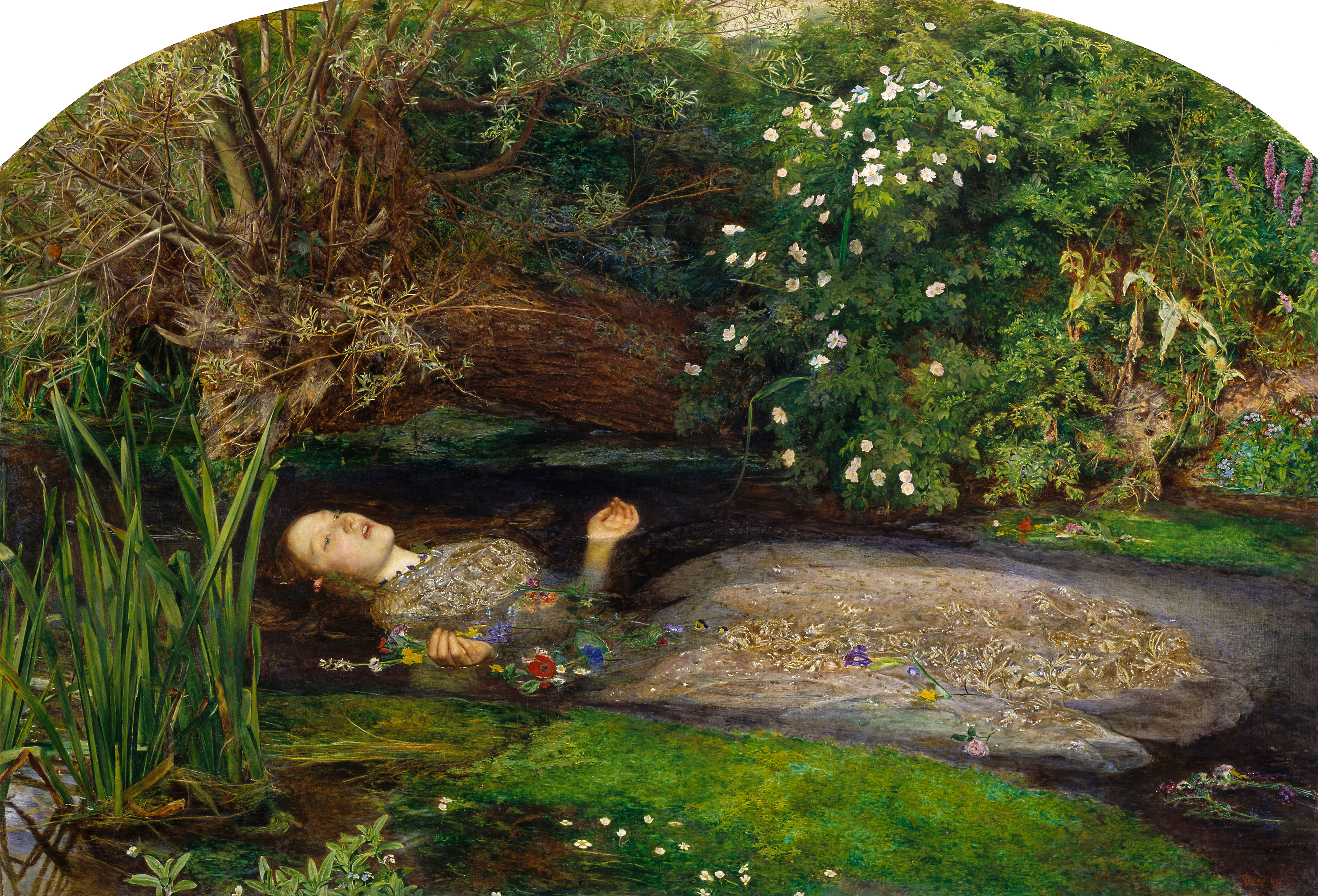
Ophelia
A flower, a river, and youth in suspension.
Composition: a river with no exit
Ophelia lies almost along the lower edge, her body a slow horizontal line. Dense branches fracture the sky and offer no distant opening, so the eye has to travel with the water. The calm horizontal structure contradicts her descent: the image feels stable while the body has lost its ground.
Colour: a few “fate colours” inside cool green
Deep foliage, olive and grey-blue make a restrained cool field; the russet-gold dress supplies warmth. White sleeves, face and flowers raise the value. The red poppy forms a complementary contrast against green, carrying narrative weight rather than decoration.
Try this formula: 60% deep foliage #3F5140 + 20% grey-blue #748589 + 12% russet gold #9A7650 + 5% bone white #D9D3C2 + 3% poppy red #B74438. Reserve the most saturated colour for one small object.
Light and technique: nature made almost verifiable
Millais worked beside Surrey’s Hogsmill River for roughly five months before completing the figure in the studio. Grass, branches, water and flowers receive specimen-like attention. Even outdoor light lets the face and sleeves seem to rise from the water; small highlights keep the surface moving.
Why it moves us
Millais refuses to give Ophelia a final speech. Her upturned palms might offer the flowers or surrender herself; her restrained expression leaves feeling for the viewer to complete. Nature keeps growing. Death is quiet, and the green world gently absorbs a person.
The artist
Sir John Everett Millais (1829–1896) was a British painter, illustrator and co-founder of the Pre-Raphaelite Brotherhood. Ophelia joins literary imagination, close observation and tactile surface detail. It is held by Tate Britain, accession N01506.
Facts: Tate; image: Wikimedia Commons. The artwork is public domain, but museum digitisation terms vary by jurisdiction. Copyright and reproduction rights belong to the artist, Tate and relevant image rightsholders; check the source page before reuse. Appreciation by Daily Art.
