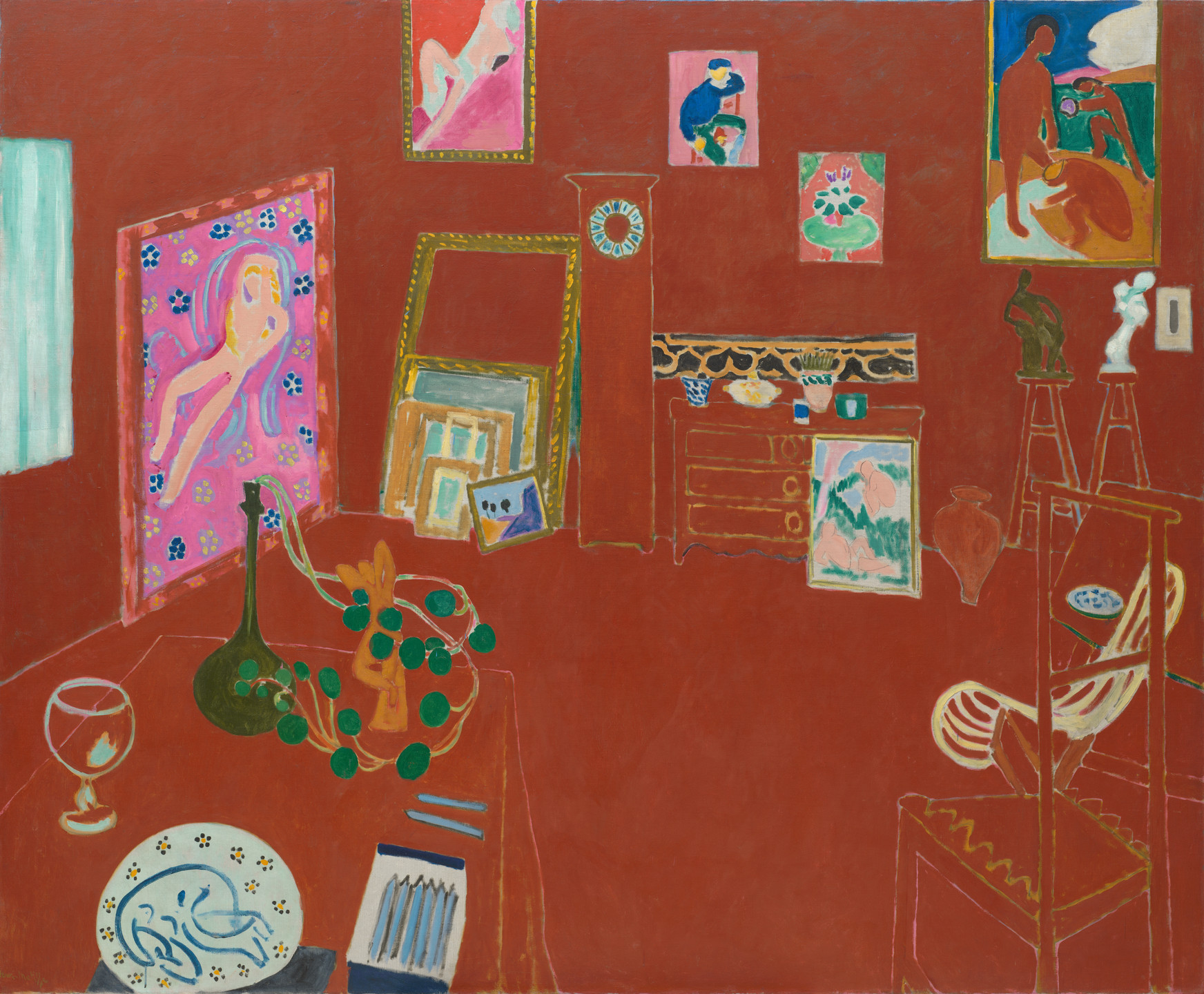
The Red Studio
L’Atelier Rouge
When one colour takes the room, looking stops being entry and becomes impact.
Composition: a room rewritten as a plane
Wall, floor and tabletop still offer coordinates, but perspective is deliberately flattened. The tilted table brings its vessels toward us; framed paintings puncture the red like windows. There is no single centre. The eye maps pictures, sculpture, table and contour lines, while red becomes the route connecting them.
Colour: monochrome as courage
A warm Venetian red owns the large field. Blue-grey, black, cream and yellow-green interrupt it in small doses. Red and blue-green create near-complementary tension, but the cool notes remain windows and punctuation—not rival protagonists.
Working palette: 70% warm red #A9483F + 15% deep blue-grey #526D79 + 10% cream #D8C7A6 + 5% yellow-green #B2A34A. Let one colour own the surface; reserve its counterpoint for edges and openings.
Light and method: contour instead of shadow
Traditional interiors build volume through light and shade. Here, light is almost withdrawn. Furniture, frames, table legs and window divisions hold the space together through contour and shape. Oil still coats the canvas, but the room approaches wallpaper, print or design. Matisse is selecting what must remain visible.
Why it moves
The painting’s courage is almost physical: if red is this powerful, let it be nearly everywhere. Matisse admitted he could not fully explain his choice. That unresolved impulse keeps the work warm with the risk of an experiment in progress. The objects float like memories from an artist’s life—a room, and a way of preserving a life through images.
The artist
Henri Matisse (1869–1954), a central figure of Fauvism, treated colour as an independent structural force. The Red Studio belongs to the moment when his colour experiments opened into flattened, decorative space. MoMA acquired it in 1949.
Facts: MoMA collection; image: Wikimedia Commons. Copyright belongs to Henri Matisse, his estate/rightsholders and relevant image-rights holders; follow the source terms. Appreciation is original analysis by Daily Art.
