DAILY ART · DAILY APPRECIATION · 2026.07.27
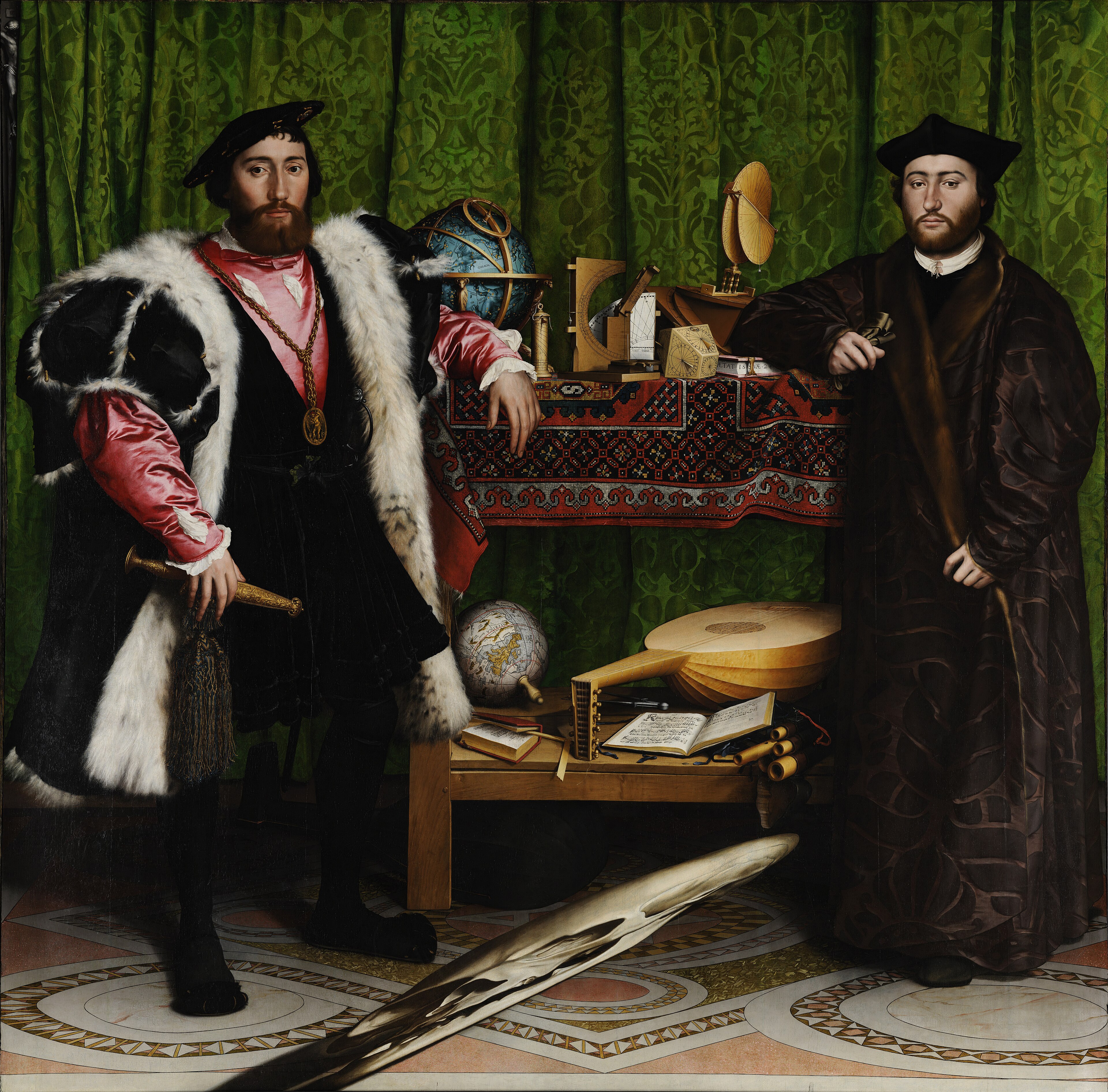
The Ambassadors
A portrait you have to move through
Hans Holbein the Younger, 1533, oil on oak, 207 × 209.5 cm. National Gallery, London.
Composition: order with a fracture
The two figures stand like architectural brackets around a table of globes, books, instruments and a lute. The foreground skull cuts across that order on a violent diagonal. From the front, the image is about status and mastery; from the right, death takes the centre back. Holbein makes the viewer’s body part of the narrative.
Colour: ceremonial tension
Deep green, vermilion, antique gold and umber form a dark jewel palette. Red and green create a controlled complementary tension, while grey-brown lowers the saturation into something grave rather than loud. The skull is not white; it sinks into the floor as the base note beneath every display of learning.
Light and technique
The light is even and unsensational. Restrained highlights make satin, chain, carpet knots, wood and metal tactile. Layered oil on panel gives the reds density and the gold a cool glint. The decisive device is anamorphosis: the skull is stretched for one viewpoint, then restored from another.
The artist and his moment
Born in Augsburg and trained in Basel, Holbein later became a court painter to Henry VIII. Painted in 1533, the work belongs to a Europe of religious upheaval and diplomatic pressure. Jean de Dinteville, on the left, was the French ambassador; Georges de Selve, on the right, was a bishop. A small silver crucifix behind the curtain quietly answers the skull below.
Why it moves
It does not lecture us about mortality. It makes us walk toward it. We first admire the clothing, precision and intellectual abundance; then one shift of position reveals that every identity here is temporary. The painting is dazzling without being merely decorative: reality gets the first word, death the last.
Borrow the feeling
Try 60% deep green/black-brown, 25% muted red, 10% antique gold, 5% chalky grey. Stabilise the frame with two vertical structures, then let one diagonal or distorted element pierce them. Keep the accent dimmer than expected; concealed contrast makes the viewer lean in.
Source: National Gallery, London, NG1314. Image: Wikimedia Commons. The 1533 painting is public domain; verify museum image-reproduction terms on the source page. Copyright belongs to the original author/rightsholders where applicable. Original analysis and layout by Daily Art.
