Christina’s World
Andrew Wyeth · 1948 · tempera on gessoed panel · MoMA
What catches the eye?
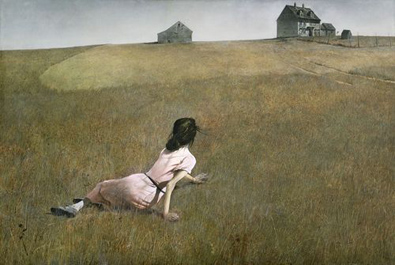
Not the house, but the faded rose shirt. It pins an almost camouflaged body to the field, then sends the eye along the slope toward home. The real pull is the ordinary distance made impossibly heavy.
Composition: distance as resistance
The high horizon gives the field most of the frame. Christina sits low left; the farmhouse sits high right; diagonal grass marks connect them. Rectangular buildings meet the body’s organic curve, a hard–soft rhythm. Landscape becomes the effort required to cross a familiar space.
Color theory: a quiet complementary spark
Dry straw, umber, warm gray, and blue-gray form a low-saturation earth system. The muted rose shirt makes a small warm contrast against the yellow-green field, becoming the first visual anchor. Try: #B8A98A dry straw, #817A6C warm gray, #745044 red brown, #C77F82 faded rose, #9FAAB0 sky gray-blue.
Light and technique
Broad, almost shadowless light makes the silence believable. Tempera’s dry precision gives the foreground grass a tactile surface while flattening the distant buildings. More detail, less movement—the tension grows in the stillness.
Why it moves us / who made it?
MoMA identifies the subject as Wyeth’s neighbor Anna Christina Olson, whose illness limited her mobility; the body was posed by Wyeth’s wife, Betsy. Wyeth grew up in a Pennsylvania art family and worked between Pennsylvania and Maine. His wife suggested the title, shifting the work from portrait toward psychological landscape: it does not explain Christina, but leaves us with someone reaching toward the everyday.
Borrow the feeling
Try a 70/20/10 ratio: earth neutrals, warm gray-brown structure, one desaturated rose accent. Add a diagonal gesture toward something distant. The emotional charge comes from the interval, not extra drama.
Source & rights
Artwork record: MoMA collection. Local source.jpg was downloaded from the file shown on English Wikipedia, marked Fair use; it is a low-resolution reference, not an authorized original. Copyright belongs to Andrew Wyeth / Artists Rights Society and relevant rights holders. Original critical analysis and layout; no reproduction permission is implied.