Majorelle Blue · The Color a Painter Patented to Keep
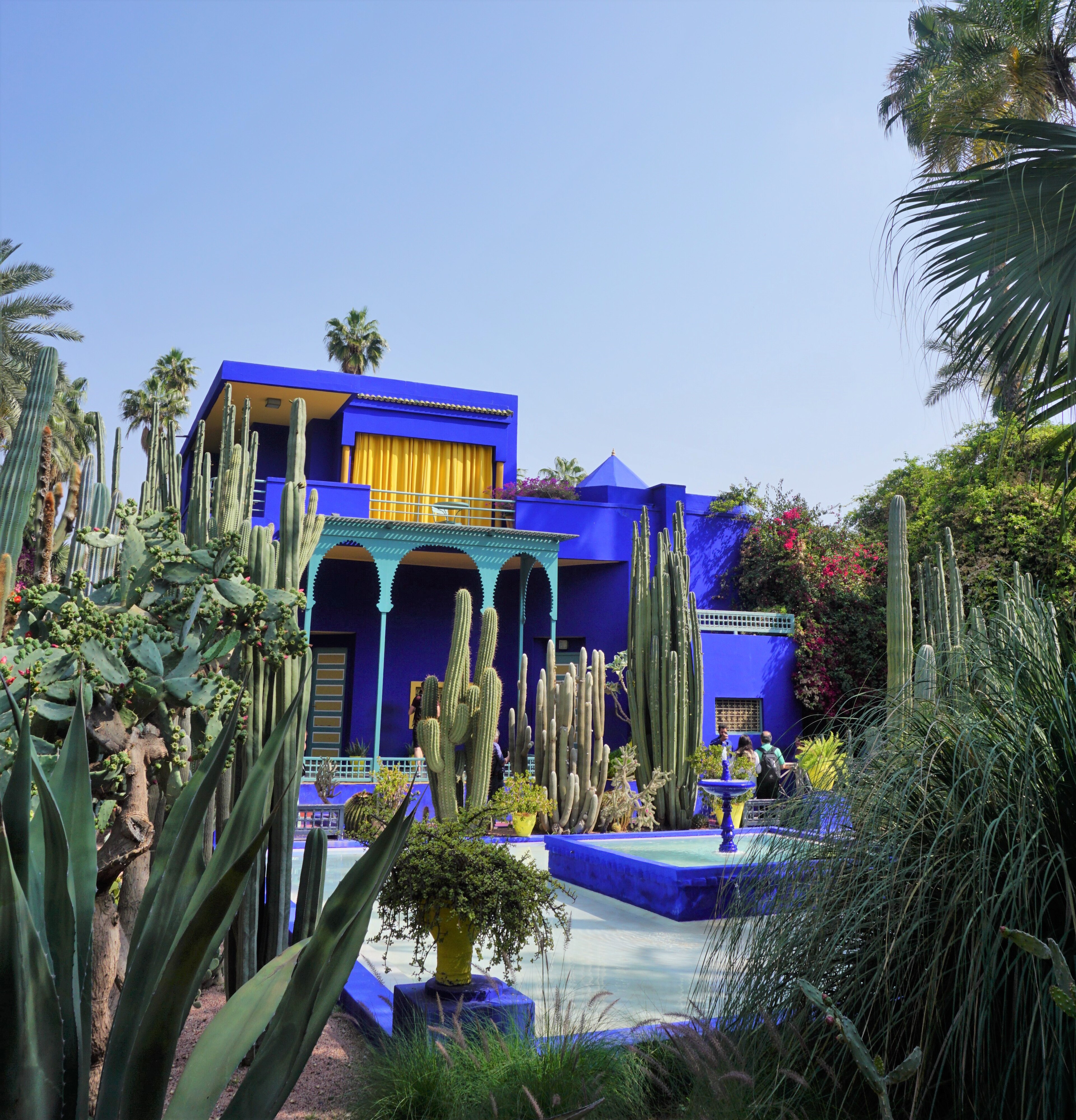
A wall of cacti stands guard in the foreground, so dense you have to look through the gaps to find the house behind it — a blue so intense it barely reads as real. That's not off-the-shelf paint. It's a formula the painter mixed himself and patented, and today the whole world knows it by his name: Majorelle Blue. A lemon-yellow curtain, mint-green colonnades, hot-pink bougainvillea spilling over the wall — this one building stacks up half the "difficult" colors on the wheel, and somehow none of them fight.
01Composition
The foreground is a wall of cacti and spiky agave, stacked at different heights, filling the near third of the frame so thick you have to look through the gaps to reach the blue villa behind it. Shooting the subject through something rather than straight-on gives the whole image a sense of trespass — like you've wandered into a private garden, not lined up for a postcard shot at a landmark.
Vertically, the cacti's straight spines, the villa's boxy geometry, and the palm trunks in the distance all rhyme with each other into one chorus of verticals; it's only the horizontal lines — the upper balcony railing, the ground-floor colonnade, the straight edge of the pool — that pin the composition down and keep it from sliding apart. The tourists in frame are reduced to small, shaded silhouettes under the colonnade, which only underlines that the building and the plants are the real subject here.
02Color Theory
Majorelle Blue is a saturated, violet-leaning deep blue — Wikipedia lists its standard value as #6050DC, though walls photographed on-site in direct sun usually read even darker and richer, closer to a cobalt-ultramarine, because the desert light pushes the pigment's apparent saturation further. On the color wheel that blue sits near violet, which makes the lemon-yellow curtain nearly its complement — complementary contrast is the easiest way to get punch, and also the easiest way to overdo it, but Majorelle's trick is scale: the yellow only ever shows up in small doses — a curtain, a pot — never as a field. That keeps the complementary jolt working as seasoning, not as the whole dish.
The mint-green colonnades and railings act as a buffer between the blue and the yellow — green sits closer to blue on the wheel, so it eases the eye across rather than forcing a hard cut. The hot-pink bougainvillea spilling over the wall is the single highest-saturation warm note in the whole picture, used in the smallest quantity of all — and precisely because of that, it reads as the picture's one accent mark. The deep green of the cacti and palms fills the rest of the foreground, absorbing all these saturated colors and keeping the overall effect vivid without tipping into gaudy.
03Technique
Majorelle bought the land in 1923, and in 1931 commissioned Cubist architect Paul Sinoir to design this studio-villa — its boxy, geometric massing is Cubist architectural language in built form. But what actually gave the garden its lasting name is the blue paint formula Majorelle mixed himself around 1937 — drawn from the colored tiles he saw all over Marrakech, the indigo-dyed burnous cloaks worn by Berber tribesmen, and the blue trim traditionally painted around windows and doors on kasbahs and adobe houses. He patented the color, and from then on it carried his name.
Because the Moroccan sun bleaches pigment hard over a year, the garden's walls are still repainted annually to keep that almost-fluorescent saturation intact — which is also why photos of "Majorelle Blue" taken in different years or different light always look subtly different from each other.
04Why It Moves Us
What makes this garden land is how it houses two opposites in the same courtyard: cacti and agave are plants built by evolution for brutal, dry conditions — spiny, austere, nothing decorative about them — and yet they're planted inside a garden whose color scheme is closer to a carnival, wrapped in saturated blue, yellow, green, and pink. Harsh desert botany and maximalist color should cancel each other out; instead they make each other work — the plants' austerity gives the color room to be as loud as it wants without tipping into excess.
And the blue's story doesn't end with the painter. Majorelle divorced late in life, was forced to sell the garden, and for two decades it sat neglected, nearly leveled for a hotel in 1980 — the same year designer Yves Saint Laurent and his partner Pierre Bergé bought and rescued it. When Saint Laurent died in 2008, his ashes were scattered in these grounds. A blue one painter mixed for himself became, decades later, a shelter he never lived to see restored, and then the final resting place of someone else's creative life entirely — one wall carrying the weight of two careers.
05Background
Jacques Majorelle (1886–1962) was born in Nancy, France, the son of Art Nouveau furniture designer Louis Majorelle. He moved to Marrakech in 1917 to recover from a heart condition, fell for the city, and in 1923 bought the land where he would build and expand this garden for almost forty years. In 1931, Cubist architect Paul Sinoir designed his studio-villa; around 1937 he formulated and patented the deep blue now known worldwide as Majorelle Blue. The garden opened to the public in 1947.
Late in life, divorce and financial trouble forced Majorelle to sell the property, and it sat neglected for over two decades, nearly demolished for a hotel development. In 1980, Yves Saint Laurent and Pierre Bergé bought the garden and restored it, pulling it back from the edge. Saint Laurent's ashes were scattered here after his death in 2008. Since 2010 the garden has belonged to the Fondation Pierre Bergé–Yves Saint Laurent, managed since 2011 by the Fondation Jardin Majorelle; it now draws more than 700,000 visitors a year and sits beside the Musée Yves Saint Laurent Marrakech, which opened in 2017.
06Steal This
- Deep violet-blue (cool, saturated) + lemon yellow (warm, near-complement) is a reliable jolt formula — keep the yellow to small-scale accents (a curtain, a cushion, a pot) and let the blue own the large surfaces; punchy without being loud.
- Between two strong contrasting colors, slot in a mint or turquoise buffer — it softens the transition and works equally well in interiors and outfit color-blocking.
- A large field of saturated color reads as vivid rather than garish once it's grounded by enough greenery — even a few houseplants will do the job a desert garden does at scale.
- Painting pots or planters in a complementary or contrasting accent color (yellow pots against a blue wall) is the simplest formula for garden or balcony styling.