A Bigger Splash · Two Weeks to Paint a Splash That Lasted Two Seconds
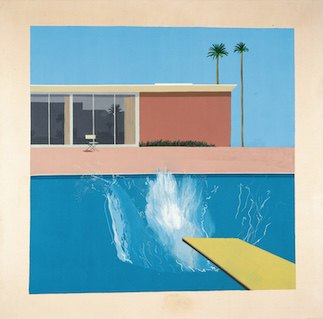
Nothing in this painting is moving except one thing. A flat salmon-pink house, two ramrod-straight palms, a nearly perfect slab of cobalt pool water — Hockney renders all of it as smooth and impersonal as an ad spread. Then, at the lower right, a lemon-yellow diving board still trembles, and in front of it a burst of white spray hangs mid-collapse. Where's the diver? Not in the frame. All you get is the two-second aftermath of someone jumping in — and Hockney spent two weeks painting that aftermath.
01Composition
The whole canvas is stacked almost entirely out of horizontal bands: sky at top, house facade below it, pool coping below that, then a wide slab of water at the bottom — four flat stripes of color, laid on like architectural drafting rather than a scene. The only verticals are two palm trunks and a few window mullions, kept almost embarrassingly restrained. The one thing that breaks all that order is the diving board slicing in diagonally — the single non-horizontal, non-vertical line in the whole picture, and the only hint of motion, pulling your eye straight to where the water is still exploding.
What's more striking is the absence built into the composition — no diver, no sign of life beyond the ripples, even the chair sits empty. The framing quietly shifts your attention from "what's happening" to "who just left."
02Color Theory
Hockney is stingy with color here — the whole painting runs on maybe four or five hues, each rolled on as flat, unmodulated color with no gradient and almost no shading, closer to a printed poster or a commercial sign than a painted surface. The salmon-pink house is warm; the cobalt pool is cool; the two sit close to opposite ends of the color wheel, translating the physical sensation of a sun-baked LA wall against cool pool water directly into color contrast. The lemon-yellow diving board is the one high-saturation accent in the whole picture — a single sharp note that pins your eye to the exact spot that matters.
03Technique
Hockney stapled the raw canvas straight to a wall rather than stretching it, and left a strip of unpainted canvas around the edges — a nod to the border of a Polaroid print. The big fields — sky, house, pool — were built up with a paint roller in two or three coats, chasing a flat, brushless, almost mechanically printed look. Only once those were dry did he go in with small brushes for the palm trees, the chair, the window reflections, and finally the splash. The splash itself was copied from a photograph in a book about building swimming pools — a real event that lasted roughly two seconds — and Hockney spent a full two weeks rendering it stroke by stroke. He later put it this way: "When you photograph a splash, it becomes something else." This painting is the largest and last of a trilogy — after the smaller A Little Splash and The Splash, both from 1966.
04Why It Moves Us
What lands hardest here is the paradox the painting exposes about itself: two weeks of labor spent precisely reconstructing something that existed for two seconds. The house, the pool, the palms sit dead still, while the splash alone carries a kind of violent, unresolved motion frozen mid-collapse in an otherwise silent scene — a stillness wrapped around a single instant, which holds your attention far longer than a painted diver mid-air ever could, because the action itself is hidden. All you get is evidence, and you're left to imagine the body that just vanished out of frame. California sun, a private pool, spare modernist architecture — this should read as pure leisure, but the sheer cleanliness of it, the total absence of people, leaves behind a quiet undertone of loneliness. The sunlit surface and the emptiness beneath it are both true at once.
05Background
David Hockney (b. 1937, Bradford, England) moved to Los Angeles in 1964 and fell hard for its blazing light, private swimming pools, and clean-lined modernist houses — the ingredients that would define his most iconic body of work, the LA pool paintings. A Bigger Splash was painted between April and June 1967, while Hockney was teaching at UC Berkeley; the house comes from his own earlier drawings of Californian buildings, and the splash was copied from a photograph in a swimming-pool construction manual. Today it's one of Tate Britain's most popular holdings and one of the most reproduced painted images of the 20th century — a measure of how central this series remains to Hockney's career is that in 2018, another of his pool paintings, Portrait of an Artist (Pool with Two Figures), sold at auction for $90.3 million, briefly setting the record for a living artist.
06Steal This
- Swap gradients and blending for roller-flat, unmodulated color fields — dropping visible brushwork and shading instantly gives an image a clean, poster-like graphic quality.
- Pair a warm pastel base (salmon, coral) with one saturated cool block (cobalt), plus a single high-saturation accent (lemon yellow) — this warm-cool-accent formula reads as bold without going busy.
- Leave a strip of raw, unfilled border or negative space around a composition of flat color blocks — it keeps large flat fields from feeling airless.
- Salmon walls + pool blue + lemon-yellow accent is a ready-made "California modern" palette — works for interiors as well as outfit color-blocking.