Las Meninas — A Room That Looks Back
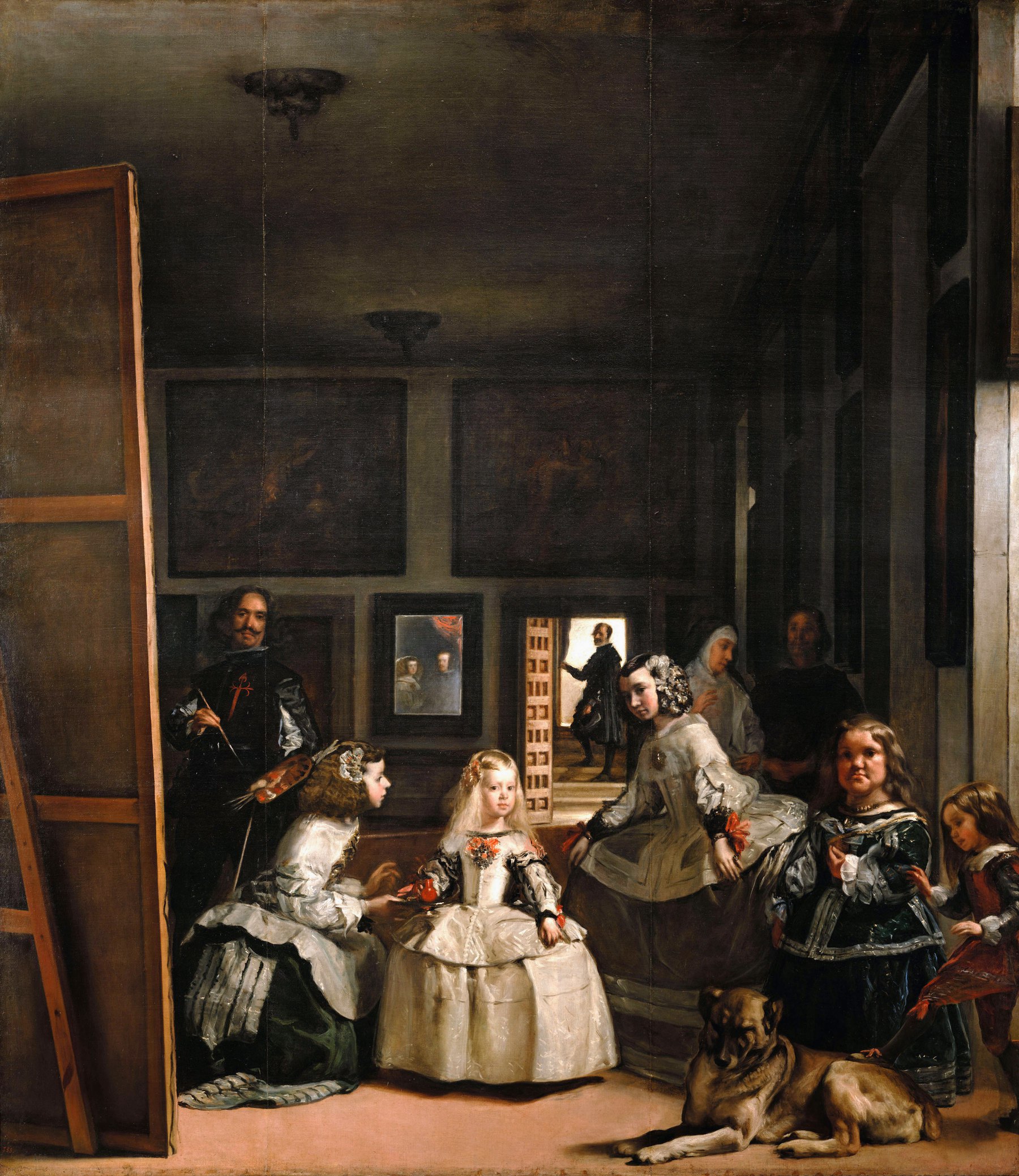
At first, Las Meninas seems to show a royal child interrupted during a portrait session. Then the room begins to turn around us. Velázquez stands before a canvas whose painted face we cannot see; a mirror catches the king and queen; several figures look outward. The painting never settles who is observing whom.
01Composition构图
The Prado identifies the setting as the Cuarto del Príncipe in Madrid's Alcázar. Velázquez builds it as a deep box: dark wall planes step backward toward the bright open doorway, while ceiling lines and framed pictures reinforce the recession.
Infanta Margarita holds the illuminated center, but the painter, mirror, and doorway create three competing vertical anchors. Our eye moves among them rather than stopping at a single protagonist.
02Color Theory配色
Most of the room is made from brown-black, muted umber, and silver-grey. Against that restraint, pale faces and the Infanta's ivory dress appear luminous without needing a spotlight effect.
Small rose and red notes—ribbons, cheeks, costume accents—cross the group horizontally. They keep the foreground figures connected inside the room's broad darkness.
03Technique技法
The painting is enormous: the Prado records it at 320.3 × 279.1 cm. At that scale, Velázquez can alternate broad, economical passages with sharper accents. From a viewing distance, abbreviated marks on dresses, hair, and reflected light resolve into convincing surfaces.
Depth comes less from meticulous outlines than from value: the bright foreground group, dim middle wall, glowing mirror, and backlit doorway form successive layers of light.
04Why It Moves Us为何动人
The unseen canvas and reflected sovereigns make the viewer's position unstable. We may be standing where the king and queen stand, or simply sharing the space into which several gazes are directed. The ambiguity is productive rather than solvable.
That is the painting's lasting thrill: it stages representation itself—artist, subject, witness, reflection—and lets each role slide into the next.
05Background作品背景
The Prado dates the painting to 1656 and, drawing on Antonio Palomino's 1724 account, identifies most of the people around Infanta Margarita: her meninas María Agustina Sarmiento and Isabel de Velasco, Mari Bárbola, Nicolasito Pertusato, Marcela de Ulloa, José Nieto in the doorway, and Velázquez himself.
The museum notes that Palomino gave this painting its own section in his history of Spanish painters—an early sign of the exceptional status it has retained.
06Steal This可借鉴
- Create depth with light intervals: bright foreground, dark middle, small distant glow.
- Give the eye competing anchors: a central subject becomes more alive when mirror, doorway, or edge figure pulls attention elsewhere.
- Leave one decisive thing unseen: withholding the canvas turns spectators into active participants.
