Sudden Shower over Shin-Ōhashi: Rain Carved Into Wood
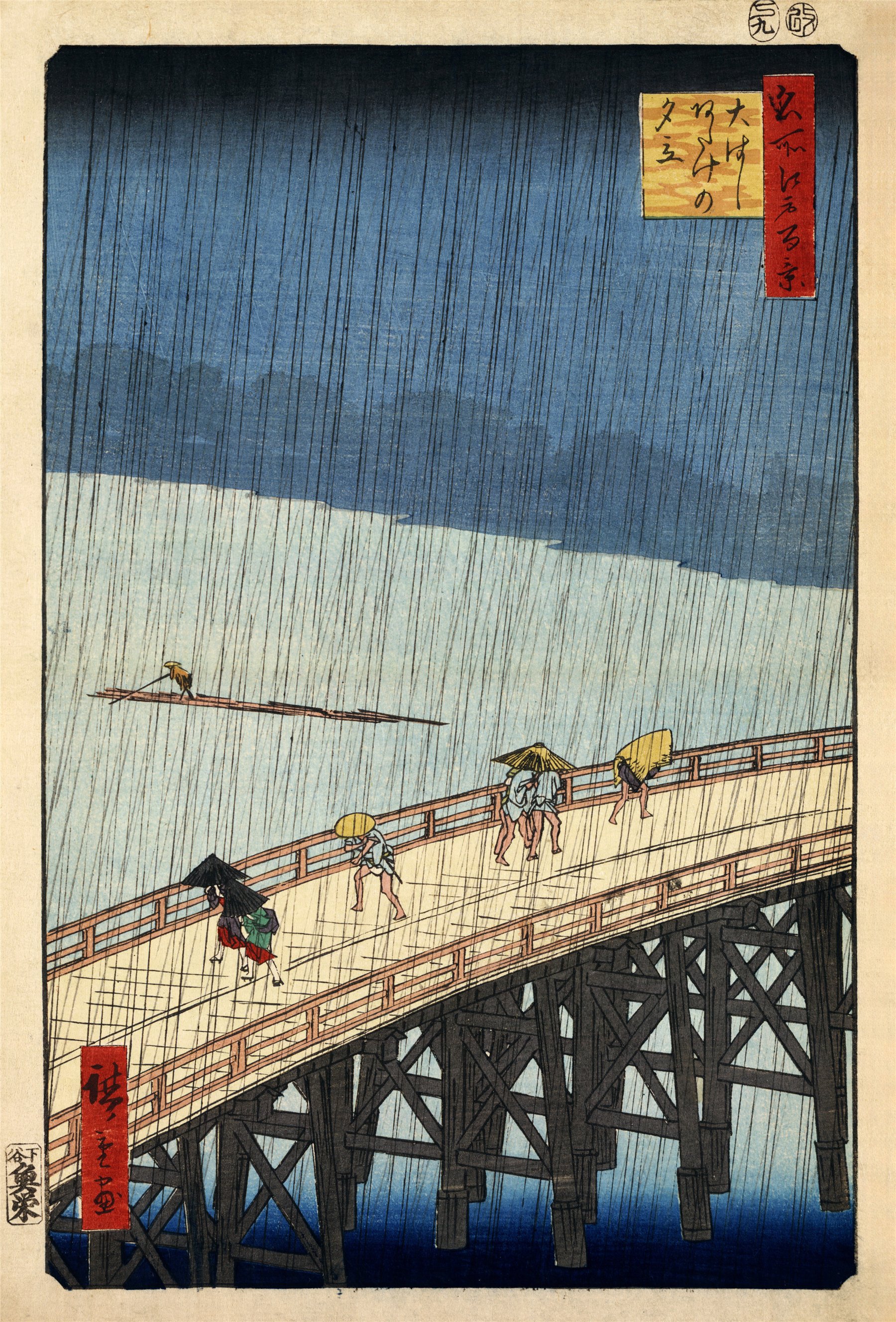
No lightning, no thunder — just a few hundred thin diagonal lines, and Hiroshige pinned a sudden downpour to paper forever. The people on the bridge hunch forward and quicken their pace; the boatman below looks like nothing is happening at all. This 1857 woodblock print later got copied, brushstroke for brushstroke, into an oil painting by Van Gogh — becoming one of ukiyo-e's clearest doorways into Western modern art.
01 Composition A Bridge, Cut in Half
The bridge slices across the frame on a steep diagonal, running from the lower-left corner to the upper right — and it's cropped hard at both the bottom and right edges. That kind of unapologetic cropping was radical in 1857, decades ahead of the "snapshot" framing that photography would later popularize, and it's exactly the boldness that later hooked the Impressionists on ukiyo-e.
The five figures on the bridge are grouped unevenly: two under a single black umbrella move fastest in the foreground, a lone walker follows mid-distance, and two more, further back, recede into the depth — your eye is walked along the rhythm of the bridge planks straight toward the vanishing point, and into the indigo curtain of rain swallowing the horizon.
Below, a boatman stands at the center of a narrow raft, pole in hand — the only horizontal reference in the whole print. His presence is a quiet reminder: the panic belongs to the people on the bridge. The river itself keeps moving at its own pace.
02 Color Theory Weather in One Gradient
The color range here is startlingly narrow — from the near-bare cream of the bridge planks, to the pale gray-blue of the river, up to an almost-black indigo at the top of the sky. Everything sits inside one blue-gray family, and depth is built entirely through shifts in value, not hue. It's an extreme case study in how little color a picture actually needs.
Against that restrained cool base, only two disproportionate warm notes are allowed in: the straw yellow of the rain hats and capes, and the vermillion red of the title cartouche in the corner. Compressed to almost nothing, those two small warm patches become the only place your eye can rest inside the rain.
The rain itself isn't printed color at all — it's carved on a separate block and printed as fine embossed lines, a technique called kesa-ame. One block, thicker and longer, prints across the sky; a second, finer and shorter, overprints the near foreground on the bridge. Layered slightly out of register, the two blocks create the illusion of rain growing thicker and closer as it nears the viewer.
03 Technique & History Edo's Weather Report, Printed
That sky, sliding from deep indigo into near-transparency, is bokashi — a hand-graded gradation applied directly to the woodblock, with the printer's brush loaded with steadily less water and pigment as it sweeps across, rather than built from multiple overprinted color blocks. It's why the exact position of the gradient varies slightly between early original impressions.
This print belongs to One Hundred Famous Views of Edo, Hiroshige's final major series (1856–1858), running to over 120 sheets and published by Uoya Eikichi. The series was still unfinished when Hiroshige died of cholera in 1858, during the epidemic that swept Edo that year; his pupil, Hiroshige II, completed the last few sheets.
The bridge is Shin-Ōhashi ("New Great Bridge"), spanning the Sumida River, an important crossing linking Edo to the Fukagawa district; "Atake" names the riverside spot near it. That "place name + weather or moment" formula is the naming logic behind the whole series — every print anchors a specific place to one fleeting instant.
04 Why It Moves Us One Rainstorm, Two Continents
What lands hardest here might be how precisely it captures something with zero geography attached to it: the instinctive hunch of the shoulders and quickened step of anyone caught in sudden rain. Hiroshige says all of it with a handful of radically simplified silhouettes — the everyday version of mono no aware, the pathos of things: weather that lasts seconds, held forever.
In 1887, Van Gogh copied this print almost exactly in oil, in Paris, right down to the rain lines and the Japanese characters in the border — retitled Bridge in the Rain (after Hiroshige). It's one of the most direct pieces of evidence for how hard ukiyo-e hit the West during the Japonisme wave, and the starting point for how Impressionist and Post-Impressionist painters — Van Gogh, Monet, Degas — learned bold cropping and flat color planes from masters like Hiroshige and Hokusai.
05 Background The Artist
Utagawa Hiroshige (1797–1858) is the defining landscape master of late-Edo ukiyo-e, ranked alongside Hokusai as one of the two great names in the genre. Born into a firefighter's family, he trained in ukiyo-e and made his name with The Fifty-three Stations of the Tōkaidō, then spent much of his career recording the seasons and scenery of Edo and its highways.
One Hundred Famous Views of Edo was the most ambitious project of his final years, and the most complete visual record he left of the city. Not long after his death, Japan westernized rapidly through the Meiji Restoration, and many of the bridges and streets in these prints vanished entirely — making this series one of the few surviving visual testimonies of a city that no longer exists.
06 Steal This Gradient, Negative Space, One Warm Note
- Trade color-stacking for a gradient: the entire sky's depth comes from value shifts within a single hue. Before reaching for another color in a palette, try pushing the full brightness range of the one you already have.
- In a cool palette, a little warm goes a long way: straw yellow and vermillion together take up less than 5% of the frame, yet they're the only place the eye lands — restraint over most of the canvas makes the accent do more work.
- Crop boldly for a sense of "now": the bridge is cut off by the frame instead of shown whole, and that's exactly what makes it feel caught mid-moment. You don't need to fit the whole subject in frame — a partial view often reads as more immediate.
- Use repetition to fake motion: a few hundred nearly-parallel lines is the simplest animation there is. Dense, repeated straight strokes can suggest speed and weather in an otherwise still image — a trick that works just as well in graphic design and illustration.