Pillars of Creation
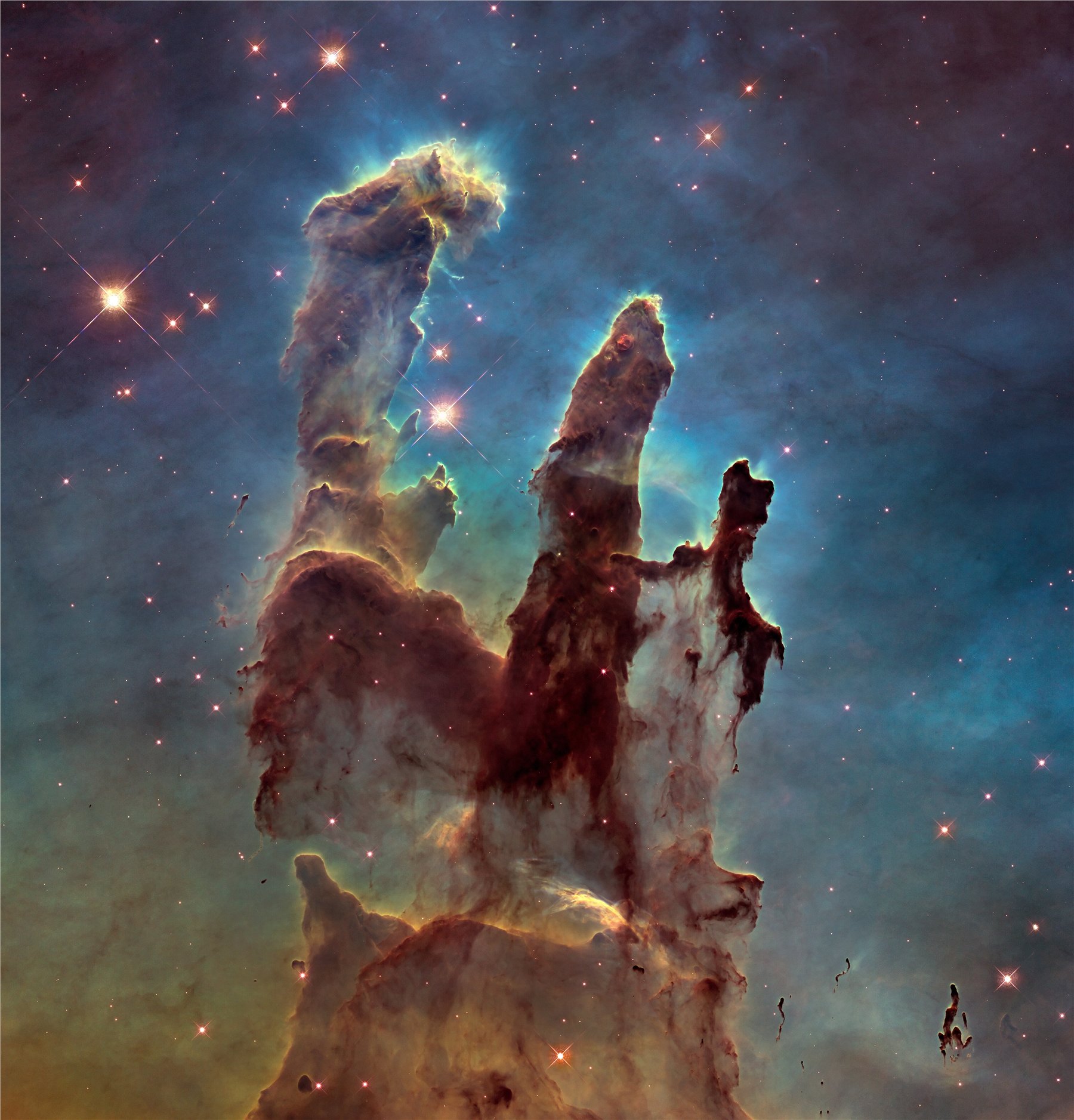
Three towering columns of dark dust rise out of shadow, their edges gilded gold and rust by unseen starlight. First captured in 1995 and reprocessed in 2014, this photograph is one of the most reproduced, reposted, and referenced images in human history. It isn't a landscape — it's a nursery for new stars, a cosmic birth millions of years in the making that is still, right now, underway.
01 Composition A trio built for the Sublime
Three staggered columns: descending in height from left to right, forming a rhythmic, jagged skyline — a variation on the classic rule of thirds, deliberately broken to avoid symmetry and stiffness.
Broad base, tapering shaft: each pillar narrows from a wide shadowed base toward its tip, creating strong vertical thrust that pulls the eye upward, almost against its will — the textbook formula for the Sublime: making a small viewer feel the scale of the cosmos.
Glowing gas at each tip touches the starfield like a fingertip; the deep negative space between the pillars doesn't weaken the subject — it makes it feel more solid, more massive. Those bright tips are what astronomers call EGGs (evaporating gaseous globules), the exact spots where new stars are first taking shape.
02 Color Complementary contrast as narrative
The image is built on one core complementary contrast: warm rust-and-gold dust pillars against a cool blue-green backdrop of ionized hydrogen and oxygen — orange-red sits directly opposite blue-green on the color wheel. That contrast makes the subject pop off the background, and it's also a genuine physical encoding: the pillars reflect warm dust-light, while the background glows blue-green where young stars' ultraviolet radiation has ionized the surrounding gas.
The Hubble Palette: what the telescope actually captures is invisible narrow-band wavelength data (Hydrogen-alpha, [OIII], [SII], and others). Scientists assign each band to an RGB channel and composite them into one image — translating invisible data into an emotional, visible language. It isn't fabrication; it's color-as-narrative taken to its logical extreme.
03 Light & Technique Rim light, layered exposures
Rim lighting: young, blazing-hot stars behind the pillars gild their edges in a halo of light while the bulk of each column stays in shadow — the exact same technique portrait photographers use to give a subject depth and volume rather than flat, frontal light.
Multi-band composite: Hubble doesn't shoot one exposure — it captures several narrow-band frames through different filters, then layers them in post-processing. That's the same underlying logic as zone-system exposure in film, or HDR stacking in modern digital photography. The 2014 version, made by the Hubble Heritage Team with the higher-resolution Wide Field Camera 3, contains several times more detail than the 1995 original.
04 Why It Moves Us Birth and erosion, at once
A collapse of scale: each pillar is actually several light-years tall — the tallest nearly 4 light-years — yet the composition and lighting make it read as something within reach, a sculpture you could almost touch. Translating an incomprehensible scale into something the eye can grasp is exactly what makes this image work.
This is simultaneously a nursery and its own graveyard: dense hydrogen inside the pillars is collapsing to form new stars, while the ultraviolet radiation and stellar winds from those very newborns are, at the same time, slowly eroding and dissolving the pillars themselves. Birth and dissolution happening in the same frame, at the same moment — a genuinely tragic beauty baked into the science itself. It's also why this single image ended up on more T-shirts, album covers, and textbook covers than almost any other — a case study in how science becomes visual culture.
05 The Artist(s) Telescope and team
The original 1995 version was captured by astronomers Jeff Hester and Paul Scowen using Hubble's second-generation Wide Field and Planetary Camera (WFPC2), and became iconic almost instantly. In 2014, to mark Hubble's 25th anniversary in orbit, the Hubble Heritage Team (STScI/AURA) re-imaged the same field with the higher-resolution Wide Field Camera 3 (WFC3) and produced the version used here.
In 2022, the James Webb Space Telescope (JWST) re-photographed the same region in near-infrared light, seeing straight through the dust to reveal even more newborn stars hidden inside the pillars — two telescopes, two ways of seeing, writing two entirely different poems about the same subject.
06 Steal This Color / Lighting
- Complementary pop: warm subject against a cool background (or the reverse) is the simplest, most effective formula for making a subject read as separate from its surroundings — apply it directly to portrait or product color grading.
- Rim light over front light: put the main light source behind the subject rather than in front of it, letting detail sink into shadow while only the edges glow — it reads as far more dramatic than flat, even frontal lighting.
- False-color as design principle: for infographics or data visualization, borrow the "band = channel" logic — assign a distinct hue to each category of data so color itself carries meaning, not just decoration.
- Staggered height composition: three elements of different heights, unevenly spaced, read as far more dynamic than equal-height or single-element layouts — useful in typesetting, display design, even how you layer an outfit.