The Kiss
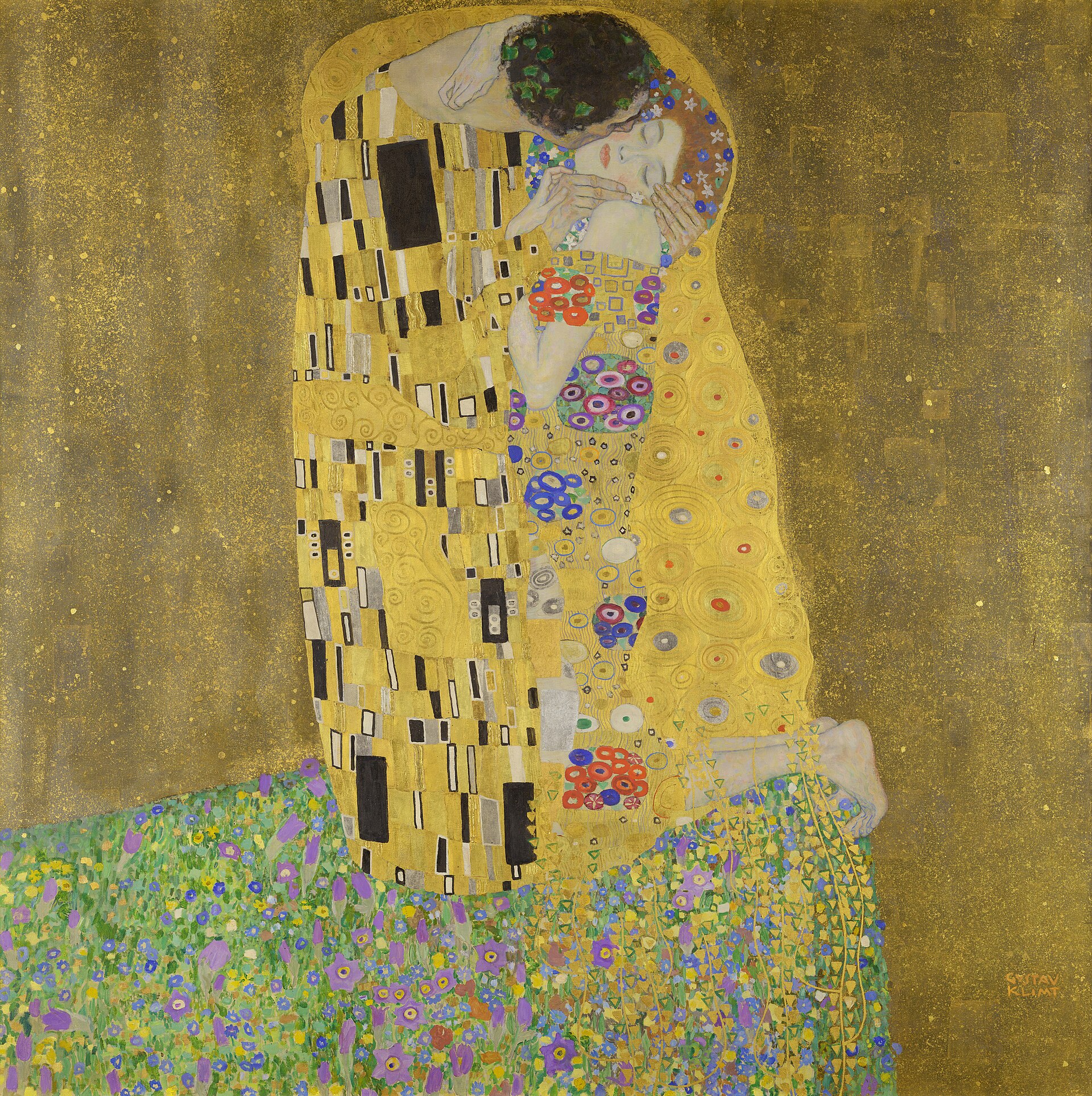
Against a shimmering wall of gold, two lovers kneel at the edge of a flowering cliff. He bends to cradle her face; she closes her eyes and tilts up to meet him, folding into his arms. The trick is that you barely see two people — one golden robe wraps them into a single silhouette, a glowing, upright column. This is the summit of Klimt's Golden Phase, and the most famous kiss in the history of art.
01 Composition
Start with the frame: a rare perfect square (180×180 cm, 1:1). A square is inherently stable, inward-looking, directionless — so your eye stays locked on the embracing mass at the center. Nothing leads it out.
The couple form a vertical ovoid (read it as a flower-bud or a pillar of light), set high and slightly right. Klimt leaves the left and top as a vast gold void, giving the image room to breathe. The single horizontal — the flowering meadow at the base — anchors the column like a plinth. One vertical, one horizontal: the structure holds.
All the feeling sits in the top-right: her upturned face and those hands. His face is hidden from us; hers is fully given. Then look at her toes — curled over the cliff's edge. The picture is stable, but stable on a precipice.
02 Colour & Theory
The dominant "colour" is gold — and gold is a kind of non-colour: not pigment but reflective metal leaf, so the surface flickers and shifts as you move past it. That huge gold field (warm, bright, opulent) is really an analogous palette — a gradient through the warm family of gold, bronze and ochre — rich without shouting.
What makes it sing is the tiny dose of saturated jewel tones tucked into her dress: rose-red, cobalt, meadow-green, violet. They occupy almost no area, yet sitting on all that gold they blaze. This is the high-end logic of large low-chroma field + small high-chroma accent. The green grass against red flowers also hides a red–green complementary pairing that energizes the base.
03 Light & Mood
There is almost no conventional light-and-shadow. The gold ground is flat — it casts no shadow and recedes into no distance. The light doesn't come from a lamp inside the picture; it comes from the metal itself. Stand before the original and the gold literally moves and glints as you shift — the painting is alive.
The only zone that is truly modelled is the two faces and the few visible hands — the flush of a cheek, the bend of a knuckle, painted with real volume in oil. Flat ornament wrapped around solid flesh: that contrast is Klimt's signature. Gold is the eternal, sacred light; flesh is the warmth of the present moment.
04 Technique & Symbol
Oil with gold and silver leaf on canvas, mixed media, roughly 180 × 180 cm. Klimt's father was a gold engraver — gold was in his blood. After two trips to Ravenna in 1903, where the Byzantine gold mosaics floored him, he began papering his canvases in leaf, launching the Golden Phase.
Look at the patterns on the two robes: his side is black-and-white rectangles and blocks (hard, geometric); her side is coloured circles, ovals and flowers (soft, organic). Squares versus circles, rigid versus yielding — Klimt is writing the masculine and feminine in pure ornament, and in the embrace the two pattern-languages interlock into one.
05 Why It Moves Us · Klimt
It moves us because it paints love as fusion: not two outlines anymore, but a single glowing pillar of gold. It is tender, erotic and almost sacred at once — a gold ground was the treatment reserved for saints, and he spent it on a kiss. And the cliff under her feet laces the sweetness with suspense: love is beautiful, and balanced on an edge. That complexity is exactly why it never collapses into a sugary postcard.
Gustav Klimt (1862–1918), Austrian, was the soul of the Vienna Secession. The Kiss was painted at the peak of his fame and finances — bought by the Austrian state before it was even finished. The models may be Klimt himself and his lifelong companion, the fashion designer Emilie Flöge, though he never explained: "Whoever wants to know something about me," he said, "ought to look carefully at my pictures."
06 Steal This Palette
- Klimt formula: champagne gold / bronze (~60%) + ivory cream (~25%) + one jewel tone as the spark (emerald, rose-red or sapphire, ~10–15%). Gold is the field; allow only one pop of colour.
- For an outfit: a champagne-gold satin or knit as the large warm base, ivory to support it, then one emerald earring or one rose-red lip as the saturated accent. Gold hates clutter — negative space + a single bright note is what reads as luxe.
- For makeup: the Klimt eye = warm gold shadow + a natural flush on the cheek (echoing the one part of her he painted real). Place the metallic only at the center of the lid and let reflection do the glowing — don't flood it.
- One principle to keep: to make a quiet base like gold or cream feel expensive, you don't add more colours — you add a subtle gradient within one analogous family plus a pinprick of high saturation. Restraint is the grammar of luxury.