Café Terrace at Night
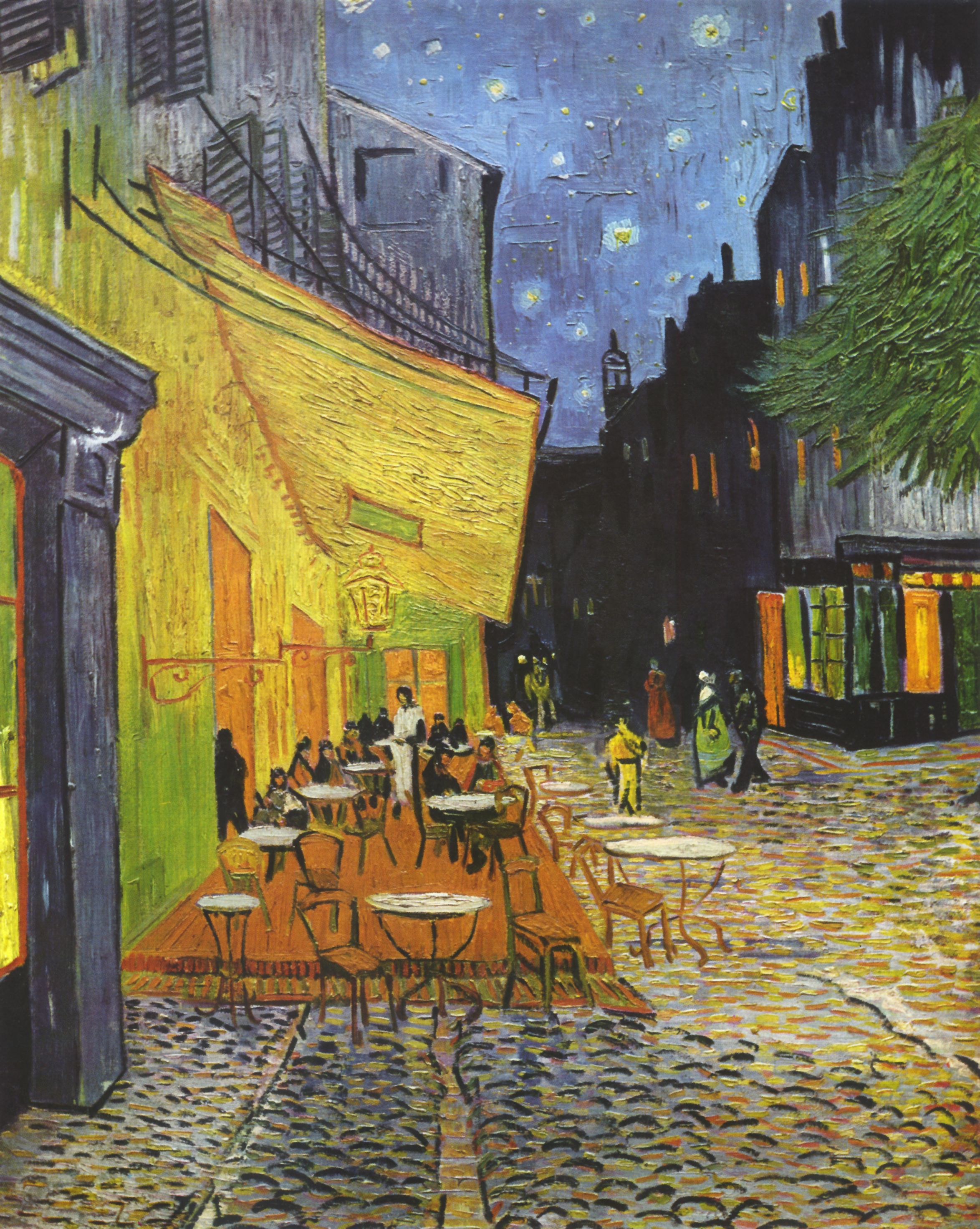
A cobbled street, a café glowing under a gas lamp. The awning blazes a hot, buttery yellow that spills onto the wall and the stones; down the street the sky goes deep blue and — for the first time in his life — Van Gogh paints stars. The quietly radical move: there is not a speck of black anywhere. Night, here, is built entirely from blue, violet and green.
01 Composition
This is a painting that pulls you in by perspective. The seams of the cobblestones, the eaves, the rows of tables all converge down the street toward a dark alley deep in the picture — a clear one-point perspective that gives the street real depth.
The huge golden awning on the left is the lead: a tilted wedge of warmth that is bright, heavy and advancing. Against it, the dark blue buildings on the right sit back and steady the frame — one bright, one dark; one forward, one back, and the scales balance. Foreground tables and silhouettes act as a repoussoir, framing your view into the street; the white-clad waiter at the centre is the brightest vertical, the point all the warm light gathers toward. Stars overhead and the lamp below rhyme across the canvas.
02 Colour & Theory
The engine is one complementary pair: blue ↔ orange-yellow. The warm gaslight (an orange family) sits directly opposite the cobalt sky on the colour wheel. Placed side by side, complements trigger simultaneous contrast: the yellow burns hotter for the blue, the blue deepens for the yellow — each ignites the other. This is the colour science Van Gogh absorbed from Chevreul and Charles Blanc, and from his hero Delacroix.
And the key line, from a letter to his sister (paraphrased): “a night painting without any black — nothing but beautiful blue, violet and green.” So look closely: the darks are not black, they are saturated cools — violet-blue in the cobbles, ink-blue down the alley, green in the door and tree. Warm (yellow/orange) covers little but pops most; cool (blue/violet/green) holds the large ground. That is the elegant rule of small warm accent + large cool field: restrained, yet focused.
03 Light & Mood
No moon, no street-lamp close-up — the single source is the gas lamp under the awning. Van Gogh never paints “the light” itself; he dyes it onto whatever it touches: the lit wall is feverish sulphur-yellow, the floor a pale lemon-green, and everything cools toward blue as it leaves the glow. Colour temperature does the work of value — warmth and coolness stand in for light and shadow. That is the painting’s cleverest stroke.
The mood is therefore both warm and vast: human bustle close up, an endless starred sky above. This is the first starry night in Van Gogh’s work — the same month he painted Starry Night Over the Rhône, a full year before the famous The Starry Night. Here the sky is still calm, like a thought just lit.
04 Technique & Medium
Oil on canvas, about 80.7 × 65.3 cm, painted September 1888 on the Place du Forum in Arles, southern France. It was made outdoors, at night, on the spot — Van Gogh wrote with delight that he loved “painting the night in the very night.”
The handling is impasto with directional strokes: the cobbles are dragged toward the vanishing point one stroke at a time, while the sky is dotted with separated touches for stars and haloes — an echo of the Neo-Impressionist dot (Seurat), but looser and more impulsive. Mostly pure, ungrayed colours laid side by side, left for the viewer’s eye to mix at a distance — which is exactly why it still glows on a screen.
05 Why It Moves Us· Van Gogh
It moves us because it is so rarely warm. Van Gogh’s pictures often burn with anxiety; this one is relaxed, hospitable, almost happy: tables of people gathered around a lamp, conversation drifting out, the dark tamed into a warm blanket. Tiny lamplight against an enormous night — not tragic, but the temperature of “someone is waiting up for you.” (Some scholars read the white-clad central figure ringed by roughly twelve others as a hidden “Last Supper” — a contested interpretation; Van Gogh himself never described it that way.)
Vincent van Gogh (1853–1890), Dutch. Arles in 1888 was his most prolific, most luminous stretch: he rented the “Yellow House,” dreamed of an artists’ colony, and waited for Gauguin to join him in the south. In roughly fifteen months he made over two hundred works — and sold almost none in his lifetime. The café still trades in Arles today, repainted the same gold and renamed “Café Van Gogh.”
06 Steal This Palette
- The formula: cobalt / navy (~50%) + golden yellow / saffron (~30%) + warm rust & olive-green accents (~20%) — and zero black.
- Wear it: let navy be the “night” as your large base (denim, navy knit); add one saffron / mustard piece as “the lamp” focal point, with camel/rust accents, olive as the bridge, and cream as the waiter’s highlight. Keep the warm small and single — that’s what makes it sing.
- One rule for looking expensive: to make a colour brighter, set its complement beside it (yellow by blue); to make “dark” richer, reach for deep blue-violet instead of black — softer, more alive.
- For interiors: warm light + cool walls = instant café depth and warmth — the same logic restaurants use when they light a cool room with warm-yellow bulbs.